Australia weighs in to make the perfect kilogram
June 14, 2007 Avogadro Project Sphere

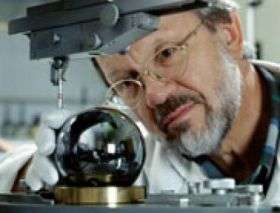
CSIRO Master Optician Achim Leistner measures the roundness of a sphere. Credit: CSIRO

Australian scientists and optical engineers will be making a perfect sphere that may one day re-define the kilogram – and they have taken delivery of the cylinder of silicon from which it will be made.

The kilogram is one of seven base units in the International System (SI) used in science, commerce and everyday life.

However, it is the only one still defined by a physical object – a lump of metal, known as the International Prototype, sitting in a vault in France. All the others have moved with the scientific times and are defined in terms of a fundamental constant of nature so anyone anywhere can reproduce them and they do not change over time.

Under the auspices of the International Bureau of Weights and Measures (BIPM), near Paris, the decision has been made that international effort will focus on two ways of re-defining the kilogram: one of which involves making a perfect sphere from a single crystal of exceptionally pure silicon.

The work will be done with the close cooperation of Australia’s National Measurement Institute (NMI) and CSIRO’s Australian Centre for Precision Optics (ACPO), which share the same site in the Sydney suburb of Lindfield.

While a physical object will still be necessary for calibrating scales and balances, the silicon atoms in the sphere will always remain the same. It is for this reason that the scientists working on what’s known as the Avogadro Project are collaborating to determine what is effectively the number of atoms in a sphere. Once the number of atoms is known, the definition of the kilogram can be based on it from then on.

The best sphere the ACPO team has made had a total out-of-roundness of 35 nanometres. That is, the diameter varies by an average of only 35 millionths of a millimetre, making it probably the roundest object in the world.

“The only people who can make what is likely to be the roundest object in the world are our colleagues at CSIRO’s ACPO,” Dr Barry Inglis, Chief Executive of NMI says.

Mr Alain Picard of the BIPM, who is bringing the silicon to Australia, says: "My laboratory has maintained the International Prototype kilogram since 1889. We are really pleased that this international collaboration will finally let us improve the definition of the unit of mass by basing it on a physical constant."

Ms Katie Green is part of ACPO’s team of expert optical engineers who will fabricate the spheres and Mr Walter Giardini of NMI lends skills in precision measurement to the project.

It has taken three years to produce the 20 cm long cylinder of silicon. The special silicon, known as monoisotopic silicon, was made in Russia and grown into a near perfect crystal in Germany. It will take something like twelve weeks to make one sphere 93 mm in diameter (the team will make two).

Source: CSIRO Australia


print this article email this article download pdf blog this article bookmark this article     Stumble it Digg this share on Facebook retweet share on Reddit add to delicious
Rate this story - 4.5 /5 (31 votes)


June 14, 2007 all stories

Comments: 0

4.5 /5 (31 votes)
  • Stumble this up

  • Digg this

  • share this

  • hide
  • Related Stories

  • Sandia Lab weighs in on new definition for kilogram
    created Feb 28, 2008 | popularity not rated yet | comments 0
  • A Better Definition for the Kilogram? Scientists Propose a Precise Integer Number of Carbon Atoms
    created Sep 21, 2007 | popularity not rated yet | comments 0
  • Combating Friction and Stiction
    created Mar 16, 2007 | popularity not rated yet | comments 0
  • New standard mass made with ISTC help
    created Mar 03, 2005 | popularity not rated yet | comments 0
  • New 'finFETs' promising for smaller transistors, more powerful chips
    created Nov 10, 2009 | popularity not rated yet | comments 0


  • hide
  • Relevant PhysicsForums posts

  • Reverse Universe
    created 2 hours ago
  • Self Study From Books
    created 2 hours ago
  • Fresnel Biprism
    created 6 hours ago
  • If light has mass, and is a wave...
    created 14 hours ago
  • More from Physics Forums - General Physics

Other News

Building a more versatile laser

Building a more versatile laser

Physics / Optics & Photonics

created 7 hours ago | popularity 4.3 / 5 (7) | comments 0

(PhysOrg.com) -- One of the drawbacks associated with using semiconductor lasers is that many of them can only produce a beam of a single wavelength, and can only send that beam in one direction at a time. ...


Measuring Electron Orbitals

Measuring Electron Orbitals

Physics / General Physics

created 8 hours ago | popularity 5 / 5 (4) | comments 0

(PhysOrg.com) -- For the first time, it has been possible to measure electron density in individual molecular states using what is known as the photoelectric effect. Now published in Science, this method repres ...


Scientists demonstrate 'universal' programmable quantum processor

Scientists demonstrate 'universal' programmable quantum processor

Physics / Quantum Physics

created Nov 15, 2009 | popularity 4.6 / 5 (18) | comments 11

Physicists at the National Institute of Standards and Technology have demonstrated the first "universal" programmable quantum information processor able to run any program allowed by quantum mechanics -- th ...


Do we need dark matter?

Do we need dark matter?

Physics / General Physics

created Nov 12, 2009 | popularity 4.1 / 5 (18) | comments 33

It's the biggest problem in physics: the matter we can see in the universe accounts for just five per cent of the observed gravity that holds galaxies together.


The LHC tunnel

Peckish bird briefly downs big atom smasher

Physics / General Physics

created Nov 09, 2009 | popularity 4.1 / 5 (14) | comments 23

A peckish bird briefly knocked out part of the world's biggest atom smasher by causing a chain reaction with a piece of bread, the European Organisation for Nuclear Research (CERN) said Monday.