New invention may allow thirsty crops to signal farmers
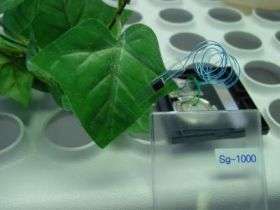
Corn and potato crops may soon provide information to farmers about when they need water and how much should be delivered, thanks to a University of Colorado at Boulder invention optioned to AgriHouse Inc., a Berthoud, Colo., high-tech company.
The technology includes a tiny sensor that can be clipped to plant leaves charting their thickness, a key measure of water deficiency and accompanying stress, said Research Associate Hans-Dieter Seelig of CU-Boulder's BioServe Space Technology Center. Data from the leaves could be sent wirelessly over the Internet to computers linked to irrigation equipment, ensuring timely watering, cutting down on excessive water and energy use and potentially saving farmers in Colorado millions of dollars per year, he said.
"We think this is an exciting technology, and the implications for the agriculture industry are enormous," said Seelig. Based in large part on Seelig's 2005 CU-Boulder doctoral thesis in aerospace engineering sciences, the technology was optioned to AgriHouse in March by the University of Colorado Technology Transfer Office, giving AgriHouse the exclusive right to negotiate a license with CU within 12 months.
Richard Stoner, AgriHouse founder and president, said existing technology like soil moisture sensors used to assess a crop's water needs do not always provide an accurate picture of existing plant and field conditions. "What we are developing is a non-intrusive device that gently rests on the plants and lets them interface with the digital world," he said. "Basically, this is a device that will allow plants to talk to humans and communicate their needs, like when to water and apply fertilizer."
Stoner is the principal investigator on a $150,000 Small Business Technology Transfer research grant awarded in May by the National Science Foundation to AgriHouse to develop the new technology. Seelig is an institutional investigator on the effort. In 2006, Seelig was awarded a $10,000 proof-of-concept grant for his research from CU's Technology Transfer Office.
Less than one-tenth the size of a postage stamp, the sensor consists of an integrated-circuit chip that clips to individual plant leaves and collects and stores information, said Seelig. When the leaves lose enough water to contract to a critical width, the sensor can wirelessly signal computers.
The computers, for example, could instruct individual pivot irrigation systems used widely on Colorado's eastern plains to dispense set amounts of water to particular crops, automatically turning the motors that drive them on-and-off and conserving water and energy in the process, he said.
"Farmers today rely on standard practices that include a good eye and a green thumb," said Stoner. "But this new system can tell a farmer precisely when a plant's water uptake potential is at its peak, which could conceivably decrease the number of watering days for certain crops by up to a day or two each week."
Economists estimate that agricultural activity accounts for about 40 percent of the total freshwater use in the United States. About 60 percent of all crops in the United States are irrigated using water from lakes, reservoirs, wells and rivers.
Stoner likened the plant communication aspect of the invention to a scene in the 1986 comedy musical film, "Little Shop of Horrors," when a giant carnivorous plant tells humans to "feed me." "This technology allows plants to say, 'water me,' " he said.
High eastern plains water-use has led to lawsuits against Colorado for violations of interstate water compacts, including a recent $30 million payment to Kansas for overuse of the Arkansas River, said Seelig. A recent U.S. Supreme Court lawsuit against Colorado and Nebraska for overuse of Republican River water threatened to shut down all Colorado wells impacting the river if solutions for reducing irrigation water are not found. Farmers irrigate nearly one-half million acres on the eastern plains from the Ogallala Aquifer that directly impacts the Republican River, he said.
The researchers have been experimenting with cowpea, a legume, but believe the new leaf-sensor technology would be transferable to a variety of crops, including corn, wheat, potatoes, sugar beets and pinto beans. In the future, it might also be applicable to monitoring large swaths of urban grass like city parks, Stoner said.
"This device is very precise, and will allow a plant to receive just the right amount of water," said Seelig. "If a plant can tell a water valve when to open and when to close, farmers are going to save a lot of money."
Source: University of Colorado at Boulder


