Sensing light with 'liquid Lego'
June 14, 2007 Sensing light with ‘liquid Lego’

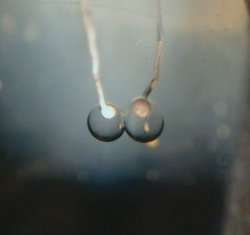
Microscopic light sensors created using millimetre-sized water droplets and hair-thin electrodes. Credit: University of Oxford

Scientists at Oxford University and Duke University in the United States have used tiny water droplets to build a unique microscopic light sensor.

Their approach turns water droplets into protocells: empty artificial cells that can be filled with different cellular components. In theory, networks of protocells could be used to simulate biological systems – such as heart muscle or brain tissue.

“Each millimetre-sized water droplet in our network acts as a protocell. Chains of droplets are put together like liquid Lego, and are just as easily taken apart or reorganised,” said Dr Matthew Holden of Oxford University’s Department of Chemistry who conducted the research with Oxford’s Professor Hagan Bayley and Professor David Needham at Duke University.

The scientists took a protein (bacteriorhodopsin) normally used by bacteria to produce energy and incorporated it into a network of droplets. This protein reacts to green light by pumping protons across a cell membrane, which creates a positive electrical charge. By piercing the droplets with hair-thin electrodes this current can be measured with a sensitive amplifier. In the future such droplets could be arranged to form ‘pixels’ in an imaging array – acting as an artificial eye.

‘Using protocells to simulate biological systems offers significant advantages to working with live cells, where there is far less control over their contents, size and function,’ said Dr Holden. ‘Many living cells do not survive outside a narrow temperature range and are extremely sensitive to environmental conditions, such as pH. In the long run protocell-based systems could reduce the cost and complexity of biological experiments and, in some cases, might be used in place of animal testing.’

Although protocells have provided biological and evolutionary insights before this is the first time they have been shown working together to perform a function. The researchers hope to create increasingly complex systems as a stepping-stone towards understanding a variety of biological functions ranging from nerve impulses to heartbeats.

A report of the research is published in the Journal of the American Chemical Society.

Source: University of Oxford


print this article email this article download pdf blog this article bookmark this article     Stumble it Digg this share on Facebook retweet share on Reddit add to delicious
Rate this story - 4.5 /5 (13 votes)


June 14, 2007 all stories

Comments: 0

4.5 /5 (13 votes)
  • Stumble this up

  • Digg this

  • share this

  • hide
  • Related Stories

  • Research describes connections between Circadian and metabolic systems
    created Nov 17, 2009 | popularity not rated yet | comments 0
  • New study describes connections between Circadian and metabolic systems
    created Nov 12, 2009 | popularity not rated yet | comments 0
  • The lotus's clever way of staying dry (w/ Video)
    created Oct 22, 2009 | popularity not rated yet | comments 0
  • Jet-propelled Imaging for an Ultrafast Light Source
    created Aug 04, 2009 | popularity not rated yet | comments 0
  • Jet-propelled imaging for an ultrafast light source
    created Jul 29, 2009 | popularity not rated yet | comments 0


Other News

A sticky solution for identifying effective probiotics

Chemistry / Biochemistry

created 11 hours ago | popularity 5 / 5 (1) | comments 0

Scientists have crystallised a protein that may help gut bacteria bind to the gastrointestinal tract. The protein could be used by probiotic producers to identify strains that are likely to be of real benefit to people.


Sandia CR5

Machine Converts CO2 into Gasoline, Diesel, and Jet Fuel

Chemistry / Biochemistry

created Nov 23, 2009 | popularity 4.6 / 5 (29) | comments 19

(PhysOrg.com) -- Researchers at Sandia National Laboratories have built a machine that uses the sun's energy to convert carbon dioxide waste from power plants into transportation fuels such as gasoline, diesel, ...


New hydrogen-storage method discovered

New hydrogen-storage method discovered

Chemistry / Materials Science

created Nov 22, 2009 | popularity 4.3 / 5 (41) | comments 15

Scientists at the Carnegie Institution have found for the first time that high pressure can be used to make a unique hydrogen-storage material. The discovery paves the way for an entirely new way to approach ...


Accidental discovery produces durable new blue pigment for multiple applications

Accidental discovery produces durable new blue pigment for multiple applications

Chemistry / Biochemistry

created Nov 16, 2009 | popularity 4.5 / 5 (32) | comments 6

An accidental discovery in a laboratory at Oregon State University has apparently solved a quest that over thousands of years has absorbed the energies of ancient Egyptians, the Han dynasty in China, Mayan ...


One word: bioplastics

One word: bioplastics

Chemistry / Materials Science

created Nov 17, 2009 | popularity 4.6 / 5 (13) | comments 4

(PhysOrg.com) -- Every year, more than 250 billion pounds of plastic are produced worldwide. Much of it ends up in the world's oceans, a fact that troubles MIT biology professor Anthony Sinskey.