Plastic that grows on trees
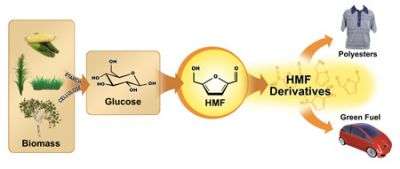
Scientists took a giant step closer to the biorefinery this week, reporting in the June 15 issue of the journal Science that they have directly converted sugars ubiquitous in nature to an alternative source for those products that make oil so valuable, with very little of the residual impurities that have made the quest so daunting.
It has been an elusive goal for the legion of chemists trying to pull it off: Replace crude oil as the root source for plastic, fuels and scores of other industrial and household chemicals with inexpensive, nonpolluting renewable plant matter.
Scientists took a giant step closer to the biorefinery today, reporting in the journal Science that they have directly converted sugars ubiquitous in nature to an alternative source for those products that make oil so valuable, with very little of the residual impurities that have made the quest so daunting.
"What we have done that no one else has been able to do is convert glucose directly in high yields to a primary building block for fuel and polyesters," said Z. Conrad Zhang, senior author who led the research and a scientist with the PNNL-based Institute for Interfacial Catalysis, or IIC.
That building block is called HMF, which stands for hydroxymethylfurfural. It is a chemical derived from carbohydrates such as glucose and fructose and is viewed as a promising surrogate for petroleum-based chemicals.
Glucose, in plant starch and cellulose, is nature's most abundant sugar. "But getting a commercially viable yield of HMF from glucose has been very challenging," Zhang said. "In addition to low yield until now, we always generate many different byproducts," including levulinic acid, making product purification expensive and uncompetitive with petroleum-based chemicals.
Zhang, lead author and former post doc Haibo Zhao, and colleagues John Holladay and Heather Brown, all from PNNL, were able to coax HMF yields upward of 70 percent from glucose and nearly 90 percent from fructose while leaving only traces of acid impurities.
To achieve this, they experimented with a novel non-acidic catalytic system containing metal chloride catalysts in a solvent capable of dissolving cellulose. The solvent, called an ionic liquid, enabled the metal chlorides to convert the sugars to HMF. Ionic liquids provide an additional benefit: It is reusable, thus produces none of the wastewater in other methods that convert fructose to HMF.
Metal chlorides belong to a class of ionic-liquid-soluble materials called halides, which "in general work well for converting fructose to HMF," Zhang said — but not so well when glucose is the initial stock. In fact, attempts at direct glucose conversion created so many impurities that it was simpler to start with the fructose, less common in nature than glucose.
Zhang and his team, working with a high-throughput reactor capable of testing 96 metal halide catalysts at various temperatures, discovered that a particular metal — chromium chloride — was by far the most effective at converting glucose to HMF with few impurities and, as such reactions go, at low temperature, 100 degrees centigrade.
"This, in my view, is breakthrough science in the renewable energy arena," said J.M. White, IIC director and Robert A. Welch chair in materials chemistry at the University of Texas. "This work opens the way for fundamental catalysis science in a novel solvent."
The chemistry at work remains largely a mystery, Zhang said, but he suspects that metal chloride catalysts work during an atom-swapping phase that sugar molecules go through called mutarotation, in which an H (hydrogen) and OH (hydroxyl group) trade places.
The hydrogen-hydroxyl position-switch that allows the catalytic conversion was verified by nuclear magnetic resonance performed at the William R. Wiley Environmental Molecular Sciences Laboratory, a DOE national scientific user facility located at PNNL.
During the swap, the molecule opens, Zhang said. "The key is to take advantage of the open form to perform a hydride transfer through which glucose is converted to fructose."
Zhang's next step is to tinker with ionic solvents and metal halides combinations to see if he can increase HMF yield from glucose while reducing separation and purification cost.
"The opportunities are endless," Zhang said, "and the chemistry is starting to get interesting."
Source: PNNL


