In nature, proteins sweep up nanoparticles
Here’s a pollution-control tip from nature: Deep inside a flooded mine in Wisconsin, scientists from several institutions including the U.S. Department of Energy’s Lawrence Berkeley National Laboratory have discovered a world in which bacteria emit proteins that sweep up metal nanoparticles into immobile clumps. Their finding may lead to innovative ways to remediate subsurface metal toxins.
The research, which appears in the June 15, 2007 issue of the journal Science, reveals that the proteins travel far from the microbes that produce them, and then amass metal nanoparticles into piles that are too large to be swept away by underground currents. Precisely how and why the bacteria undertake this bit of housecleaning remains a mystery, but it suggests that proteins could play a key role in bioremediation strategies designed to trap harmful metals such as arsenic, lead, uranium, and plutonium.
“We have found, in the environment, that cells release proteins and polypeptides which promote the aggregation of nanoparticulate metals,” says John Moreau, lead author of the study and a former PhD student in UC Berkeley’s Department of Earth and Planetary Sciences. “The intriguing discovery that biomolecules may shape nanoparticles into larger aggregates, which reduces the nanoparticles’ mobility, could have significant implications for bioremediation.”
Moreau conducted the research under the guidance of Jill Banfield, a principal investigator in the Geochemistry Department of Berkeley Lab’s Earth Sciences Division, and a UC Berkeley professor in the Department of Earth and Planetary Sciences and in the Department of Environmental Science, Policy and Management. Other scientists involved in the research include Michael Martin and Benjamin Gilbert of Berkeley Lab, and Peter Weber and Ian Hutcheon of Lawrence Livermore National Laboratory.
The research team analyzed a biofilm rich in zinc sulfide that was collected from the water-filled mine. The sulfide is a metabolic waste product of bacteria that thrive in the oxygen-free mine. Once the sulfide is released into the watery environment, it readily combines with metals, in this case zinc, to form nano-sized biominerals that measure about one-billionth of a meter in diameter.
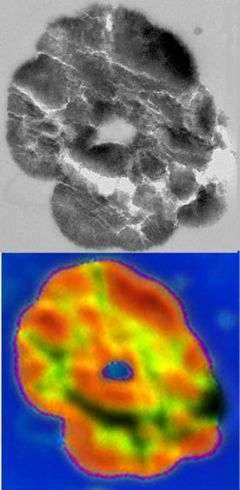
The team examined the biofilm using transmission electron microscopy at Berkeley Lab’s National Center for Electron Microscopy, a national user facility that probes material at the nanoscale. They found that the zinc sulfide nanoparticles were arranged in dense aggregates. Such tightly packed metal sulfide formations are not new to scientists, but they do beg a question that remains unanswered: Why do the nanoparticles group together" Something so small should disperse throughout the mine. Instead, the metal nanoparticles form blobs that measure several microns in diameter (one micron is one-millionth of a meter). And these larger blobs anchor the nanoparticles in place. Stopping nanoparticles in their tracks, as this process does, could become a critical component of a bioremediation strategy, if only scientists understand how it works.
To explore this question, the team turned to Berkeley Lab’s Advanced Light Source, a national user facility that generates intense light for scientific research. Using an imaging tool called Fourier-transform infrared spectroscopy, the team analyzed the zinc sulfide aggregates and detected the characteristic signal of proteins.
Next, to further zero in on this intriguing signal, they examined the sample using an extremely high-spatial-resolution imaging tool called secondary ion probe spectrometry, which is located at the Department of Energy’s Lawrence Livermore National Laboratory. Also called NanoSIMS, the tool determines the quantitative elemental and isotopic composition of a sample’s surface.
To their surprise, they found proteins and polypeptides embedded within the zinc sulfide nanoparticles. Specifically, the nanoparticles were arranged like tree rings, and the proteins coated the particles’ surfaces and filled the gaps between them.
“We found that the mineral aggregates, which are produced as a consequence of microbial activity, actually contain a lot of protein,” says Banfield. “This is very interesting because biomineralization has traditionally been thought of as a phenomenon that occurs within a cell, or in contact with it. But in this case, we see an intimate association of proteins and minerals that takes place as far as hundreds of microns away from the cell.”
In other words, in addition to pumping nano-sized sulfide waste particles into the environment, bacteria also pump proteins into the environment. These proteins then sweep the sulfide nanoparticles out of solution into a ball.
Scientists don’t why this occurs. Perhaps it’s a serendipitous accident. Proteins and peptides could be released by bacteria after they die, and are then scavenged by zinc sulfide. Or there could be a physiological reason. Perhaps the bacteria use the protein to sequester their sulfide waste product, which could otherwise accumulate and entomb the bacteria or interfere with their cellular machinery. Think of it as trash pickup at the nanoscale. Regardless, the process stops the spread of metal nanoparticles in natural environments, which is reason enough to explore it further.
“If we understand what causes nanoparticles to aggregate, we have the potential to control their mobility in the subsurface by adding constituents that drive aggregation,” says Banfield.
The scientists also sought to understand the mechanism by which proteins promote nanoparticle aggregation. They found that the presence of cysteine, an amino acid that is a building block to most proteins, yielded the most extensive and prolonged aggregation, with some blobs measuring ten microns in diameter.
Their discovery could also refine the search for the earliest indications of life on Earth, as well as help determine whether planets like Mars once harbored life. Scientists involved in this research hunt for biosignatures, which are the telltale calling cards left behind by microbes that may have lived eons ago. The presence of fine particulate sulfides in minerals is one such biosignature, although it is only suggestive of life. Now, the presence of sulfide nanoparticles intermingled with proteins promises to be a definitive biosignature.
Source: Lawrence Berkeley National Laboratory


