Russians blame NASA for computer failure
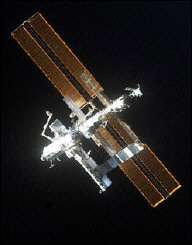
June 15, 2007 The International Space Station

Russian sources blame the United States for the failure of a key computer aboard the International Space Station, ABC News reported Friday.

When the National Aeronautics and Space Administration, NASA, set up the station's solar array it sent electromagnetic interference into the Russian computer, shutting it down, Russian sources told ABC News.

An unnamed source in the Russian space agency said there could be a "fatal flaw" with the station's main computer, ABC News reported.

U.S. and Russian space officials said the station could fly for a few months without correcting its flight, giving astronauts more time to work on the computer.

Meanwhile, U.S. astronauts James Reilly and Danny Olivas from the Space Shuttle Atlantis planned to climb out of the International Space Station Friday to secure a thermal blanket that peeled away during launch.

Copyright 2007 by United Press International


print this article email this article download pdf blog this article bookmark this article     Stumble it Digg this share on Facebook retweet share on Reddit add to delicious
Rate this story - 4.1 /5 (11 votes)


June 15, 2007 all stories

Comments: 0

4.1 /5 (11 votes)
  • Stumble this up

  • Digg this

  • share this

  • hide
  • Related Stories

  • Virgin Galactic unveils commercial spaceship
    created Dec 07, 2009 | popularity not rated yet | comments 0
  • Japan's 'space beer' sparkles among drinkers
    created Dec 07, 2009 | popularity not rated yet | comments 0
  • Volunteers wanted for simulated 520-day Mars mission
    created Oct 20, 2009 | popularity not rated yet | comments 0
  • Indian satellite confirmed US moon landing: scientist
    created Sep 02, 2009 | popularity not rated yet | comments 0
  • NASA patches air-purifying system on space station
    created Jul 26, 2009 | popularity not rated yet | comments 0


  • hide
  • Relevant PhysicsForums posts

  • Telescope Recommendations Anyone?
    created 5 hours ago
  • Uranus' satellite Miranda question
    created Dec 07, 2009
  • black dwarf sun
    created Dec 06, 2009
  • Question about c = vλ
    created Dec 05, 2009
  • More from Physics Forums - General Astronomy

Other News

Hubble's deepest view of universe unveils never-before-seen galaxies

Hubble's Deepest View of Universe Unveils Never-Before-Seen Galaxies (w/ Video)

Space & Earth / Astronomy

created 16 hours ago | popularity 4.7 / 5 (28) | comments 16

(PhysOrg.com) -- In 2004, Hubble created the Hubble Ultra Deep Field (HUDF), the deepest visible-light image of the Universe, and now, with its brand-new camera, Hubble is seeing even farther. This image was ...


Mars

Life on Mars theory boosted by new methane study

Space & Earth / Space Exploration

created 13 hours ago | popularity 4.8 / 5 (18) | comments 4

Scientists have ruled out the possibility that methane is delivered to Mars by meteorites, raising fresh hopes that the gas might be generated by life on the red planet, in research published tomorrow in Earth an ...


Absence of evidence for a meteorite impact event 13,000 years ago

Absence of evidence for a meteorite impact event 13,000 years ago

Space & Earth / Earth Sciences

created 16 hours ago | popularity 4.4 / 5 (8) | comments 10

An international team of scientists led by researchers at the University of Hawaii at Manoa have found no evidence supporting an extraterrestrial impact event at the onset of the Younger Dryas ~13000 years ...


Gravestones Talking through Time

Gravestones Talking through Time

Space & Earth / Earth Sciences

created 8 hours ago | popularity 4.7 / 5 (3) | comments 0

(PhysOrg.com) -- A visit to your local graveyard can provide not only a history lesson, but a science lesson as well. Historians know that gravestones can reflect the lives of people whose memories are lost ...


Aussie galaxy survey to lead to 'new physics'

Aussie galaxy survey to lead to 'new physics'

Space & Earth / Astronomy

created 11 hours ago | popularity 4.5 / 5 (12) | comments 4

(PhysOrg.com) -- Australian astronomers have released the first set of data from the first project to look at the effects of "dark energy" halfway back in the Universe's lifetime.