Computer models suggest planetary and extrasolar planet atmospheres
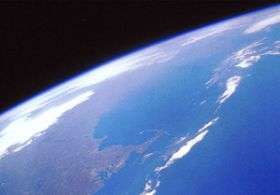
The world is abuzz with the discovery of an extrasolar, Earth-like planet around the star Gliese 581 that is relatively close to our Earth at 20 light years away in the constellation Libra.
Bruce Fegley, Jr., Ph.D., professor of earth and planetary sciences in Arts & Sciences at Washington University in St. Louis, has worked on computer models that can provide hints to what comprises the atmosphere of such planets and better-known celestial bodies in our own solar system.
New computer models, from both Earth-based spectroscopy and space mission data, are providing space scientists compelling evidence for a better understanding of planetary atmospheric chemistry. Recent findings suggest a trend of increasing water content in going from Jupiter (depleted in water), to Saturn (less enriched in water than other volatiles), to Uranus and Neptune, which have large water enrichments.
"The farther out you go in the solar system, the more water you find," said Fegley.
Fegley provided an overview of comparative planetary atmospheric chemistry at the 233rd American Chemical Society National Meeting, held March 25-29, 2007, in Chicago. Fegley and Katharina Lodders-Fegley, Ph.D., research associate professor of earth and planetary sciences, direct the university's Planetary Chemistry Laboratory.
"The theory about the Gas Giant planets (Jupiter, Saturn, Uranus, and Neptune) is that they have primary atmospheres, which means that their atmospheres were captured directly from the solar nebula during accretion of the planets," Fegley said.
Gas Giants
He said that Jupiter has more hydrogen and helium and less carbon, nitrogen and oxygen than the other Gas Giant planets, making its composition closer to that of the hydrogen- and helium-rich sun. The elements hydrogen, carbon and oxygen are predominantly found as water, the gases molecular hydrogen and methane and in the atmospheres of the Gas Giant planets.
"Spectroscopic observations and interior models show that Saturn, Uranus and Neptune are enriched in heavier elements," he said. "Jupiter, based on observations from the Galileo Probe, is depleted in water. People have thought that Galileo might just have gone into a dry area. But Earth-based observations show that the carbon monoxide abundance in Jupiter's atmosphere is consistent with the observed abundances of methane, hydrogen and water vapor. This pretty much validates the Galileo Probe finding."
The abundances of these four gases are related by the reaction CH4+H20 = CO+3H2. Thus, observations of the methane, hydrogen and CO abundances can be used to calculate the water vapor abundance. Likewise, Earth-based observations of methane, hydrogen and carbon monoxide in Saturn's atmosphere show that water is less enriched than methane.
In contrast, observations of methane, hydrogen and carbon monoxide in the atmospheres of Uranus and Neptune show that water is greatly enriched in these two planets. Although generally classed with Jupiter and Saturn, Uranus and Neptune are water planets with relatively thin gaseous envelopes.
"On the other hand, the terrestrial planets Venus, Earth and Mars have secondary atmospheres formed afterwards by outgassing — heating up the solid material that was accreted and then releasing the volatile compounds from it," Fegley said. "That then formed the earliest atmosphere."
He said that by plugging in models he's done on the outgassing of chondritic materials and using photochemical models of the effects of UV sunlight, he and his collaborator Laura Schaefer, a research assistant in the Washington University Department of Earth and Planetary Sciences, can speculate on the atmospheric composition of Earth-like planets in other solar systems.
"With new theoretical models we are able to surmise the outgassing of materials that went into forming the planets, and even make predictions about the atmospheres of extrasolar terrestrial planets," he said.
"Because the composition of the galaxy is relatively uniform, most stars are like the sun — hydrogen-rich with about the same abundances of rocky elements — we can predict what these planetary atmospheres would be like," Fegley said. "I think that the atmospheres of extrasolar Earth-like plants would be more like Mars or Venus than the Earth."
Fegley said that photosynthesis accounts for the oxygen in Earth's atmosphere; without it, the Earth's atmosphere would consist of nitrogen, carbon dioxide and water vapor, with only small amounts of oxygen. Oxygen is 21 percent of Earth's atmosphere; in contrast, Mars has about one-tenth of one percent made by UV sunlight destroying carbon dioxide.
"I see Mars today as a great natural laboratory for photochemistry; Venus is the same for thermochemistry, and Earth for biochemistry," he said. "Mars has such a thin atmosphere compared to Earth or Venus. UV light can penetrate all the way down to the Martian surface before it's absorbed. That same light on Earth is mainly absorbed in the ozone layer in the lower Earth stratosphere. Venus is so dense that light is absorbed by a cloud layer about 45 kilometers or so above the Venusian surface."
Source: Washington University in St. Louis


