The kapok connection -- Study explains rainforest similarities
June 16th, 2007 The kapok connection -- Study explains rainforest similarities

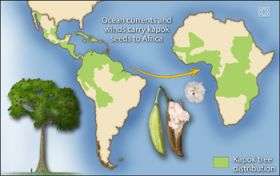
Kapok trees are challenging the notion that African and South American rainforests are similar. Credit: Zina Deretsky, National Science Foundation

Celebrated in Buddhist temples and cultivated for its wood and cottony fibers, the kapok tree now is upsetting an idea that biologists have clung to for decades: the notion that African and South American rainforests are similar because the continents were connected 96 million years ago.

Research by University of Michigan evolutionary ecologist Christopher Dick and colleagues shows that kapok---and perhaps other rainforest--trees colonized Africa after the continents split when the trees' seeds traveled across the ocean.

The findings, funded by the National Science Foundation (NSF), appear online this week in the journal Molecular Ecology.

"This research provides vital information for one of the most highly threatened areas of the planet, tropical rainforests," said Sam Scheiner, program director in NSF's Division of Environmental Biology, which funded the research. "In order to plan for and mitigate global climate change, we need to understand the history of life on Earth through studies like this one."

Oceanic dispersal links the world's rainforests, said Dick, "and this study is one of the first to catch that process in action at the species level. Although single seeds are very unlikely to survive an oceanic voyage and then successfully become established elsewhere, such improbable events become probable over 10 to 15 million years."

Dick studied the rainforest form of Ceiba pentandra, a species of kapok that grows taller than a 16-story building, its head poking above the forest canopy.

Its flowers produce more than 50 gallons of nectar per tree in a season, attracting bats that travel as far as 12 miles between trees and transfer pollen in the process. When the seed pods ripen, they break open to reveal fluffy fibers that are used to stuff pillows and mattresses. The seeds, which are about the size of a sunflower seed, are buoyant and able to float down rivers along which the colossal trees grow.

Dick and colleagues investigated which of several possible scenarios could be the reason for the current distribution of Ceiba pentandra.

Dick concluded that extreme long distance travel by wind or ocean currents explains how the trees spread from South America to Africa. He plans to continue investigating the role of oceanic dispersal to see if the same is true for other species and for entire plant communities.

"This tree has become locally extinct in parts of the Peruvian Amazon as a result of overexploitation for plywood," Dick said. "It might be saved from widespread extinction by continuing to invade new land areas through oceanic dispersal."

Source: National Science Foundation


print this article email this article download pdf blog this article bookmark this article     Digg this Stumble it share on Facebook share on Reddit add to delicious save to Yahoo! bookmarks
4.8/5 after 15 votes


June 16th, 2007 all stories
Biology /

Comments: 0
Rank: 4.8/5 after 15 votes

  • Stumble this up

  • Digg this

  • Share it:
  • share on Facebook
  • share on MySpace
  • share on Slashdot
  • rss-newsfeed
  • share on Google
  • share on Reddit
  • add to delicious
  • save to Yahoo! bookmarks
  • share on Windows Live
  • Add to Mixx!
Rating: 4.8/5 after 15 votes

  • Related Stories

  • 'Living fossil' tree contains genetic imprints of rain forests under climate change
    created Oct 30, 2008 | popularity not rated yet | comments 0
  • Entomologists name 'diving beetle' for Comedy Central's Stephen Colbert
    created May 06, 2009 | popularity not rated yet | comments 0
  • Scientists create new enzymes for biofuel production
    created Mar 23, 2009 | popularity not rated yet | comments 0
  • Shade coffee benefits more than birds
    created Dec 22, 2008 | popularity not rated yet | comments 0
  • Research consortium to sequence turkey genome
    created Nov 24, 2008 | popularity not rated yet | comments 0

Tags


  • Physicists Demonstrate Quantum Memory with Matter Qubits
    Physicists Demonstrate Quantum Memory with Matter Qubits
    Physics / General Physics
    created Jul 03, 2009 | popularity 4.4 / 5 (17) | comments 1
  • 'Holey' Nanosheets for Wastewater Dye Removal
    Nanotechnology / Nanomaterials
    created Jul 01, 2009 | popularity 5 / 5 (5) | comments 1
  • Jellyfish Robot Swims Like its Biological Counterpart
    Jellyfish Robot Swims Like its Biological Counterpart
    Electronics / Robotics
    created Jun 26, 2009 | popularity 4.4 / 5 (8) | comments 1
  • Could Maxwell's Demon Exist in Nanoscale Systems?
    Could Maxwell's Demon Exist in Nanoscale Systems?
    Physics / General Physics
    created Jun 24, 2009 | popularity 4.4 / 5 (18) | comments 29
  • Living Safely with Robots, Beyond Asimov's Laws
    Living Safely with Robots, Beyond Asimov's Laws
    Electronics / Robotics
    created Jun 22, 2009 | popularity 4.6 / 5 (52) | comments 40
  • Other News

    California water plan aims to save Puget Sound orcas

    Biology / Ecology

    created 9 hours ago | popularity not rated yet | comments 0

    A plan to restore salmon runs on California's Sacramento River also could help revive killer whale populations 700 miles to the north in Puget Sound, as federal scientists struggle to protect endangered species in a complex ...


    Scientists 'rebuild' giant moa using ancient DNA

    Biology / Plants & Animals

    created Jul 01, 2009 | popularity 5 / 5 (10) | comments 12

    (PhysOrg.com) -- Scientists have performed the first DNA-based reconstruction of the giant extinct moa bird, using prehistoric feathers recovered from caves and rock shelters in New Zealand.


    Pacific Giant Salamander (Dicamptodon tenebrosus)

    Salamanders, regenerative wonders, heal like mammals, people

    Biology / Microbiology

    created Jul 01, 2009 | popularity 5 / 5 (20) | comments 11

    The salamander is a superhero of regeneration, able to replace lost limbs, damaged lungs, sliced spinal cord -- even bits of lopped-off brain. But it turns out that remarkable ability isn't so mysterious after ...


    Genetically modified trees

    Anti-biotech groups obstruct forest biotechnology

    Biology / Biotechnology

    created Jun 30, 2009 | popularity 3.7 / 5 (7) | comments 5

    The potential of forest biotechnology to help address significant social and environmental issues is being "strangled at birth" by the rigid opposition of some groups and regulations that effectively preclude ...


    Super-sleepers could help super-sizers!

    Super-sleepers could help super-sizers!

    Biology / Plants & Animals

    created Jun 29, 2009 | popularity 5 / 5 (2) | comments 4

    Burrowing frogs can survive buried for several years without food or water. Scientists have discovered that the metabolism of their cells changes radically during the dormancy period allowing the frogs to ...