Successful completion of deep ice coring in the Antarctic
January 23, 2006
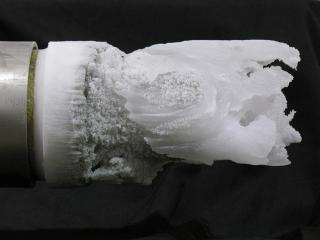
An international team of scientists and technical staff under the leadership of the Alfred Wegener Institute for Polar and Marine Research has successfully completed the deep ice coring at the Alfred Wegener Institute’s Kohnen Station in Dronning Maud Land, Antarctica. Reaching a depth of 2774 metres, first on-site examinations of the ice core indicate that the ice cored at the deepest 200 metres is very old.
The investigations, carried out as part of the EPICA program (European Program for Ice Coring in Antarctica), were designed to gain detailed information about historic climate. Scientists are expecting the data to enhance the understanding of global climate events significantly. A detailed analysis in home laboratories will generate climate data with a very high temporal resolution in the core’s upper 2400 metres, covering the last glacial cycle. The cores retrieved from greater depths are presumably up to 900,000 years old. Such insights into the distant climate history of the Antarctic facilitate a deeper understanding of the significance of polar regions for global climate events, both in the past and at present.
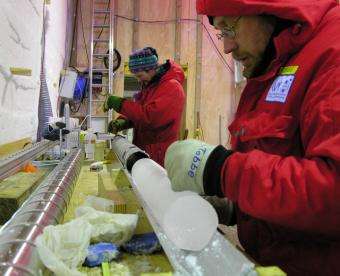
Deep ice coring projects represent long-term research programs. Exploratory work for EPICA, to determine a suitable drill site in Dronning Maud Land, began in 1996. It included extensive geophysical and glaciological investigations, both from the air and on the ground, in a previously unexplored region of the Antarctic.
After establishment of the drill site, construction of Kohnen summer station commenced in 1999 at 75°S and 0° 4’E, 2900 metres above sea level. During the final construction stages of the station in 2001, establishment of the drill site had already begun. The deep coring started in 2001/2002, and the core was sunk over four coring seasons. Throughout the entire depth, ice cores of remarkable quality could be retrieved.
Field work in the Antarctic creates not only scientific challenges. The operating conditions for people and technical equipment are extreme: during the summer months of December and January, prevailing temperatures at Kohnen Station range from minus 35°C to minus 20°C, and at the beginning of the current field season in November of 2005, temperatures below minus 50°C were recorded.
The EPICA project is carried out by a consortium of research teams from ten European countries (Belgium, Denmark, Germany, Great Britain, France, Italy, the Netherlands, Norway, Sweden and Switzerland). EPICA is coordinated by the European Science Foundation (ESF) and financed through national contributions and EU funds. Currently, the lead management rests with Professor Heinrich Miller of the Alfred Wegener Institute. As early as December 2004, the first deep coring of the project, at Dome Concordia Station located on the inland ice plateau of the Eastern Antarctic, was completed five metres above bedrock at a depth of 3270 metres. Hence, after analysis of the core from Kohnen Station, two data sets will be available for comparison, enabling much better interpretation of the records.
Source: Alfred Wegener Institut fuer Polar und Meeresforschung
-
Scientists cautious over Russia's Antarctic lake drilling
Feb 06, 2012 |
5 / 5 (3) |
0
-
Construction starts on new marine research vessel
Jan 31, 2012 |
not rated yet |
0
-
New coastland map could help strengthen sea defenses
Oct 06, 2009 |
3 / 5 (2) |
0
-
Ice and a slice of climate history
Aug 25, 2004 |
not rated yet |
0
-
Antarctic lake could reveal evolution, new life: scientists
2 hours ago |
not rated yet |
0
-
Engineers build first sub-10-nm carbon nanotube transistor
Feb 01, 2012 |
4.9 / 5 (31) |
30
-
Something old, something new: Evolution and the structural divergence of duplicate genes
Jan 31, 2012 |
4.6 / 5 (7) |
1
-
The hidden nanoworld of ice crystals: Revealing the dynamic behavior of quasi-liquid layers
Jan 30, 2012 |
5 / 5 (3) |
1
-
Stock market network reveals investor clustering
Jan 27, 2012 |
3.9 / 5 (23) |
8
-
Of microchemistry and molecules: Electronic microfluidic device synthesizes biocompatible probes
Jan 26, 2012 |
5 / 5 (1) |
0
More news stories
Humans may have helped the decline of African rainforests 3000 years ago
(PhysOrg.com) -- Large areas of rainforests in Central Africa mysteriously disappeared over three thousand years ago, to be replaced by savannas. The prevailing theory has been that the cause was a change ...
Could Venus be shifting gear?
(PhysOrg.com) -- ESAs Venus Express spacecraft has discovered that our cloud-covered neighbour spins a little slower than previously measured. Peering through the dense atmosphere in the infrared, the ...
Space & Earth / Space Exploration
15 hours ago |
5 / 5 (7) |
7
|
NASA budget will axe Mars deal with Europe: scientists
US President Barack Obama's budget proposal to be submitted next week for 2013 will cut NASA's budget by 20 percent and eliminate a major partnership with Europe on Mars exploration, scientists said Thursday.
Space & Earth / Space Exploration
18 hours ago |
5 / 5 (2) |
18
Mars Science Laboratory computer issue resolved
(PhysOrg.com) -- Engineers have found the root cause of a computer reset that occurred two months ago on NASA's Mars Science Laboratory and have determined how to correct it.
Space & Earth / Space Exploration
16 hours ago |
4.7 / 5 (6) |
3
|
Two new moons for Jupiter
Advances in technology have lead to the discovery of new planets outside of our Solar System, and now even new moons in our own backyard.
Space & Earth / Space Exploration
15 hours ago |
4 / 5 (1) |
7
Google users warned of threat to smartphone wallets
Users of Google smartphone wallets were being warned on Friday that there is a way to crack pass codes intended to thwart thieves from going on illicit shopping sprees.
Anonymous knocks CIA website offline (Update)
The website of the Central Intelligence Agency was inaccessible on Friday after the hacker group Anonymous claimed to have knocked it offline.
New error-correcting codes guarantee the fastest possible rate of data transmission
Error-correcting codes are one of the triumphs of the digital age. Theyre a way of encoding information so that it can be transmitted across a communication channel such as an optical fiber o ...
New power source discovered
(PhysOrg.com) -- Researchers at the Massachusetts Institute of Technology (MIT) and RMIT University have made a breakthrough in energy storage and power generation.
Complex wiring of the nervous system may rely on a just a handful of genes and proteins
Researchers at the Salk Institute have discovered a startling feature of early brain development that helps to explain how complex neuron wiring patterns are programmed using just a handful of critical genes. ...
The power of estrogen -- male snakes attract other males
A new study has shown that boosting the estrogen levels of male garter snakes causes them to secrete the same pheromones that females use to attract suitors, and turned the males into just about the sexiest ...