ISS Astronauts Complete 4th Spacewalk
June 18, 2007 ISS Astronauts Complete 4th Spacewalk

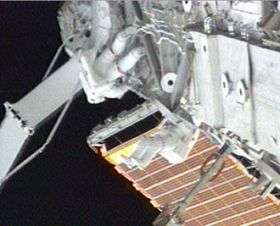
Mission Specialists Patrick Forrester and Steven Swanson check the Drive Lock Assembly 2 on the S3/S4 truss segment of the International Space Station. Image credit: NASA TV

STS-117’s final spacewalk came to an end Sunday at 6:54 p.m. EDT. During the 6-hour, 29-minute orbital stroll, Mission Specialists Patrick Forrester and Steven Swanson performed tasks to activate the International Space Station’s new truss segment and completed work that will help future spacewalkers.

Forrester and Swanson began the excursion at 12:25 p.m. and quickly went to work preparing the Starboard 3 and 4 (S3/S4) truss segment for operation. The S3/S4 was installed onto the station on June 11. Most of the S3/S4 work centered on activating the Solar Alpha Rotary Joint (SARJ), which will allow the S3/S4 arrays to track the Sun.

Early in the spacewalk, Forrester verified the installation of the Drive Lock Assembly 2, one of two mechanisms that will drive rotation of the SARJ, while Swanson installed a TV camera and its support structure. Then, the duo removed the final launch restraints on the SARJ before removing a keel pin and drag link to clear the path for the station’s mobile transporter.

The get-ahead tasks included the installation of a computer network cable onto the Unity module and the removal of a Global Positioning System antenna. The two astronauts also finished the installation of a piece of debris shielding on the Destiny laboratory.

Mission Specialist Jim Reilly coordinated the spacewalk and Pilot Lee Archambault operated the robot arm. Forrester and Swanson conducted STS-117’s second spacewalk. Reilly and Mission Specialist Danny Olivas conducted the other two. Sunday’s spacewalk is the 87th devoted to station assembly and maintenance.

Attention now turns to Atlantis' departure and the events leading up to undocking. The STS-117 crew is scheduled to exit the station Monday before the hatches close at 6:23 p.m. EDT. Atlantis is slated to undock at 10:42 a.m. Tuesday.

However, mission managers may decide to add a day of docked operations for STS-117 if the Russian navigation computers do not perform adequately during a test of Russian attitude control capabilities Monday morning at 10:28 a.m.

Credit: NASA


print this article email this article download pdf blog this article bookmark this article     Stumble it Digg this share on Facebook retweet share on Reddit add to delicious
Rate this story - 4 /5 (1 vote)


June 18, 2007 all stories

Comments: 0

4 /5 (1 vote)
  • Stumble this up

  • Digg this

  • share this

  • hide
  • Related Stories

  • Atlantis Undocks From Station, Set to Land Thursday in Florida
    created Jun 19, 2007 | popularity not rated yet | comments 0
  • Atlantis Astronauts Making 2nd Spacewalk
    created Jun 13, 2007 | popularity not rated yet | comments 0
  • Astronauts take mission's 3rd and final spacewalk
    created Sep 06, 2009 | popularity not rated yet | comments 0
  • 7 shuttle astronauts are parents of many children
    created Aug 24, 2009 | popularity not rated yet | comments 0
  • Discovery, space station maneuver to dodge debris
    created Mar 23, 2009 | popularity not rated yet | comments 0


  • hide
  • Relevant PhysicsForums posts

  • Question about 2-body gravity
    created 18 hours ago
  • life on Mars
    created 21 hours ago
  • Semi-major axis from cartesian co-ordinates
    created Nov 23, 2009
  • Primary Mirror grinding
    created Nov 23, 2009
  • More from Physics Forums - General Astronomy

Other News

Cassini Captures Ghostly Dance of Saturn's Northern Lights

Cassini Captures Ghostly Dance of Saturn's Northern Lights (w/ Video)

Space & Earth / Space Exploration

created 11 hours ago | popularity 5 / 5 (4) | comments 0

(PhysOrg.com) -- In the first video showing the auroras above the northern latitudes of Saturn, Cassini has spotted the tallest known "northern lights" in the solar system, flickering in shape and brightness ...


First black holes may have incubated in giant, starlike cocoons, says CU-Boulder study

First black holes may have incubated in giant, starlike cocoons

Space & Earth / Astronomy

created 14 hours ago | popularity 4.4 / 5 (10) | comments 13

(PhysOrg.com) -- The first large black holes in the universe likely formed and grew deep inside gigantic, starlike cocoons that smothered their powerful x-ray radiation and prevented surrounding gases from ...


ET: Check your voicemail

ET: Check your voicemail

Space & Earth / Space Exploration

created 11 hours ago | popularity 3.4 / 5 (5) | comments 5

(PhysOrg.com) -- Alien beings on faraway planets may not have noticed, but it’s been 35 years since human beings made the first deliberate effort to send them a message.


Humanity would need five Earths to create the resources needed if everyone lived as like Americans, a report has stated

Mankind using Earth's resources at alarming rate

Space & Earth / Environment

created 20 hours ago | popularity 3.2 / 5 (13) | comments 19

Humanity would need five Earths to produce the resources needed if everyone lived as profligately as Americans, according to a report issued Tuesday.


Infrared Image of Circumstellar Disk Illuminates Massive Star Formation Process

Infrared Image of Circumstellar Disk Illuminates Massive Star Formation Process

Space & Earth / Astronomy

created 9 hours ago | popularity 4.5 / 5 (2) | comments 0

(PhysOrg.com) -- A team of astronomers from Ibaraki University, Japan Aerospace Exploration Agency, Kanagawa University, University of Tokyo, Academica Sinica, and National Astronomical Observatory of Japan ...