Voyage to the Giant Asteroids
The asteroid belt between Mars and Jupiter is like the solar system's cluttered old attic. The dusty, forgotten objects there are relics from a time long ago, each asteroid with its own story to tell about the solar system's beginnings.
These are stories planetary scientists want to hear. Much is still unknown about our solar system's distant past. We learn the basic story in school: A vast disc of gas and dust around the sun slowly gathered into larger and larger chunks, eventually forming the planets we know today. But how exactly did this happen, and why did it produce the kinds of worlds that it did, including a certain blue planet well-suited for life?
To answer these questions, NASA plans to launch a robotic probe named Dawn. Its mission: Fly to two giant asteroids, Ceres and Vesta, and explore them up close for the first time. Liftoff is scheduled for July 2007.
Vesta, for starters
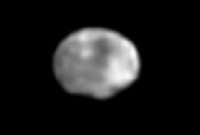
Dawn's first stop is Vesta—an asteroid that may implicate ancient supernovas in the solar system's birth.
Telescopic observations of Vesta and studies of meteorites believed to have come from Vesta suggest that the asteroid may have been partially molten early in its history, allowing heavy elements like iron to sink and form a dense core with a lighter crust on top.
"That's interesting--and a bit puzzling," says Chris Russell, Principal Investigator for Dawn at the University of California, Los Angeles. Melting requires a source of heat such as gravitational energy released when material comes together to make an asteroid. But Vesta is a small world—"too small," he says--only about 530 km across on average. "There would not have been enough gravitational energy to melt the asteroid when it formed."
A supernova (or two) may provide the explanation: Some scientists believe that when Vesta first formed, it was "spiced up" by aluminum-26 and iron-60 created in possibly two supernovas that exploded around the time of the solar system's birth. These forms of iron and aluminum are radioactive isotopes that could have provided the extra heat needed to melt Vesta. Once these radioactive isotopes decayed, the asteroid would have cooled and solidified to its present state.
This idea would explain why Vesta's surface appears to bear the marks of ancient basaltic lava flows and magma oceans, much as Earth's moon does. The supernovas would also change the sequence of events involved in planet formation:
"When I went to school, the thought was that the Earth got together, heated up, and the iron went to the center and the silicate floated on top, producing a core-forming event," Russell says. This view assumes that smaller planetoids that collided and merged to form Earth were amorphous masses that hadn't yet formed their own iron cores. But if chunks of rock the size of Vesta could melt and form dense cores, "it would affect the way the planets and their cores grew and evolved."
If all goes as planned, Dawn would reach Vesta and enter orbit in October 2011. Detailed images of Vesta's surface will reveal traces of its molten past, while spectrometers catalog the minerals and elements that make up its surface. Vesta's gravitational field will be mapped out by the motions of Dawn itself as the probe orbits the asteroid, and that should settle once and for all whether Vesta indeed has an iron core.
On to Ceres
After orbiting Vesta for 7 months, Dawn will undertake a maneuver never before attempted: leave the orbit of one distant body, and fly to and orbit another.
This kind of "asteroid hopping" would be practically impossible if Dawn used conventional rocket fuel. "We would need one of the largest rockets that the US has to carry all the propellant," says Marc Rayman, Project System Engineer for Dawn at NASA's Jet Propulsion Laboratory. Instead, Dawn uses ion propulsion, which requires only one-tenth as much propellant. Dawn’s engines proved themselves onboard an earlier, experimental spacecraft known as Deep Space 1, managed by NASA's New Millennium Program.
Dawn's fuel-efficient ion engines will propel the craft from Vesta, arriving at Ceres by February 2015.
Measuring 950 km in diameter, Ceres is by far the largest object in the asteroid belt. Remarkably, it is not a rocky world like Vesta, but one covered in water ice. "Ceres is going to be a real surprise to us," says Russell. Because it appears to harbor a layer of ice 60 to 120 km thick, the surface of Ceres has probably changed more dramatically over time than Vesta's, obscuring much of its early history. But while Ceres may not offer such an early window onto planet formation, it could teach scientists about the role that water has played in planetary evolution since then. For example, why can some rocky worlds like Ceres and Earth hold on to large amounts of water, while others, like Vesta, end up bone dry?
"Vesta will tell us about the earliest epoch, and Ceres will tell us about what happened later," Russell says. Together, they offer two unique stories from our solar system's past, and who-knows-how-many lessons about how the planets came to be.
Source: by Patrick Barry, Science@NASA


