Scientists study 'stealth' tsunami that killed 600 in Java last summer
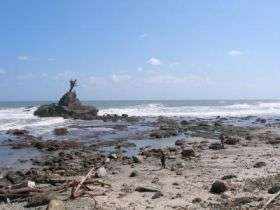
Though categorized as magnitude 7.8, the earthquake could scarcely be felt by beachgoers that afternoon. A low tide and wind-driven waves disguised the signs of receding water, so when the tsunami struck, it caught even lifeguards by surprise. That contributed to the death toll of more than 600 persons in Java, Indonesia.
“The general assumption was that if you were near the coast where the earthquake took place, you would feel it and be able to run to higher ground,” said Hermann Fritz, first author of a new Geophysical Research Letters paper about the July 17, 2006 tsunami. “This event caught people by surprise and showed that it’s not always that simple.”
The earthquake was slow rupturing, so it didn’t produce strong ground shaking on Java that might have alerted people on the beach, he explained.
No local warning was issued for the tsunami waves, which arrived only tens of minutes after the earthquake. Fortunately, the event took place on a Monday. Had the massive waves hit the day before, which was a major national holiday, the popular beach would have been much more crowded – and the toll higher.
“Warning systems typically don’t work very well for locations near earthquakes, where there are only tens of minutes between the earthquake and the tsunami’s arrival,” noted Fritz, a Georgia Institute of Technology assistant professor who led an inspection team to Java a week after the event. “It’s pretty much a spontaneous self-evacuation. You normally feel the earthquake or see the ocean withdraw. If you hear the noise in the last tens of seconds before it hits, then it’s just a matter of who makes it and who doesn’t.”
The survey team, which included scientists from five different countries, interviewed survivors and studied evidence left behind by the tsunami, including debris fields. Beyond the quiet nature of the catastrophe, they discovered evidence of a 21-meter (65-foot) wave that hit a portion of the coastline near the island of Nusa Kambangan, indicating a second event that may have added to the severity of the disaster.
Elsewhere along the 300 kilometers of coastline studied by the International Tsunami Survey team, the waves ranged from 5 to 7 meters, 16 to 24 feet.
“This event indicates that there was likely a combination of both a tectonic tsunami and a submarine landslide or a canyon failure triggered by the earthquake,” said Fritz, whose research is supported by the U.S. National Science Foundation. “The runup was unusually high along one portion of the coast, too much for a 7.8 magnitude earthquake. The only explanation we could think of is that a submarine mass movement triggered by the earthquake could have added to the effect of the earthquake, given the essentially straight coastline with little room for large-scale tsunami focusing.”
For people in seismically-active areas like Indonesia, an earthquake usually provides the first warning of a tsunami. Whether caused by an earthquake or an underwater landslide, the first visible sign of an oncoming tsunami is often a rapid withdrawal of the ocean that exposes the seafloor or coral reefs. When that appears, the first tsunami wave won’t be far behind.
In the July 2006 Java tsunami, lifeguards did not notice the withdrawal because the water was receding anyway because of a normal low tide – and because of large wind-produced waves.
“The lifeguards did not recognize the precursors of the tsunami, either the shaking of the earth or the drawing down of the sea,” said Fritz, who also interviewed survivors of the 2004 Indonesian tsunami. “The irony is that many of the lifeguards survived because they were in tall concrete structures sitting more than four meters above the ground, getting just their feet wet – a classic example of vertical evacuation in engineered structures. We interviewed one of them, and it was quite moving. It was his job to watch out for the people on the beach, and what happened was pretty tough on him.”
Survivors compared the sound of the tsunami to that of an aircraft landing or a loud boiling sound. “That primarily comes from the bore forming, or breaking of the waves a couple of hundred meters off shore,” Fritz explained. “In high impact areas, the first tsunami wave then comes in as a rolling wave of water, whereas in low-impact areas it may only be recognized as an unusually fast and high tide.”
A tsunami normally produces more than one wave, and the waves can be 10 or 20 minutes apart. Often, the second or third wave is the largest, so many deaths occur when victims return to low-lying areas to look for relatives or assess damage after the first wave hits.
In Indonesia, the government has instituted education programs to help residents respond to tsunami warning signs by quickly moving to higher ground. In many cases, safety can mean moving a mile inland or 10 meters up a hill.
“It’s always going to be difficult to provide a warning in Java because the earthquake zone is so near,” explained Fritz, a faculty member at Georgia Tech’s Savannah, Ga. campus. “It’s most critical for people to be able to evacuate themselves.”
In other locations, such as the Hawaiian Islands, warning systems are useful because tsunamis caused by continental earthquakes take hours to reach the islands, he said.
In the deep ocean, tsunami waves move at the speed of a jet aircraft. However, when they approach land, the waves slow as their height builds and energy dissipates. By the time they roll onto a beach, the waves may be moving at vehicle highway speed, but that quickly drops as they encounter structures and vegetation.
“If you start running from the beach when the tsunami strikes, chances are you are not going to make it,” Fritz said. “But if you have a head-start, you have a much better chance – if you know where you’re going.”
Source: Georgia Institute of Technology


