Astronomers Measured Mass of Largest Dwarf Planet
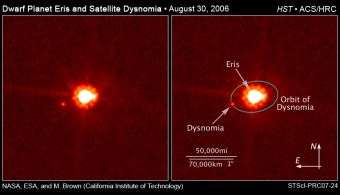
Aptly named after the Greek goddess of conflict, the icy dwarf planet, Eris, has rattled the general model of our solar system. The object was discovered by astronomer Mike Brown of Caltech in the outer reaches of the Kuiper belt in 2005.
Its detection provoked debate about Pluto’s classification as a planet. Eris is slightly larger than Pluto.
So if Pluto qualified as a full-fledged planet, then Eris certainly should too. Astronomers attending the International Astronomical Union meeting in 2006 worked to settle this dilemma. In the end, we lost a planet rather than gaining one. Pluto was demoted and reclassified as a dwarf planet along with Eris and the asteroid Ceres, the most massive member of the asteroid belt.
Adding insult to injury for the former ninth planet, Brown has now determined that Eris is also more massive than Pluto. This new detail was determined by observations of Eris’ tiny moon Dysnomia. The Hubble Space Telescope and Keck Observatory took images of the moon’s movement, from which Brown precisely calculated Eris to be 27 percent more massive than Pluto. In fact, if you scooped up all the asteroids in the asteroid belt they would fit inside Eris, with a lot of room to spare.
Currently, Eris is more than three times farther from the Sun than Pluto. It is so cold out there that the dwarf planet’s atmosphere has frozen onto the surface as a frosty glaze. The coating gleams brightly, reflecting as much sunlight as fresh fallen snow. The path Eris takes around the Sun is shaped like an oval rather than a circle. In about 290 years, Eris will move close enough to the Sun to partially thaw. Its icy veneer will melt away revealing a rocky, speckled landscape similar to Pluto’s.
Source: NASA/Space Telescope Science Institute, Baltimore, by Ray Villard


