Reconstructing the biology of extinct species: A new approach
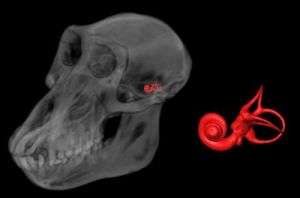
An international research team has documented the link between the way an animal moves and the dimensions of an important part of its organ of balance, the three semicircular canals of the inner ear on each side of the skull. The team's article on its research will be published on 26 June in the print edition of the Proceedings of the National Academy of Sciences and in the journal's online early edition during the week of 18 to 22 June.
"We have shown that there is a fundamental adaptive mechanism linking a species' locomotion with the sensory systems that process information about its environment," says Alan Walker, Evan Pugh Professor of Anthropology and Biology at Penn State University, one of the team's leaders. The researchers studied 91 separate primate species, including all taxonomic families. The study also included 119 additional species, most of which are mammals ranging in size from mouse to elephant, that habitually move in diverse ways in varied environments.
The project is the first large-scale study to document the relationship of the dimensions of the semicircular canals to locomotion. These structures are filled with a fluid, which moves within the canals when the animal moves. The fluid's movement is sensed by special cells that send signals to the brain, triggering the neck and eye muscles to reflexively keep the visual image stable.
The basic hypothesis of the project was that the organ of balance -- which helps stabilize an animal's gaze and coordinate its movements as it travels through the environment -- should be irrevocably linked to the type of locomotion produced by its limbs. "If an animal evolves a new way of moving about the world, its organ of balance must evolve accordingly," Walker explains. From the visual information, the animal tracks its position relative to stationary objects such as tree trunks, branches, rocks or cliffs, or the ground. Having a stable image of the environment is especially crucial for acrobatic animals that leap, glide, or fly.
To make the discovery, the scientists scanned skull samples of each species, measuring the size of each semicircular canal and calculating the radius of curvature. Most of the specimens were scanned at the Center for Quantitative Imaging at Penn State on the OMNI-X high-resolution x-ray CT scanner, which can resolve features approximately 1/100 the size of those detected by medical CT scanners. In addition, experienced field workers used personal knowledge or film of animals in the wild to classify species into one of six locomotor categories ranging from very slow and deliberate to fast and agile. The scientists then compared the canal size of each species to its category of movement.
The results revealed a highly significant statistical relationship between the radius of curvature of the semicircular canals and the species' habitual way of moving. More acrobatic species consistently have semicircular canals with a larger radius of curvature than do slower-moving ones. For example, a small, fast-moving leaper like a bushbaby has semicircular canals that are relatively and absolutely much bigger than those of the similar-sized, slow-moving loris. However, because larger animals have absolutely larger canals, the analysis had to take body size into account. The research revealed that this functional tie between the semicircular canals and locomotor pattern is evident both within the primates alone and within the entire mammalian sample.
"How an animal moves is a basic adaptation," says Walker, an expert in primate locomotion. "Now we have a way to reconstruct how extinct species moved that is completely independent of analysis of the limb structure. For the first time, we can test our previous conclusions using a new source of information."
Source: Penn State


