Everyday text shows that Old Persian was probably more commonly used than previously thought
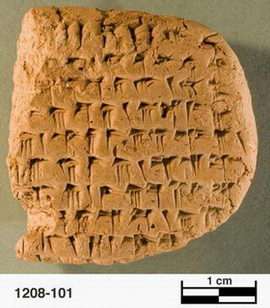
For the first time, a text has been found in Old Persian language that shows the written language in use for practical recording and not only for royal display. The text is inscribed on a damaged clay tablet from the Persepolis Fortification Archive, now at the Oriental Institute at the University of Chicago. The tablet is an administrative record of the payout of at least 600 quarts of an as-yet unidentified commodity at five villages near Persepolis in about 500 B.C.
“Now we can see that Persians living in Persia at the high point of the Persian Empire wrote down ordinary day-to-day matters in Persian language and Persian script,” said Gil Stein, Director of the Oriental Institute. “Odd as it seems, that comes as a surprise — a very big surprise.”
Old Persian writing was the first of the cuneiform scripts to be deciphered, between about 1800 and 1845. When the script was cracked, scholars saw that the Old Persian language was an ancestor of modern Persian and a relative of Sanskrit. Knowing that, they could understand the inscriptions of Darius, Xerxes and their successors, the kings of the Persian Empire founded by Cyrus the Great in the mid-sixth century B.C. and destroyed by Alexander the Great and his successors after 330 B.C.
Until now, most scholars of Old Persian thought that Old Persian script and language were used only for the inscriptions of kings on cliff faces or palaces, or else to identify vessels of precious metals or other luxury goods that were connected with the kings and their palaces. To write records of administration or business, the Persians relied on languages and scripts — Aramaic, Babylonian, Elamite, and others — already in use at the advent of the Empire.
The Persepolis Fortifaction tablets were excavated at the imperial palace complex of Persepolis, in southwestern Iran, by the Oriental Institute in the 1930s and, through the permission of the Iranian government, were sent to the Oriental Institute in 1937 on a long-term loan for purposes of translation and analysis.
The Archive includes tens of thousands of clay tablets and fragments with texts in Elamite, an indigenous language already written in Iran for almost 2,000 years before the Persian Empire was founded. It also includes hundreds of clay tablets and fragments with texts in Aramaic, a Semitic language already used for practical recording over much of the Near East since the days of the Assyrian and Babylonian Empires (ninth to sixth centuries B.C.). It also includes thousands of tablets with no texts at all, but with impressions of seals.
But over the years of study, a few extraordinary items have also been discovered among the Persepolis tablets: a text in Phrygian (a language of western Anatolia, in modern Turkey), a text in Greek, and now a text in Persian, the language of the Empire’s rulers.
“Most of the scribes around Persepolis could speak and write more than one language, and this text might be just a quirky experiment done by one of them,” said Matthew W. Stolper, head of the Oriental Institute’s Persepolis Fortification Archive Project. “But it might also be the tip of an iceberg.” He explained that in 500 B.C., just as now, administrative records did not work as isolates, only as items in much larger files. Before 1933, there was only one known example of an Achaemenid administrative tablet written in Elamite, but since the discovery of the Persepolis Fortification Archive there are thousands. Like that first Achaemenid Elamite tablet, this Old Persian tablet “could also be the first forerunner of something much bigger.”
Because there are no other such documents in Old Persian, interpreting this one depends on comparisons with the Elamite and Aramaic documents with which it was found. “The Old Persian tablet departs so much from expectations that its authenticity would have been questioned if it had not been found in the Fortification Archive,” said Stolper, the John A. Wilson Professor in the Oriental Institute.
“This shows how important it is to keep the Persepolis Fortification texts together, to keep the Archive intact,” Stein said. “Unexpected discoveries are still being made, and the meaning and reliability of every piece depend on its connections with the whole information system of the entire Fortification Archive.”
Members of the Oriental Institute’s Persepolis Fortification Archive Project first announced the discovery of the Old Persian tablet in November, 2006, at a colloquium at the Collège de France and the University of Chicago’s Paris Center. They described the document in greater detail at a meeting of the American Oriental Society in March, 2007. An article by Stolper and Jan Tavernier, of the University of Leuven (Belgium), with images and discussion of the tablet and the text is now available from the online journal ARTA at www.achemenet.com/ressources/e … tolper-Tavernier.pdf .
Source: University of Chicago


