Solar physicists report paradox: Less sunlight, but temps rise
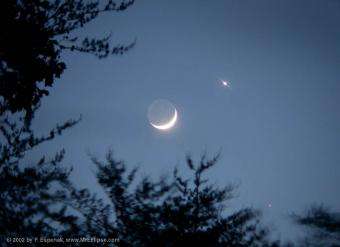
Less sunlight reaching the Earth's surface has not translated into cooler temperatures, according to a team of solar physicists at New Jersey Institute of Technology. The scientists, who monitor the Earth's reflectance by measuring what is known as the moon's earthshine, have observed that the amount of light reflected by Earth -- its albedo -- has increased since 2000. The result has been less sunlight reaching the Earth's surface.
"Our findings have significant implications for the study of climate change," said Philip R. Goode, PhD, principal investigator and distinguished professor of physics at NJIT. "The results raise questions about how global temperatures can still rise when the amount of sunlight reaching the surface has decreased." The scientists find that the seemingly paradoxical result is due to an increase in the cloud cover coupled with a peculiar re-arrangement of the clouds, but are unsure why this is happening. This large variability of the clouds and albedo presents a fundamental, unmet challenge to our ability to understand and predict the Earth's climate.
Goode is the director of Big Bear Solar Observatory, California, where the observations were carried out. NJIT has owned and operated the observatory since 1997. Goode's findings are reported tomorrow in "Can the Earth's Albedo and Surface Temperatures Increase Together," published tomorrow by Eos (Jan. 24, 2006), the weekly newspaper of geophysics published by the American Geophysical Union. The National Aeronautics and Space Administration funded the research.
"Recently analyzed cloud data from the International Satellite Cloud Climatology Project (ISCCP) confirm the trend in reflectance," said Goode. "The data also reveal that from 2000 to now the clouds have changed so that the Earth may continue warming, even with declining sunlight. These large and peculiar variabilities of the clouds, coupled with a resulting increasing albedo, presents a fundamental, unmet challenge for all scientists who wish to understand and predict the Earth's climate." Co-authors with Goode are post-doctoral associates Enric Palle and Pilar Montanes-Rodriguez, who work at the observatory, and Steven E. Koonin, a professor of theoretical physics at California Institute of Technology (Cal Tech).
Climate depends on sunlight, less the part of sunlight that is promptly reflected plus how well the Earth holds heat. At any moment, more than half the Earth is swathed in clouds, and they dominate the Earth's reflectance. Both the sunlight reaching Earth and the amount of atmospheric heat trapped are sensitive to clouds, which both cool the Earth (especially low thick clouds) by reflecting the sunlight and warm the Earth by acting as blankets (especially high thin clouds).
It has been argued that an increasing albedo during the past five years would be inconsistent with the observed behavior in the global land and sea-surface temperatures because, in principle, an increase in the albedo would seem to imply that the decrease in the sunlight absorbed by the planet would lead to cooler temperatures.
The just-released update of the 20-year sequence of ISCCP satellite cloud data shows that during the first 15 years of observations, the percent difference between high lying and low-lying clouds remained steady at 7-8 percent. But in the last five years, for some unknown reason, the difference has almost doubled to 13 percent. The ISCCP data is a careful compilation of cloud observations covering the entire Earth from a range of meteorological satellites.
"That increase in the difference signals a relative decrease in the cooling effect of clouds," said Goode. "Thus, the rising reflectance of the Earth has not led to a reversal of global warming from the increase in sunlight being reflected back into space." What has happened is that the low, cooling clouds have decreased during the most recent years, while high, warming clouds have increased even more. Thus, the cloud data also reveal an increase in total cloud amount during 2000-2004. That increase is consistent with the earlier earthshine result of growing reflectance throughout that period.
Goode noted that the Earth's reflectance depends primarily on cloud properties. Recent ground-based and satellite studies of the albedo have shown a surprisingly significant inter-annual and decadal variability. From about 1985-2000, the Earth steadily received more sunlight, before the recent reversal of the trend from 2000-2004. "This is not the first time such a situation occurred," Goode said.
Ground-based radiometers hint at a similar reversal from the 1960's through the mid-1980's, which some scientists have dubbed global dimming. Thus, it seems there may be a large, unexplained decadal variation in sunlight reaching the Earth, as well as a large effect of clouds re-arranging by altitude.
"From these data and results, we caution scientists against concluding that global dimming would mean a cooler Earth, and that clouds need a better treatment in climate models" said Goode.
The earthshine studied by Goode and his colleagues can be seen as a ghostly glow associated with the moon's "dark side" -- or the portion of the lunar disk not lit by the Sun. The cloudier the Earth, the brighter the earthshine. "The phenomenon of earthshine was first observed by Leonardo DaVinci," said Goode.
Source: New Jersey Institute of Technology


