Physicists Observe Universal State
June 19, 2007 Physicists Observe Universal State

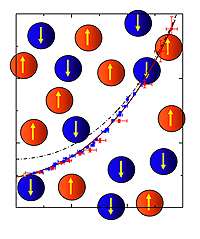
First published evidence for universal thermodynamics using data from three different strongly interacting Fermi gas experiments, with a schematic background of the interacting particles.

A team of Australian and Chinese scientists have found the first observed evidence for "universality" in a paper to be published in the prestigious Nature Physics journal next month.

The finding has been made by the Australian Research Council Centre of Excellence for Quantum-Atom Optics, University of Queensland (UQ) team of Peter Drummond and Xia-Ji Liu in a joint publication with Hui Hu of Renmin University of China (RUC) in Beijing.

Professor Drummond said the central aim of physics was to find simple descriptions for complex behaviours.

"In normal systems, a particle's behaviour is determined by its type; atoms react differently to protons for example," he said. "However, recent work by our UQ team has shown that for systems with strongly interacting particles (specifically particles such as fermions which like to remain apart) their behaviour does not depend on the type of particle. This behaviour is known as Universal Behaviour."

Last year, theory from the same UQ team, based at UQ's School of Physical Sciences, predicted the properties of this universal matter.

Professor Drummond said three US laboratories had now published measurements of experiments on ultra-cold atoms, under conditions of a very high vacuum and a strong magnetic field, which gave the required universal regime.

"All three experiments, on different types of atom and under different conditions, agree precisely with the theory produced at UQ," he said.

The UQ/RUC team collected data from the three experiments, and showed that all the data lay on a single, universal curve as predicted last year.

"This breakthrough lays the foundation for understanding the universal state, exciting researchers who are trying to better understand high Tc superconductors," Professor Drummond said.

"Much credit must be given to the superb experimental work of John Thomas (Duke University), Debbie Jin (Colorado University) and Randy Hulet (Rice University), in whose laboratories the measurements were carried out."

Similar experiments are now underway in Swinburne University of Technology in Melbourne, also part of the ARC Centre of Excellence for Quantum-Atom Optics.

The paper published in Nature Physics can be accessed at Nature Physics online.

Source: University of Queensland


print this article email this article download pdf blog this article bookmark this article     Stumble it Digg this share on Facebook retweet share on Reddit add to delicious
Rate this story - 4.3 /5 (56 votes)


June 19, 2007 all stories

Comments: 0

4.3 /5 (56 votes)
  • Stumble this up

  • Digg this

  • share this

  • hide
  • Related Stories

  • iPhone Software That Controls Robot Movements (w/ Video)
    created Nov 18, 2009 | popularity not rated yet | comments 0
  • Comcast's NBC talks cap its decades-long rise
    created Nov 16, 2009 | popularity not rated yet | comments 0
  • The upside of feeling down
    created Nov 09, 2009 | popularity not rated yet | comments 0
  • Squeak, squeak -- can you hear me now?
    created Nov 09, 2009 | popularity not rated yet | comments 0
  • Scientists witness nature's complexity unfold in self-assembling quasicrystals
    created Oct 31, 2009 | popularity not rated yet | comments 0


  • hide
  • Relevant PhysicsForums posts

  • moment of inertia and friction
    created 8 hours ago
  • two-dimensional collision
    created 11 hours ago
  • The acceleration of mass using light
    created 13 hours ago
  • Badminton
    created 14 hours ago
  • More from Physics Forums - General Physics

Other News

In the Brain, Seven Is A Magic Number

In the Brain, Seven Is A Magic Number

Physics / General Physics

created 17 hours ago | popularity 4.3 / 5 (22) | comments 7

Having a tough time recalling a phone number someone spoke a few minutes ago or forgetting items from a mental grocery list is not a sign of mental decline; in fact, it's natural.


Scientists react as they stand in front of a screen at CERN

First atoms reported smashed in Large Hadron Collider (Update)

Physics / General Physics

created 19 hours ago | popularity 4.7 / 5 (24) | comments 12

Two circulating beams on Monday produced the first particle collisions in the world's biggest atom smasher, the Large Hadron Collider (LHC), three days after its restart, scientists announced.


Straightening messy correlations with a quantum comb

Straightening messy correlations with a quantum comb

Physics / Quantum Physics

created 19 hours ago | popularity 4.8 / 5 (8) | comments 0

Quantum computing promises ultra-fast communication, computation and more powerful ways to encrypt sensitive information. But trying to use quantum states as carriers of information is an extremely delicate ...


New tool for helping pediatric heart surgery

Physics / General Physics

created 4 hours ago | popularity not rated yet | comments 0

A team of researchers at the University of California, San Diego and Stanford University has developed a way to simulate blood flow on the computer to optimize surgical designs. It is the basis of a new tool that may help ...


Visual assistance for cosmic blind spots

Visual assistance for cosmic blind spots

Physics / General Physics

created 20 hours ago | popularity 4.3 / 5 (3) | comments 0

A bit of imagination on the part of a measuring instrument wouldn't be a bad thing. It could help to add data from areas where the instrument is unable to measure. However, it must do so constructively. In ...