Nanotube adhesive sticks better than a gecko's foot
June 19, 2007 Nanotube adhesive sticks better than a gecko's foot

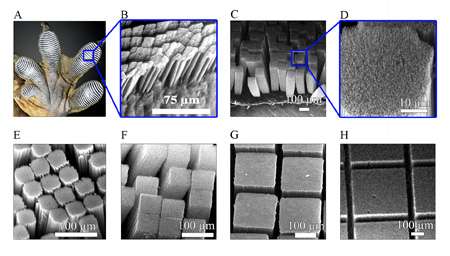
Microfabricated aligned multiwalled carbon nanotube setae and spatulas. (A) Optical picture of gecko foot showing that the setae are arranged in many lobes along the foot. (B) SEM image of natural gecko setae terminating into thousands of smaller spatulas. (E–H) SEM images of synthetic setae of width 50 (E), 100 (F), 250 (G), and 500 (H) µm. (C and D) Side views (C) and higher magnification SEM image (D) of the 100 µm setae. Image courtesy of the University of Akron.

Mimicking the agile gecko, with its uncanny ability to run up walls and across ceilings, has long been a goal of materials scientists. Researchers at Rensselaer Polytechnic Institute and the University of Akron have taken one sticky step in the right direction, creating synthetic “gecko tape” with four times the sticking power of the real thing.

In a paper published in the June 18–22 issue of the Proceedings of the National Academy of Sciences, the researchers describe a process for making polymer surfaces covered with carbon nanotube hairs. The nanotubes imitate the thousands of microscopic hairs on a gecko’s footpad, which form weak bonds with whatever surface the creature touches, allowing it to “unstick” itself simply by shifting its foot.

For the first time, the team has developed a prototype flexible patch that can stick and unstick repeatedly with properties better than the natural gecko foot. They fashioned their material into an adhesive tape that can be used on a wide variety of surfaces, including Teflon.

Pulickel Ajayan, the Henry Burlage Professor of Materials Science and Engineering at Rensselaer, and Lijie Ci, a postdoctoral research associate in Ajayan’s lab, created the material in collaboration with Ali Dhinojwala, professor of polymer science at the University of Akron, and University of Akron graduate students Liehui Ge and Sunny Sethi.

“Several people have tried to use carbon nanotube films and other fibrous structures as high-adhesive surfaces and to mimic gecko feet, but with limited success when it comes to realistic demonstrations of the stickiness and reversibility that one sees in gecko feet,” Ajayan said. “We have shown that the patchy structures from micropatterned nanotubes are essential for this unique engineering feat to work. The nanotubes also need to be the right kind, with the right dimensions and compliance.”

“Geckos inspired us to develop a synthetic gecko tape unlike any you’ll find in a hardware store,” Dhinojwala says. “Synthetic gecko tape uses ‘van der Waals interactions’ — the same interactions that hold liquids and solids together — to stick to a variety of surfaces without using sticky glues.”

The material could have a number of applications, including feet for wall-climbing robots; a dry, reversible adhesive in electronic devices; and outer space, where most adhesives don’t work because of the vacuum.

Source: Rensselaer Polytechnic Institute


print this article email this article download pdf blog this article bookmark this article     Stumble it Digg this share on Facebook retweet share on Reddit add to delicious
Rate this story - 4.7 /5 (66 votes)


June 19, 2007 all stories

Comments: 0

4.7 /5 (66 votes)
  • Stumble this up

  • Digg this

  • share this

  • hide
  • Related Stories

  • Mimicking gecko feet: Dry adhesive based on carbon nanotubes gets stronger
    created Oct 09, 2008 | popularity not rated yet | comments 0
  • Sticky gecko feet: The role of temperature and humidity
    created May 14, 2008 | popularity not rated yet | comments 0
  • Engineers Create Super Compressible Carbon Nanotube Foam-like Films
    created Nov 24, 2005 | popularity not rated yet | comments 0
  • UA synthetic gecko foot-hairs leading to reusable adhesives
    created Aug 15, 2005 | popularity not rated yet | comments 0
  • From nature, robots
    created Sep 25, 2009 | popularity not rated yet | comments 0


  • hide
  • Relevant PhysicsForums posts

  • Birds Sucked into Engines?
    created 1hour ago
  • Can we be confident in a specific cosmological model without sufficient empirical evi
    created 1hour ago
  • Left Hand Rule
    created 3 hours ago
  • How do we know all electrons are the same?
    created 3 hours ago
  • More from Physics Forums - General Physics

Other News

carbon fiber

Ultra-Long Carbon Nanotubes Could Serve as Future Transmission Lines

Nanotechnology / Nanomaterials

created Nov 10, 2009 | popularity 4.9 / 5 (23) | comments 14

(PhysOrg.com) -- When it comes to carbon nanotubes, the majority of research so far has focused on small-scale applications. But now, a team of researchers from Rice University has created carbon nanotubes ...


Researchers turn algae into high-temperature hydrogen source

Researchers turn algae into high-temperature hydrogen source

Nanotechnology / Nanophysics

created Nov 12, 2009 | popularity 3.6 / 5 (7) | comments 5

In the quest to make hydrogen as a clean alternative fuel source, researchers have been stymied about how to create usable hydrogen that is clean and sustainable without relying on an intensive, high-energy ...


Argonne 'homegrown' hybrid solar cell aims for low-cost power

Argonne 'homegrown' hybrid solar cell aims for low-cost power

Nanotechnology / Nanomaterials

created Nov 10, 2009 | popularity 4.2 / 5 (11) | comments 3

(PhysOrg.com) -- Scientists at the U.S. Department of Energy’s (DOE) Argonne National Laboratory have refined a technique to manufacture solar cells by creating tubes of semiconducting material and then "growing" ...


Engineers image nanostructure of a solid acid catalyst and boost its catalytic activity

Nanotechnology / Nanomaterials

created Nov 09, 2009 | popularity 5 / 5 (3) | comments 2

The catalytic processes that facilitate the production of many chemicals and fuels could become much more environmentally friendly thanks to a breakthrough achieved by researchers from Lehigh and Rice Universities.


Scientists develop DNA origami nanoscale breadboards for carbon nanotube circuits

Scientists develop DNA origami nanoscale breadboards for carbon nanotube circuits

Nanotechnology / Nanomaterials

created Nov 10, 2009 | popularity 5 / 5 (7) | comments 0

In work that someday may lead to the development of novel types of nanoscale electronic devices, an interdisciplinary team of researchers at the California Institute of Technology has combined DNA's talent ...