Getting rid of the twin image that plagues holography

June 19, 2007 By Miranda Marquit

For decades, since the ability to create a holographic record was discovered, a problem has plagued the field. “In holography,” Tatiana Latychevskaia tells PhysOrg.com, “a twin image unfortunately appears. It is seen out of focus so that, with small molecules, you would not be able to judge if what you are seeing is part of the molecule, or just the twin image.”

Latychevskaia is a scientist at the University of Zurich, and she is part of an effort to make the holographic study of individual molecules practical. And, with a recent discovery of how to eliminate the twin image, Latychevskaia appears to be on her way.

The experiment was done in the group of Hans-Werner Fink, also at the University of Zurich, and the findings are reported in “Solution to the Twin Image Problem in Holography,” published in Physical Review Letters.
Getting rid of the twin image that plagues holography
Enlarge

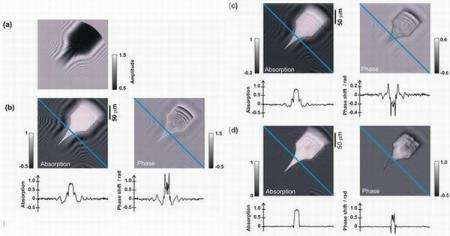
A tungsten tip is iteratively reconstructed as a hologram: (a) normalized hologram (b) conventional reconstruction yields reconstructed absorption and phase distributions (c) first iteration makes oscillations due to twin image apparent in these reconstructions (d) after the 500th iteration. Credit: Hans-Werner Fink, Reprinted with permission from Phys. Rev. Lett. Vol. 98, 233901 (2007). Copyright 2007 by the American Physical Society. (http://link.aps.org/abstract/PRL/v98/e233901)

“Holography is much better than just a photo,” explains Latychevskaia. “With a hologram, you can see the 3-D structure of the molecule. And, you can also see phase and absorption properties.” She goes on to point out that the ability to understand how molecules work would be a great aid in current fields of biology, especially in drug design. “Holography can provide greater insight, and the ability to see without this twin image obstructing the view is important.”

Fink also sees the benefits of using holography for biological applications. “Right now we have powerful technologies, but they rely on crystallography,” he explains. “Many protein molecules have to be arranged in a crystal structure.” Additionally, he continues, “the high energy beams, like x-rays, used to study these molecules can damage them.”

The key to the holography that Fink and Latychevskaia propose is using a low-energy electron beam. “This low energy is gentler on the molecule. We don’t have to accept damage to the molecules,” Fink says.

Fink explains that an object, the molecule in question, is placed in front of the electron beam and the electrons are scattered. A detector sits about 10 centimeters from the object to bring about the electron holographic image by interference of the object wave with the reference wave. “We don’t use lenses,” Fink says. “The experiment is performed with coherent electron waves.”

Latychevskaia says that part of the problem with the low-energy approach to holography was that, until now, there was no way to correct the twin image. “In early years, the solution was to separate the beams in two and the twin image would be at the side. An electron beam such as we use, though, can’t be separated. So the twin image obstructed the view of the molecule.”

Through a series of iterations and numerical aids in reconstruction, Latychevskaia found that the twin image could be removed, allowing for a hologram that allows the 3-D study of a molecule. Fink says that he has already submitted a timeline to the European Union for getting complete structural information from a single molecule by October 2009. “We hope to establish this as a tool for structural microbiology,” Fink enthuses. “With the twin image removal, a long-standing physics problem has now been solved.”

Copyright 2007 PhysOrg.com.
All rights reserved. This material may not be published, broadcast, rewritten or redistributed in whole or part without the express written permission of PhysOrg.com.


print this article email this article download pdf blog this article bookmark this article     Stumble it Digg this share on Facebook retweet share on Reddit add to delicious
Rate this story - 4.8 /5 (82 votes)


June 19, 2007 all stories

Comments: 0

4.8 /5 (82 votes)
  • Stumble this up

  • Digg this

  • share this

  • hide
  • Related Stories

  • First glimpse of a key DNA repair protein at work
    created Oct 03, 2008 | popularity not rated yet | comments 0
  • Eliminating the 'Twin'
    created Aug 02, 2006 | popularity not rated yet | comments 0
  • Scientists Explore Galactic Frontier, Release First-Ever All-Sky Map (w/ Video)
    created Oct 15, 2009 | popularity not rated yet | comments 0
  • The role of genetic factors in adult ADHD
    created Sep 15, 2009 | popularity not rated yet | comments 0
  • Scientists Build Nanostructures out of Single DNA Strands
    created Sep 08, 2009 | popularity not rated yet | comments 0


  • hide
  • Relevant PhysicsForums posts

Other News

Invisibility visualized: German team unveils new software for rendering cloaked objects

Invisibility visualized: German team unveils new software for rendering cloaked objects

Physics / Optics & Photonics

created 20 hours ago | popularity 5 / 5 (3) | comments 2

(PhysOrg.com) -- Scientists and curiosity seekers who want to know what a partially or completely cloaked object would look like in real life can now get their wish -- virtually. A team of researchers at the ...


Researchers take the lead out of piezoelectrics

Researchers take the lead out of piezoelectrics

Physics / Condensed Matter

created 21 hours ago | popularity 3 / 5 (2) | comments 0

There is good news for the global effort to reduce the amount of lead in the environment and for the growing array of technologies that rely upon the piezoelectric effect. A lead-free alternative to the current ...


Do we need dark matter?

Do we need dark matter?

Physics / General Physics

created Nov 12, 2009 | popularity 3.9 / 5 (10) | comments 28

It's the biggest problem in physics: the matter we can see in the universe accounts for just five per cent of the observed gravity that holds galaxies together.


A line on string theory

A line on string theory

Physics / General Physics

created Nov 12, 2009 | popularity 4.7 / 5 (33) | comments 13

(PhysOrg.com) -- A Harvard theoretical physicist has discussed with scientists at the Large Hadron Collider in Switzerland the possibility that they may discover a theorized "stau" particle, with a lifetime ...


The LHC tunnel

Peckish bird briefly downs big atom smasher

Physics / General Physics

created Nov 09, 2009 | popularity 4.2 / 5 (13) | comments 18

A peckish bird briefly knocked out part of the world's biggest atom smasher by causing a chain reaction with a piece of bread, the European Organisation for Nuclear Research (CERN) said Monday.