Archaeologists discover gold processing center
Archaeologists from the University of Chicago have discovered a gold processing center along the middle Nile, an installation that produced the precious metal sometime between 2000 and 1500 B.C. The center, along with a cemetery they discovered, documents extensive control by the first sub-Saharan kingdom, the kingdom of Kush.
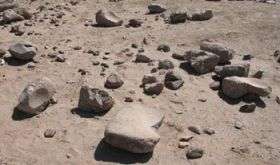
The team from the University’s Oriental Institute found more than 55 grinding stones made of granite-like gneiss along the Nile at the site of Hosh el-Geruf, about 225 miles north of Khartoum, Sudan. The region was also known also known as Nubia in ancient times. Groups of similar grinding stones have been found on desert sites, mostly in Egypt, where they were used to grind ore to recover the precious metal. The ground ore was likely washed with water nearby to separate the gold flakes.
“This large number of grinding stones and other tools used to crush and grind ore shows that the site was a center for organized gold production,” said Geoff Emberling, Director of the Oriental Institute Museum and a co-leader of the expedition. The research was funded by the the National Geographic Society and the Packard Humanities Institute, which also has offered to support all the teams working in the Fourth Cataract salvage project, the location of the University’s expedition.
“Even today, panning for gold is a traditional activity in the area,” said Bruce Williams, a Research Associate at the Oriental Institute and also a co-leader of the expedition. “Water is a key ingredient for the production of gold and it is possible that bits of gold ore were found in gravel deposits nearby in wadis (dry creek beds) and crushed on the site.”
The team also excavated a cemetery where they uncovered burials with artifacts that suggest the region was part of the Kingdom of Kush, which would have ruled an area much larger than previously believed. Such discoveries show that the kingdom, the first in sub-Saharan Africa to control a territory as much as 750 miles in length.
“This work is extremely exciting because it can give us our first look at the economic organization of this very important, but little known ancient African state,” said Gil Stein, Director of the Oriental Institute. “Until now, virtually all that we have known about Kush came from the historical records of their Egyptian neighbors, and from limited explorations of monumental architecture at the Kushite capital city Kerma. The Oriental Institute excavations at Hosh el-Geruf will allow scholars to understand the rural sources of the riches of Kush.”
The University of Chicago expedition is part of an international recovery project underway intended to find artifacts related to Kush and other civilizations that flourished in the area before archaeological sites are covered by a steadily rising Nile. The area is being flooded by Hamdab or Merowe Dam, located at the downstream end of the Fourth Cataract. The lake to be formed by this dam will flood about 100 miles of the Nile Valley in an area that had previously seen no archaeological work.
“Surveys suggest that there are as many as 2,500 archaeological sites to be investigated in the area. Fortunately, this is an international effort-teams from Sudan, England, Poland, Hungary, Germany and the United States have been working since 1996, with a large increase in the number of archaeologists working in the area since 2003,” Emberling said.
The area will probably be flooded next year, but the team hopes to return for another season of exploration. The sites studied by Emberling and Williams provide important new information on the ancient Kingdom of Kush, which flourished from about 2000 to 1500 B.C.
“The Kingdom of Kush was unusual in that it was able to use the tools of power-military and governance-without having a system of writing, an extensive bureaucracy or numerous urban centers,” Emberling said. “Studying Kush helps scholars have a better idea of what statehood meant in an ancient context outside such established power centers of Egypt and Mesopotamia.” Among the artifacts they found in burials nearby at the site al-Widay were pottery vessels that appear to have been made in the center of the kingdom, a city called Kerma, some 225 miles downstream.
The graves for the cemetery, which were for elite members of the community, included 90 closely-packed, roughly constructed stone circles covered shafts that were circular and lined with stones, a feature noted in the so-called Pan Graves of Lower Nubia and Egypt during the Second Intermediate Period, about 1700 B.C., said Emberling. “These, and the broad-bottomed black-topped cups they contained, are generally assigned to the Medjay, people of the Eastern Desert, who at times served as soldiers and police in Egypt.”
“A few of the tombs had the rectangular shafts of the later Classic Kerma burials, graceful tulip-shaped beakers and jars of Kerma type and even imported vessels from Egypt, as well as scarabs and faience and carnelian beads, and there were even several beds or biers,” he said. “Finds of Kerma material at the Fourth Cataract was one of the major surprises of the salvage effort and suggests the leaders of Kush were able to expand their influence much further than was previously known, possibly including as much as 750 miles along the banks of the Nile,” said Williams.
Source: University of Chicago


