Brain's voluntary chain-of-command ruled by not 1 but 2 captains
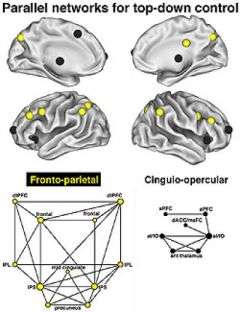
A probe of the upper echelons of the human brain's chain-of-command has found strong evidence that there are not one but two complementary commanders in charge of the brain, according to neuroscientists at Washington University School of Medicine in St. Louis.
It's as if Captains James T. Kirk and Jean-Luc Picard were both on the bridge and in command of the same starship Enterprise.
In reality, these two captains are networks of brain regions that do not consult each other but still work toward a common purpose — control of voluntary, goal-oriented behavior. This includes a vast range of activities from reading a word to searching for a star to singing a song, but likely does not include involuntary behaviors such as control of the pulse rate or digestion.
"This was a big surprise. We knew several brain regions contribute to top-down control, but most of us thought we'd eventually show all those regions linking together in one system, one little guy up top telling everyone else what to do," says senior author Steven Petersen, Ph.D., James S. McDonnell Professor of Cognitive Neuroscience and professor of neurology and psychology.
The findings, published online this week in the Proceedings of the National Academy of Sciences, may aid efforts to understand the effects of brain injury and develop new strategies to treat such injuries.
"For example, on rare occasions patients with brain injuries will develop behaviors that are stimulus-bound: Every time they encounter a particular stimulus, they respond exactly the same way," explains first author Nico Dosenbach, an M.D./Ph.D. student. "One man with a brain injury started undressing everytime he saw a bed, regardless of whether it was in a furniture store or his own bedroom. This research may help us understand what's happening to these patients."
The study is a follow-up to a 2006 paper by Dosenbach, Petersen and others. In the earlier experiments, researchers identified brain regions that were consistently active as volunteers prepared for a mental task. They suggested that the regions were creating task sets, plans for using the specialized talents of various brain regions to achieve a goal. The application of brainpower in customized ways is at the heart of the brain's formidable capabilities. It means that the brain can take a single stimulus (for example, seeing the printed word "dog" on a page) and do many different things with it (read it aloud, create a mental picture or produce a list of associated verbs).
Petersen's group eventually identified 39 brain regions that consistently became active before the brain goes to work on a task. They did this through functional magnetic resonance imaging (MRI) scans, which track blood oxygenation levels in various brain regions as volunteers complete mental tasks. Blood oxygenation increases to a particular brain region show that the region is contributing to a task.
For the new study, Dosenbach, Petersen and colleagues including graduate student Damien Fair and Bradley Schlaggar, M.D., Ph.D., used a different brain scanning technique called resting state functional connectivity MRI. For this technique, volunteers are asked to relax while their brains are scanned instead of working on a task. Researchers in the labs of coauthor Marcus Raichle, M.D., and elsewhere have shown that variations in MRI scan results occur even when volunteers are idle, and that these variations can be studied for useful insights into brain function and architecture.
To enhance their analysis, Dosenbach and Petersen turned to graph theory, a branch of mathematics that visually graphs relationships between pairs of objects. "A similar approach is used in the party game Six Degrees of Kevin Bacon," Petersen notes. "You use paired connections — appearances in the same movie, marital relationships — to go from one actor or actress to another until you've identified a chain of connections linking Kevin Bacon and another performer that wasn't immediately obvious."
Using an analytic technique originally developed by Raichle's group, scientists employed resting state functional connectivity MRI to identify pairs of brain regions where blood oxygen levels rose and fell roughly in synch with each other, implying the regions likely work together. They graphed the results, representing each brain region with a shape. They drew a line between paired brain regions if their blood oxygenation patterns correlated tightly enough. "You might expect that everything is connected to everything, and you would get sort of a big mess and not much information," Dosenbach says. "But that's not at all what we found. Even at low levels of correlation, there were two sides to these graphs. Brain regions on either side had multiple connections to other regions on their side, but they never connected to regions on the opposite side."
It's not unprecedented to have a stable system independently controlled by two or more masters. In fact, this is a common pattern known as a complex adaptive system. Scientists use an approach called network dynamics to study these systems in biology, ecology, economics, computer science, sociology and other disciplines.
As another example of a complex adaptive system, Petersen cites body temperature, which is regulated by several independent factors including sweat glands, metabolism and activity level. When one controlling factor goes awry, others can try to compensate for it.
Having established that two control networks existed, researchers turned back to their functional brain scans for insight into the networks' roles. One network, dubbed the cinguloopercular network, was linked to a "sustain" signal.
"When you start doing a task, this signal turns on," Petersen explains. "It stays constant while you're doing the task, and then when you're done it turns off."
In contrast, the frontoparietal network was consistently active at the start of mental tasks and during the correction of errors.
"This maps very nicely onto another idea that's common in network dynamics and adaptive systems," Dosenbach says. "This is the idea that the factors controlling adaptive systems often act on different time scales. We think the frontoparietal network may be the more online, rapid-adapting controller, while the cinguloopercular network is the more stable, set, in-the-background controller."
This doesn't mean the cinguloopercular network never calls for a change of course.
"It just does that on a slower time scale, to make sure you don't needlessly throw out all the work you've already done," Dosenbach says. "It's amazing: on the one hand, the brain can be very flexible and rapidly adapt to changing feedback, but it can also lock in on something and tune out distractions until the task is finished. And these two separate control systems that work toward the same goal without actually talking to each other likely help create this powerful flexibility."
To follow up, Petersen and colleagues are expanding their analysis to include more brain regions that contribute to control. They are also scanning for differences in these brain networks in volunteers from different age groups and patients with brain injuries or disabilities.
Source: Washington University


