Virtual Qumran Sheds New Light on Dead Sea Scrolls Discovery Site
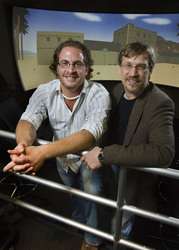
The mysterious archaeological ruins located paces from where the Dead Sea Scrolls were discovered 60 years ago served first as a fortress before being adopted by Jewish religious sect, two UCLA researchers contend.
"Qumran was established originally as a fortress, just as the archaeological evidence shows, and then it was abandoned," said Robert R. Cargill, a UCLA graduate student in Near Eastern Culture and Languages. "It was later resettled by the Essenes, an early Jewish religious community that came from Jerusalem, bringing with them the scrolls and continuing to copy and compose new scrolls."
Cargill and collaborator William M. Schniedewind, chair of the UCLA Department of Near Eastern Cultures and Languages, arrived at the conclusion while building the world's first three-dimensional computer model of the site, which has been the subject of debate since a Bedouin shepherd discovered the first scrolls in a cave above Qumran in 1947.
"Once you put all the archaeological evidence into three dimensions, the solution literally jumps out at you," said Schniedewind, the project's principle investigator.
The scholars hope their Qumran Visualization Project, slated to go on view June 29 at the San Diego Natural History Museum as part of the largest public exhibition of the scrolls ever mounted, will resolve the conflict surrounding the history and evolution of the West Bank site.
Generations of scholars have clashed over whether Qumran served exclusively as a monastery for the scholarly and pacifist Essenes; a fortress for the mighty Hasmoneans, whose victory against ancient Greek occupiers is celebrated during Hanukkah; or a rich Jerusalem family's villa that was later adapted by the Essenes as a Jewish communal compound.
With the judiciousness of Solomon, Cargill and Schniedewind cut the three competing theories down the middle, contending that none of them hold together without elements from the others.
"We felt it was of the utmost important to allow the archaeological remains to speak for themselves," said Schniedewind. "So we decided to follow the evidence in modeling the site, no matter where it would lead. In attempting to reconstruct many of the suggestions made by scholars over the years, we found that many were simply not possible architecturally. But when half of the elements were taken from each of the competing theories and added to each other, the most plausible — and buildable — explanation emerged."
Cargill and Schniedewind contend that the original 20,150-square-foot, two-story structure, which has a four-story tower and surrounds a 3,229-square-foot courtyard, could not have been built originally as the home of a sectarian religious community, as Roland de Vaux, a French Dominican priest who led the original excavation of the site, held. De Vaux maintained that the original occupants, who refer to themselves in the scrolls as the "Yahad," were the Essenes.
Central to de Vaux's theory is the existence of a communal dining hall, which was vividly described in the scrolls. While early excavations indeed discovered enough pottery to feed a religious community, the dining room was not part of the original structure, the UCLA researchers contend.
"Once we put the dining hall into the model, we realized it had to be an addition," Cargill said. "It only fits to the south of the original structure."
When the site served as a fortress, housing fewer people than the Jewish religious settlement, residents would have eaten elsewhere, possibly in a central courtyard where ovens have been excavated, the UCLA team contends.
Similarly, 1,120-square-foot, two-story scriptorium — or large work room for producing scrolls — has long been thought to be central to the religious community, but the position of the room and thickness of the walls are more consistent with an addition than an original feature of the structure, the UCLA team found.
But if Qumran does not appear to have been originally designed for communal life, its evolution is not consistent with use exclusively as a fortress either, say the UCLA researchers. In an influential 1996 article about Qumran, University of Chicago professor Norman Golb argued that the site, occupied from about 163 B.C. to A.D. 73, was always a fortress.
While original features of the structure, such as a defensive four-story tower on one side and protective precipices on two opposing sides, would be expected of a fortress, the array of outbuildings and additions reflect a more pastoral, contemplative life, the UCLA team found. For instance, the researchers have been able to bring to life a vast water system that flowed through the site, filling 10 ritual baths, separating clay for pottery production, and sustaining residents, livestock and crops. Moreover, only a low wall appears to have protected agricultural portions of the compound's northwest side —not the heavy fortification that would be expected of a fortress.
"The Qumran model shows that the nature of the expanded areas, specifically those in the northwest annex and within an inner courtyard, was of a communal, non-military nature," said Schniedewind, who participated in an archaeological dig at Qumran over a decade ago.
Cargill and Schniedewind credit French archaeologist Jean-Baptiste Humbert with first suggesting the hybrid approach that inspires their own "synthetic" theory. Humbert contended in a 2002 book that Qumran was first built as a home, possibly a vacation home, for a wealthy Jerusalem family before being abandoned and reoccupied in the late first century B.C. Like Cargill and Schniedewind, Humbert has contended that the site's eventual occupants were the Essenes.
"This interpretation was a crucial step in the right direction," Cargill said. "But the shared rooms — the dining room, the scriptorium, the pottery works — appear to have been built for a community of people. This isn't just for one wealthy family out in the desert. This is an entire community center [whose residents] sustained themselves making pottery and may have even fed themselves from their own crops."
Like many scholars before them, Cargill and Schniedewind believe the Essenes, who practiced communal ownership, brought all of their possessions to the site, including about 70 percent of the scrolls discovered in the area. They believe that the Essenes are the Yahad group described in the remaining 30 percent of the recovered scrolls, and that they are the authors of those texts, composed at Qumran, which describe communal life in the Judean desert. The UCLA team theorizes that the Essenes may have anticipated an attack from Roman soldiers when they packed the scrolls in earthenware jars and hid them in caves in the hills above Qumran.
The Qumran Visualization Project will be on view at the San Diego Natural History Museum through January 2008 as part of "Dead Sea Scrolls," the largest, longest and most comprehensive exhibit of its kind in any country. In all, 27 scrolls will be on view, 10 of which have never been publicly displayed. To this day, the Dead Sea Scrolls contain the oldest known manuscript of the Old Testament ever found.
The computer model was built over the course of 15 months using MultiGen Creator, a powerful modeling tool known for producing fully interactive real-time models. Photographs of wood grains, plasters and soil at Qumran and other similar sites throughout the Middle East provide the model's texture. The model includes virtual recreations of oil lights, ink wells, pottery and other actual artifacts discovered throughout Qumran.
A series of high-resolution panoramic photographs of the sky, the cliffs to the west of the site, the Dead Sea and the plains of Jordan to the east were grafted together in Photoshop to illustrate Qumran's surroundings. The project's architects eventually plan to replace the panoramic photography with satellite imagery, which will allow them to virtually simulate the surrounding topography and terrain. Plans also call for virtual models of the caves where the scrolls were found.
Source: UCLA


