Climate models consistent with ocean warming observations
June 19, 2007
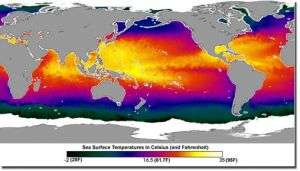
This is an image of global sea surface temperatures taken from Japan National Space Development Agency's (NASDA) AMSR-E instrument aboard NASA's Aqua spacecraft on August 27, 2003. The colors in this false-color map represent temperatures of the ocean's surface waters, ranging from a low of -2C (28F) in the darkest green areas to a high of 35C (95F) in the brightest yellow-white regions. Sea ice is shown as white and land is dark gray. Courtesy NASDA/NASA
Climate models are reliable tools that help researchers better understand the observed record of ocean warming and variability.
That’s the finding of a group of Livermore scientists, who in collaboration with colleagues at Scripps Institution of Oceanography, had earlier established that climate models can replicate the ocean warming observed during the latter half of the 20th century, and that most of this recent warming is caused by human activities.
The observational record also shows substantial variability in ocean heat content on interannual-to-decadal time scales. The new research by Livermore scientists demonstrates that climate models represent this variability much more realistically than previously believed.
Using 13 numerical climate models, the researchers found that the apparent discrepancies between modeled and observed variability can be explained by accounting for changes in observational coverage and instrumentation and by including the effects of volcanic eruptions.
The research, which will appear in the June 18 early online edition of the journal Proceedings of the National Academy of Sciences, casts doubt on recent findings that the top 700-meters of the global ocean cooled markedly from 2003-2005.
“Our analysis shows that the 2003-2005 ‘cooling’ is largely an artifact of a systematic change in the observing system,” said Krishna AchutaRao, previously of Livermore’s Program for Climate Model Diagnosis and Intercomparison (PCMDI), now at the Indian Institute of Technology Delhi and the lead author of the paper. “The previous research was based on looking at the combined ocean temperature observations from several different instrument types, which collectively appear to have a cooling effect. But if you look at the observational instruments individually, there is no cooling.”
Observational estimates of ocean heat content change in the 2005 World Ocean Atlas are based on millions of individual temperature measurements; however, they are unevenly distributed in space and time. In fact, until recently, many portions of the global ocean were very poorly sampled. To get a complete four-dimensional picture of global ocean temperatures, most researchers use statistical methods to “infill” missing observational data.
Climate models provide spatially complete ocean temperature data, so unlike the incomplete observations, infilling is not required. By sampling the models only where there are observations, the Livermore team found that infilling had a pronounced effect on observed estimates of ocean variability, and brought model results closer in line with observations. Models agreed even more closely with observations when the cooling effects of intermittent volcanic eruptions were included.
The research team also looked at the impacts of changes in ocean observing systems. A warm bias in the older instruments was recently discovered by researchers in Germany. With the introduction of new instruments called Argo floats, more complete and more reliable ocean temperature measurements have become possible. The first Argo floats were deployed in the Atlantic in 2000 and their network has rapidly ramped up to several thousand floats with near-global coverage of the world’s oceans.
“This transition from a measuring system biased warm to a more realistic one appears as a cooling. Obviously, models can’t account for spurious variability caused by instrument changes,” AchutaRao said.
Other Livermore authors include Benjamin Santer, Peter Gleckler and Karl Taylor. The Japan Agency for Marine-Earth Science and Technology, the National Oceanic and Atmospheric Administration and the National Center for Atmospheric Research also contributed to this report.
Source: Lawrence Livermore National Laboratory
-
Deconstructing a mystery: What caused Snowmaggedon?
Feb 09, 2012 |
3.8 / 5 (4) |
1
-
New study shows correlation between summer Arctic sea ice cover and winter weather in Central Europe
Feb 01, 2012 |
4.8 / 5 (5) |
0
-
Earth's energy budget remained out of balance despite unusually low solar activity
Jan 30, 2012 |
4 / 5 (12) |
26
-
Astronomers solve mystery of vanishing energetic electrons in Earth's outer radiation belt
Jan 29, 2012 |
4.5 / 5 (11) |
14
-
The proof is in the clouds
Jan 26, 2012 |
not rated yet |
0
-
Engineers build first sub-10-nm carbon nanotube transistor
Feb 01, 2012 |
4.9 / 5 (31) |
30
-
Something old, something new: Evolution and the structural divergence of duplicate genes
Jan 31, 2012 |
4.6 / 5 (7) |
1
-
The hidden nanoworld of ice crystals: Revealing the dynamic behavior of quasi-liquid layers
Jan 30, 2012 |
5 / 5 (3) |
1
-
Stock market network reveals investor clustering
Jan 27, 2012 |
3.9 / 5 (23) |
8
-
Of microchemistry and molecules: Electronic microfluidic device synthesizes biocompatible probes
Jan 26, 2012 |
5 / 5 (1) |
0
-
Do some geologists actually act a lot like Randy Marsh?
Feb 11, 2012
-
Discrepancy between oxygen and carbon-dioxide levels
Feb 09, 2012
-
where gems are found in the world
Feb 09, 2012
-
Wind Waves in Reservoir ~ Wind run-up and Wind set-up
Feb 08, 2012
-
Balance of oxygen in the atmosphere
Feb 01, 2012
-
The case for a methanol-based economy
Jan 30, 2012
- More from Physics Forums - Earth
More news stories
Latin America mining boom clashes with conservation
Latin America is experiencing a mining boom as prices rise fuelled by a hike in global demand, but the region is also being hit by a wave of violent protests, strikes and rallies by environmentalists.
6 hours ago |
not rated yet |
0
Political leaders play key role in how worried Americans are by climate change: study
More than extreme weather events and the work of scientists, it is national political leaders who influence how much Americans worry about the threat of climate change, new research finds.
Feb 06, 2012 |
5 / 5 (6) |
72
NASA budget will axe Mars deal with Europe: scientists
US President Barack Obama's budget proposal to be submitted next week for 2013 will cut NASA's budget by 20 percent and eliminate a major partnership with Europe on Mars exploration, scientists said Thursday.
Space & Earth / Space Exploration
Feb 10, 2012 |
5 / 5 (3) |
55
Humans may have helped the decline of African rainforests 3000 years ago
(PhysOrg.com) -- Large areas of rainforests in Central Africa mysteriously disappeared over three thousand years ago, to be replaced by savannas. The prevailing theory has been that the cause was a change ...
Study shows global glaciers, ice caps, shedding billions of tons of mass annually
Earth's glaciers and ice caps outside of the regions of Greenland and Antarctica are shedding roughly 150 billion tons of ice annually, according to a new study led by the University of Colorado Boulder.
Space & Earth / Earth Sciences
Feb 08, 2012 |
4.4 / 5 (9) |
14
|
Google might launch Drive for cloud storage soon
(PhysOrg.com) -- Google's next big move, according to the Wall Street Journal, is a cloud storage service called Drive. Hardly first to the plate, Google is simply catching up to introducing its cloud reposi ...
Love a click away in Indonesia's Twitter Republic
He was a geeky kid from Yogyakarta, she a glamorous city girl in Jakarta. In a country with one of the world's most vibrant social networking scenes they fell in love on Twitter.
Europeans protest controversial Internet pact
Tens of thousands of people marched in protests in more than a dozen European cities Saturday against a controversial anti-online piracy pact that critics say could curtail Internet freedom.
Walney offshore wind farm is world's biggest (for now)
(PhysOrg.com) -- The Walney wind farm on the Irish Sea--characterized by high tides, waves and windy weather--officially opened this week. The farm is treated in the press as a very big deal as the Walney ...
Navy to begin tests on electromagnetic railgun prototype launcher
The Office of Naval Research (ONR)'s Electromagnetic (EM) Railgun program will take an important step forward in the coming weeks when the first industry railgun prototype launcher is tested at a facility ...
Explained: Sigma
It's a question that arises with virtually every major new finding in science or medicine: What makes a result reliable enough to be taken seriously? The answer has to do with statistical significance -- but ...