New View of Doomed Star
June 20th, 2007 New View of Doomed Star

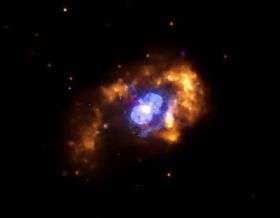
The composite image of the Eta Carinae from NASA's Chandra X-ray Observatory and Hubble Space Telescope shows the remnants of a massive eruption from the star during the 1840s. The X-ray data (yellow) show where material from that explosion has collided with nearby gas and dust. The optical data (blue) reveals material ejected from the star has formed a bipolar structure. Chandra detects a faint X-ray reflection off the inner optical nebula due to the collision of stellar winds between Eta Carinae and a suspected companion star. Credit: X-ray: NASA/CXC/GSFC/M. Corocoran et al. Optical: NASA/STScI

Eta Carinae is a mysterious, extremely bright and unstable star located a mere stone's throw - astronomically speaking - from Earth at a distance of only about 7500 light years. The star is thought to be consuming its nuclear fuel at an incredible rate, while quickly drawing closer to its ultimate explosive demise.

When Eta Carinae does explode, it will be a spectacular fireworks display seen from Earth, perhaps rivaling the moon in brilliance. Its fate has been foreshadowed by the recent discovery of SN2006gy, a supernova in a nearby galaxy that was the brightest stellar explosion ever seen. The erratic behavior of the star that later exploded as SN2006gy suggests that Eta Carinae may explode at any time.

Eta Carinae, a star between 100 and 150 more massive than the Sun, is near a point of unstable equilibrium where the star's gravity is almost balanced by the outward pressure of the intense radiation generated in the nuclear furnace. This means that slight perturbations of the star might cause enormous ejections of matter from its surface. In the 1840s, Eta Carinae had a massive eruption by ejecting more than 10 times the mass of the sun, to briefly become the second brightest star in the sky. This explosion would have torn most other stars to pieces but somehow Eta Carinae survived.

The latest composite image shows the remnants of that titanic event with new data from NASA’s Chandra X-ray Observatory and the Hubble Space Telescope. The blue regions show the cool optical emission, detected by Hubble, from the dust and gas thrown off the star. This debris forms a bipolar shell around the star, which lies near the brightest point of the optical emission. This bipolar shell is itself surrounded by a ragged cloud of fainter material. An unusual jet points from the star to the upper left.

Chandra’s data, depicted in orange and yellow, shows the X-ray emission produced as material thrown off Eta Carinae rams into nearby gas and dust, heating gas to temperatures in excess of a million degrees. This hot shroud extends far beyond the cooler, optical nebula and represents the outer edge of the interaction region. The X-ray observations show that the ejected outer material is enriched by complex atoms, especially nitrogen, cooked inside the star's nuclear furnace and dredged up onto the stellar surface.

The Chandra observations also show that the inner optical nebula glows faintly due to X-ray reflection. The X-rays reflected by the optical nebula come from very close to the star itself; these X-rays are generated by the high-speed collision of wind flowing from Eta Carinae's surface (moving at about 1 million miles per hour) with the wind of the companion star (which is about five times faster).

The companion is not directly visible in these images, but variability in X-rays in the regions close to the star signals the star's presence. Astronomers don't know exactly what role the companion has played in the evolution of Eta Carinae, or what role it will play in its future.

Source: Chandra X-ray Center


print this article email this article download pdf blog this article bookmark this article     Digg this Stumble it share on Facebook share on Reddit add to delicious save to Yahoo! bookmarks
4.5/5 after 86 votes


June 20th, 2007 all stories
Space & Earth / Astronomy

Comments: 0
Rank: 4.5/5 after 86 votes

  • Stumble this up

  • Digg this

  • Share it:
  • share on Facebook
  • share on MySpace
  • share on Slashdot
  • rss-newsfeed
  • share on Google
  • share on Reddit
  • add to delicious
  • save to Yahoo! bookmarks
  • share on Windows Live
  • Add to Mixx!
Rating: 4.5/5 after 86 votes

  • Related Stories

  • Strong winds over the keel
    created Feb 12, 2009 | popularity not rated yet | comments 0
  • Hubble captures outstanding views of mammoth stars
    created Nov 25, 2008 | popularity not rated yet | comments 0
  • Hubble's Celestial Landscape
    created Oct 02, 2008 | popularity not rated yet | comments 0
  • 1843 stellar eruption may be new type of star explosion
    created Sep 10, 2008 | popularity not rated yet | comments 0
  • The little man and the cosmic cauldron
    created May 27, 2008 | popularity not rated yet | comments 0

Tags


  • Physicists Demonstrate Quantum Memory with Matter Qubits
    Physicists Demonstrate Quantum Memory with Matter Qubits
    Physics / General Physics
    created Jul 03, 2009 | popularity 4.4 / 5 (16) | comments 1
  • 'Holey' Nanosheets for Wastewater Dye Removal
    Nanotechnology / Nanomaterials
    created Jul 01, 2009 | popularity 5 / 5 (5) | comments 1
  • Jellyfish Robot Swims Like its Biological Counterpart
    Jellyfish Robot Swims Like its Biological Counterpart
    Electronics / Robotics
    created Jun 26, 2009 | popularity 4.4 / 5 (8) | comments 1
  • Could Maxwell's Demon Exist in Nanoscale Systems?
    Could Maxwell's Demon Exist in Nanoscale Systems?
    Physics / General Physics
    created Jun 24, 2009 | popularity 4.4 / 5 (18) | comments 29
  • Living Safely with Robots, Beyond Asimov's Laws
    Living Safely with Robots, Beyond Asimov's Laws
    Electronics / Robotics
    created Jun 22, 2009 | popularity 4.6 / 5 (52) | comments 40
  • Other News

    Forty years ago man first walked on the moon

    Space & Earth / Space Exploration

    created 5 hours ago | popularity 5 / 5 (2) | comments 0

    Forty years ago on July 20, 1969, American astronaut Neil Armstrong realized the oldest dream of human civilizations when he became the first man to walk on the moon.


    The least sea ice in 800 years

    The least sea ice in 800 years

    Space & Earth / Earth Sciences

    created Jul 01, 2009 | popularity 4.3 / 5 (59) | comments 52

    New research, which reconstructs the extent of ice in the sea between Greenland and Svalbard from the 13th century to the present indicates that there has never been so little sea ice as there is now. The ...


    Gas around young galaxy

    Intense heat killed the Universe's would-be galaxies, researchers say

    Space & Earth / Astronomy

    created Jul 01, 2009 | popularity 3.2 / 5 (19) | comments 25

    (PhysOrg.com) -- Our Milky Way galaxy only survived because it was already immersed in a large clump of dark matter which trapped gases inside it, scientists led by Durham University's Institute for Computational ...


    Scientists' Drill Hits Magma: Only Third Time on Record

    Scientists' Drill Hits Magma: Only Third Time on Record

    Space & Earth / Earth Sciences

    created Jun 29, 2009 | popularity 4.7 / 5 (20) | comments 19

    (PhysOrg.com) -- Scientists drilling a borehole deep into Iceland’s rocky crust to explore new methods of using geothermal energy hit a major roadblock on Thursday: Their drill ran into molten rock at a depth ...


    NASA manager pitches a cheaper return-to-moon plan

    Space & Earth / Space Exploration

    created Jun 30, 2009 | popularity 4 / 5 (7) | comments 18

    (AP) -- Like a car salesman pushing a luxury vehicle that the customer no longer can afford, NASA has pulled out of its back pocket a deal for a cheaper ride to the moon.