Brain's inertial navigation system pinpointed
June 20, 2007 Modern human brain

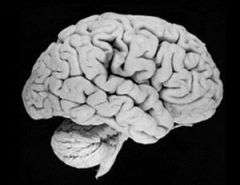
Modern human brain. Image source: Univ. of Wisconsin-Madison Brain Collection.

Researchers have discovered a sophisticated neural computer, buried deep in the cerebellum, that performs inertial navigation calculations to figure out a person’s movement through space.

These calculations are no mean feat, emphasized the researchers. The vestibular system in the inner ear provides the primary source of input to the brain about the body’s movement and orientation in space. However, the vestibular sensors in the inner ear yield information about head position only. Also, the vestibular system’s detection of head acceleration cannot distinguish between the effect of movement and that of gravitational force.

Dora Angelaki and colleagues published their findings in the June 21, 2007 issue of the journal Neuron, published by Cell Press.

Angelaki and colleagues based their brain studies on the predictions of a theoretical mathematical model postulating that the brain could compute inertial motion by combining rotational signals from the semicircular canal in the inner ear with gravity signals. They concentrated their search for the brain’s inertial navigation system on particular types of neurons, called Purkinje cells, in a region of the cerebellum known to receive signals from the vestibular system. This region is known as the posterior cerebellar vermis, a narrow, worm-like structure between the brain’s hemispheres.

In their experiments, the researchers measured the electrical activity of these Purkinje cells in monkeys as the animals’ heads were maneuvered through a precise series of rotations and accelerations. After analyzing the electrical signals measured from the Purkinje cells during these movements, the researchers concluded that the specialized Purkinje cells were, indeed, computing earth-referenced motion from head-centered vestibular information.

The researchers concluded that the output of the Purkinje cells indicates an “elegant solution” to the computational problems involved in inertial navigation.

Source: Cell Press


print this article email this article download pdf blog this article bookmark this article     Stumble it Digg this share on Facebook retweet share on Reddit add to delicious
Rate this story - 4.6 /5 (25 votes)


June 20, 2007 all stories

Comments: 0

4.6 /5 (25 votes)
  • Stumble this up

  • Digg this

  • share this

  • hide
  • Related Stories

  • Scientists shed new light on cause of inherited movement disorder
    created Jul 22, 2009 | popularity not rated yet | comments 0
  • New nucleotide could revolutionize epigenetics
    created Apr 16, 2009 | popularity not rated yet | comments 0
  • Workhorse immune molecules lead secret lives in the brain
    created Mar 30, 2009 | popularity not rated yet | comments 0
  • Cancer cells with a long breath: seeking the origin of brain tumors in children
    created Aug 12, 2008 | popularity not rated yet | comments 0
  • Ronin an alternate control for embryonic stem cells
    created Jun 26, 2008 | popularity not rated yet | comments 0


  • hide
  • Relevant PhysicsForums posts

  • nesfatin
    created 16 hours ago
  • Obsessive Compulsive Disorder
    created Nov 20, 2009
  • West's zone 2 starling resistor respiratory physiology
    created Nov 18, 2009
  • 50-0-50 rule
    created Nov 18, 2009
  • More from Physics Forums - Medical Sciences

Other News

Mammogram guidelines spark debate over health bill

Medicine & Health / Health

created 11 minutes ago | popularity not rated yet | comments 0

(AP) -- Lawmakers broke along party lines on a new aspect of the health care debate Sunday as a former National Institutes of Health chief urged women to ignore guidelines that delay the start of breast cancer screenings.


New research shows versatility of amniotic fluid stem cells

Medicine & Health / Research

created 1hour ago | popularity 5 / 5 (1) | comments 0

For the first time, scientists have demonstrated that stem cells found in amniotic fluid meet an important test of potential to become specialized cell types, which suggests they may be useful for treating a wider array of ...


Study: kids watching hours of TV at home daycare

Medicine & Health / Health

created 1hour ago | popularity not rated yet | comments 0

In a new study, the amount of television viewed by many young children in child care settings doubles the previous estimates of early childhood screen time, with those in home-based settings watching significantly more on ...


Researchers track down protein responsible for chronic rhinosinusitis with polyps

Medicine & Health / Diseases

created 1hour ago | popularity not rated yet | comments 0

A protein known to stimulate blood vessel growth has now been found to be responsible for the cell overgrowth in the development of polyps that characterize one of the most severe forms of sinusitis, a study by Johns Hopkins ...


Exposure to lead, tobacco smoke raises risk of ADHD

Medicine & Health / Health

created 2 hours ago | popularity not rated yet | comments 0

Children exposed prenatally to tobacco smoke and during childhood to lead face a particularly high risk for ADHD, according to research done at Cincinnati Children's Hospital Medical Center.