Hubble Images of Asteroids Help Astronomers Prepare for Spacecraft Visit
June 20th, 2007 Hubble Images of Asteroids Help Astronomers Prepare for Spacecraft Visit

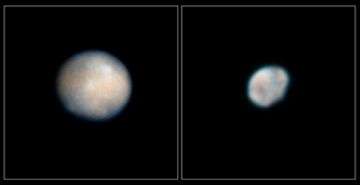
These Hubble Space Telescope images of Vesta and Ceres show two of the most massive asteroids in the asteroid belt, a region between Mars and Jupiter. The images are helping astronomers plan for the Dawn spacecraft's tour of these hefty asteroids. Credits for Vesta: NASA; ESA; L. McFadden and J.Y. Li (University of Maryland, College Park); M. Mutchler and Z. Levay (Space Telescope Science Institute, Baltimore); P. Thomas (Cornell University); J. Parker and E.F. Young (Southwest Research Institute); and C.T. Russell and B. Schmidt (University of California, Los Angeles) Credits for Ceres: NASA; ESA; J. Parker (Southwest Research Institute); P. Thomas (Cornell University); L. McFadden (University of Maryland, College Park); and M. Mutchler and Z. Levay (Space Telescope Science Institute)

Telescope images of Vesta and Ceres show two of the most massive asteroids in the asteroid belt, a region between Mars and Jupiter. The images are helping astronomers plan for the Dawn spacecraft's tour of these hefty asteroids.

On July 7, NASA is scheduled to launch the spacecraft on a four-year journey to the asteroid belt. Once there, Dawn will do some asteroid-hopping, going into orbit around Vesta in 2011 and Ceres in 2015. Dawn will be the first spacecraft to orbit two targets. At least 100,000 asteroids inhabit the asteroid belt, a reservoir of leftover material from the formation of our solar-system planets 4.6 billion years ago.

Dawn also will be the first satellite to tour a dwarf planet. The International Astronomical Union named Ceres one of three dwarf planets in 2006. Ceres is round like planets in our solar system, but it does not clear debris out of its orbit as our planets do.

To prepare for the Dawn spacecraft's visit to Vesta, astronomers used Hubble's Wide Field Planetary Camera 2 to snap new images of the asteroid. The image at right was taken on May 14 and 16, 2007. Using Hubble, astronomers mapped Vesta's southern hemisphere, a region dominated by a giant impact crater formed by a collision billions of years ago. The crater is 285 miles (456 kilometers) across, which is nearly equal to Vesta's 330-mile (530-kilometer) diameter. If Earth had a crater of proportional size, it would fill the Pacific Ocean basin. The impact broke off chunks of rock, producing more than 50 smaller asteroids that astronomers have nicknamed "vestoids." The collision also may have blasted through Vesta's crust. Vesta is about the size of Arizona.

Previous Hubble images of Vesta's southern hemisphere were taken in 1994 and 1996 with the wide-field camera. In this new set of images, Hubble's sharp "eye" can see features as small as about 37 miles (60 kilometers) across. The image shows the difference in brightness and color on the asteroid's surface. These characteristics hint at the large-scale features that the Dawn spacecraft will see when it arrives at Vesta.

Hubble's view reveals extensive global features stretching longitudinally from the northern hemisphere to the southern hemisphere. The image also shows widespread differences in brightness in the east and west, which probably reflects compositional changes. Both of these characteristics could reveal volcanic activity throughout Vesta. The size of these different regions varies. Some are hundreds of miles across.

The brightness differences could be similar to the effect seen on the Moon, where smooth, dark regions are more iron-rich than the brighter highlands that contain minerals richer in calcium and aluminum. When Vesta was forming 4.5 billion years ago, it was heated to the melting temperatures of rock. This heating allowed heavier material to sink to Vesta's center and lighter minerals to rise to the surface.

Astronomers combined images of Vesta in two colors to study the variations in iron-bearing minerals. From these minerals, they hope to learn more about Vesta's surface structure and composition. Astronomers expect that Dawn will provide rich details about the asteroid's surface and interior structure.

The Hubble image of Ceres on the left reveals bright and dark regions on the asteroid's surface that could be topographic features, such as craters, and/or areas containing different surface material. Large impacts may have caused some of these features and potentially added new material to the landscape. The Texas-sized asteroid holds about 30 to 40 percent of the mass in the asteroid belt.

Ceres' round shape suggests that its interior is layered like those of terrestrial planets such as Earth. The asteroid may have a rocky inner core, an icy mantle, and a thin, dusty outer crust. The asteroid may even have water locked beneath its surface. It is approximately 590 miles (950 kilometers) across and was the first asteroid discovered in 1801.

The observations were made in visible and ultraviolet light between December 2003 and January 2004 with the Advanced Camera for Surveys. The color variations in the image show either a difference in texture or composition on Ceres' surface. Astronomers need the close-up views of the Dawn spacecraft to determine the characteristics of these regional differences.

Source: Space Telescope Science Institute


print this article email this article download pdf blog this article bookmark this article     Digg this Stumble it share on Facebook share on Reddit add to delicious save to Yahoo! bookmarks
3.5/5 after 4 votes


June 20th, 2007 all stories
Space & Earth / Astronomy

Comments: 0
Rank: 3.5/5 after 4 votes

  • Stumble this up

  • Digg this

  • Share it:
  • share on Facebook
  • share on MySpace
  • share on Slashdot
  • rss-newsfeed
  • share on Google
  • share on Reddit
  • add to delicious
  • save to Yahoo! bookmarks
  • share on Windows Live
  • Add to Mixx!
Rating: 3.5/5 after 4 votes

  • Related Stories

  • Dawn Finishes Mars Phase
    created Feb 27, 2009 | popularity not rated yet | comments 0
  • NASA Spacecraft Falling For Mars
    created Feb 13, 2009 | popularity not rated yet | comments 0
  • Dawn Glides Into New Year
    created Nov 21, 2008 | popularity not rated yet | comments 0
  • Dawn Mission Status: Spacecraft Tests Ion Engine
    created Oct 10, 2007 | popularity not rated yet | comments 0
  • Dawn Spacecraft Lifts Off
    created Sep 27, 2007 | popularity not rated yet | comments 0

Tags


  • Physicists Demonstrate Quantum Memory with Matter Qubits
    Physicists Demonstrate Quantum Memory with Matter Qubits
    Physics / General Physics
    created Jul 03, 2009 | popularity 4.4 / 5 (17) | comments 1
  • 'Holey' Nanosheets for Wastewater Dye Removal
    Nanotechnology / Nanomaterials
    created Jul 01, 2009 | popularity 5 / 5 (5) | comments 1
  • Jellyfish Robot Swims Like its Biological Counterpart
    Jellyfish Robot Swims Like its Biological Counterpart
    Electronics / Robotics
    created Jun 26, 2009 | popularity 4.4 / 5 (8) | comments 1
  • Could Maxwell's Demon Exist in Nanoscale Systems?
    Could Maxwell's Demon Exist in Nanoscale Systems?
    Physics / General Physics
    created Jun 24, 2009 | popularity 4.4 / 5 (18) | comments 29
  • Living Safely with Robots, Beyond Asimov's Laws
    Living Safely with Robots, Beyond Asimov's Laws
    Electronics / Robotics
    created Jun 22, 2009 | popularity 4.6 / 5 (52) | comments 40
  • Other News

    Forty years ago man first walked on the moon

    Space & Earth / Space Exploration

    created 18 hours ago | popularity 4.3 / 5 (4) | comments 2

    Forty years ago on July 20, 1969, American astronaut Neil Armstrong realized the oldest dream of human civilizations when he became the first man to walk on the moon.


    The least sea ice in 800 years

    The least sea ice in 800 years

    Space & Earth / Earth Sciences

    created Jul 01, 2009 | popularity 4.2 / 5 (62) | comments 59

    New research, which reconstructs the extent of ice in the sea between Greenland and Svalbard from the 13th century to the present indicates that there has never been so little sea ice as there is now. The ...


    Gas around young galaxy

    Intense heat killed the Universe's would-be galaxies, researchers say

    Space & Earth / Astronomy

    created Jul 01, 2009 | popularity 3.4 / 5 (21) | comments 27

    (PhysOrg.com) -- Our Milky Way galaxy only survived because it was already immersed in a large clump of dark matter which trapped gases inside it, scientists led by Durham University's Institute for Computational ...


    Scientists' Drill Hits Magma: Only Third Time on Record

    Scientists' Drill Hits Magma: Only Third Time on Record

    Space & Earth / Earth Sciences

    created Jun 29, 2009 | popularity 4.7 / 5 (22) | comments 19

    (PhysOrg.com) -- Scientists drilling a borehole deep into Iceland’s rocky crust to explore new methods of using geothermal energy hit a major roadblock on Thursday: Their drill ran into molten rock at a depth ...


    NASA manager pitches a cheaper return-to-moon plan

    Space & Earth / Space Exploration

    created Jun 30, 2009 | popularity 4.1 / 5 (8) | comments 18

    (AP) -- Like a car salesman pushing a luxury vehicle that the customer no longer can afford, NASA has pulled out of its back pocket a deal for a cheaper ride to the moon.