The smallest piece of ice reveals its true nature
June 21, 2007
The Smallest Particle of Ice

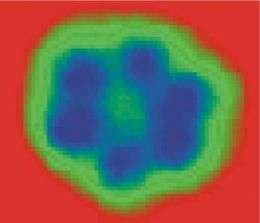
The "smallest particle of ice" -- a water hexamer as seen by STM (about 1 nanometer wide, left) and quantum mechanics (right). Credit: London Centre for Nanotechnology, 2007

Collaborative research between scientists in the UK and Germany (published in this week’s Nature Materials) has led to a breakthrough in the understanding of the formation of ice.

Dr Angelos Michaelides of the London Centre for Nanotechnology (formerly of the Fritz-Haber Institut der Max-Planck Gesellschaft in Berlin) and Professor Karina Morgenstern of the Leibniz University Hannover have combined experimental observations with theoretical modelling to reveal with unprecedented resolution the structures of the smallest pieces of ice that form on hydrophobic metal surfaces.

The results provide information about the process of ice nucleation at a molecular level and take science a significant step closer to understanding the mysterious process through which ice forms around microscopic dust particles in the upper atmosphere. Because this is the basis of cloud formation, knowing how different particles promote ice formation is crucial for climate change models.

The authors began by cooling down a metallic surface to 5 degrees above absolute zero (around –268 Celsius) at which temperature it was possible to “trap” and obtain images of the smallest possible pieces (hexamers) of ice using a scanning tunnelling microscope (STM). The hexamer – the simplest and most basic “snow flake” – is composed of just six water molecules. Other ice nanoclusters containing seven, eight and nine molecules were also imaged.

On the difficulties of imaging these ice clusters, Prof Morgenstern said: “Scientists have long struggled to resolve single water molecules within ice clusters, because they are so vulnerable to damage induced by electrons – the very thing that creates the image. The high resolution could only be achieved by reducing the current to the smallest value technically possible.”

As well as performing experiments, the team used highly-accurate (‘first principles’) theoretical models to analyse how such a structure could form. Here the theory provided some surprising insights. In ice, water molecules usually bond to each other with equal strength but with the ice nanoclusters the team identified a pattern of alternating shorter and longer bonds between the water molecules. This pattern provided new information about the ability of water molecules to share their hydrogen bonds, revealing a hitherto unknown competition between the ability of water molecules to bind to a metal surface and simultaneously accept hydrogen bonds.

Dr Michaelides said, “We are all familiar with the freezing of water. It features prominently in our daily lives, from fridge freezers to winter snow. Despite all this, the question of how individual water molecules come together and give birth to ice crystals remains mysterious. Our research provides an insight into the most important and ubiquitous type of ice nucleation event, namely heterogeneous nucleation. State-of-the-art experimental and theoretical techniques allowed us to “watch” and accurately model what happens at very low temperatures.”

The research makes it possible to explain the ways in which water structures form on different substrates, such as transition metals and salt surfaces. It may also provide a new way of thinking about the structure of ice clusters that form on solid surfaces in general, opening the door for applications in a variety of fields as diverse as astronomy, electrochemistry, and energy research. It also takes us a step closer to understanding how water interacts with different aerosols and dust particles in the atmosphere, processes which drive cloud formation and have a large impact on the planet’s climate.

Source: University College London

4.4 /5 (36 votes)  

Rank 4.4 /5 (36 votes)
Tags

Relevant PhysicsForums posts
  • Doubts about surface plasmons
    createdFeb 11, 2012
  • excited U-236 decay time in the U235 fission chain
    createdFeb 09, 2012
  • Polar catastrophe?
    createdFeb 09, 2012
  • Large scale field sonication
    createdFeb 09, 2012
  • states and energy of paired electrons in BCS
    createdFeb 08, 2012
  • difference between longitudinal and transverse refractive indices
    createdFeb 08, 2012
  • More from Physics Forums - Atomic, Solid State, Comp. Physics

More news stories

Explained: Sigma

It's a question that arises with virtually every major new finding in science or medicine: What makes a result reliable enough to be taken seriously? The answer has to do with statistical significance -- but ...

Physics / General Physics

created Feb 09, 2012 | popularity 5 / 5 (19) | comments 66

Quantum physicist explains $100K offer for proof scaled-up quantum computing is impossible

(PhysOrg.com) -- MIT researcher Scott Aaronson has certainly riled the physics community with his offer this past Friday, of $100,000 to anyone who can prove that scaled-up quantum computing is impossible. ...

Physics / Quantum Physics

created Feb 08, 2012 | popularity 4.2 / 5 (13) | comments 35 | with audio podcast weblog

Diamond light, brighter than the sun

It’s the size of five football pitches and generates light 10 billion times brighter than the sun. As the Diamond Light Source celebrates its tenth anniversary this year, Penny Bailey visits one of the ...

Physics / General Physics

created Feb 07, 2012 | popularity 4.3 / 5 (7) | comments 18 | with audio podcast

Physicists 'record' magnetic breakthrough

An international team of scientists has demonstrated a revolutionary new way of magnetic recording which will allow information to be processed hundreds of times faster than by current hard drive technology.

Physics / General Physics

created Feb 07, 2012 | popularity 4.5 / 5 (41) | comments 14 | with audio podcast

Hints of the Higgs - papers are submitted

Back in December 2011, the ATLAS and CMS experiments at CERN presented some exciting results that provided tantalising hints of the Higgs boson.

Physics / General Physics

created Feb 08, 2012 | popularity 4.1 / 5 (7) | comments 10


Google might launch Drive for cloud storage soon

(PhysOrg.com) -- Google's next big move, according to the Wall Street Journal, is a cloud storage service called Drive. Hardly first to the plate, Google is simply catching up to introducing its cloud reposi ...

Latin America mining boom clashes with conservation

Latin America is experiencing a mining boom as prices rise fuelled by a hike in global demand, but the region is also being hit by a wave of violent protests, strikes and rallies by environmentalists.

Love a click away in Indonesia's Twitter Republic

He was a geeky kid from Yogyakarta, she a glamorous city girl in Jakarta. In a country with one of the world's most vibrant social networking scenes they fell in love on Twitter.

Walney offshore wind farm is world's biggest (for now)

(PhysOrg.com) -- The Walney wind farm on the Irish Sea--characterized by high tides, waves and windy weather--officially opened this week. The farm is treated in the press as a very big deal as the Walney ...

GPS court ruling leaves US phone tracking unclear

A US Supreme Court decision requiring a warrant to place a GPS device on the car of a criminal suspect leaves unresolved the bigger issue of police tracking using mobile phones, legal experts say.

Europeans protest controversial Internet pact

Tens of thousands of people marched in protests in more than a dozen European cities Saturday against a controversial anti-online piracy pact that critics say could curtail Internet freedom.