Toshiba's New Memory Chips for Mobile Phones Support Both SLC and MLC Memory Areas
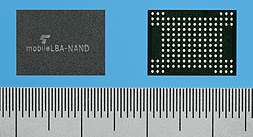
Toshiba Corporation today announced a new series of embedded NAND Flash memories for mobile phones offering both a configurable single-level cell (SLC) memory area and a multi-level cell (MLC) memory area, allowing applications and data to be stored on the same chip.
This development allows cell phone manufacturers that have been using SLC NAND with a standard NAND interface in multi-chip packages (MCPs) to easily take advantage of the lower cost and higher density advantages of MLC NAND while optimizing NAND performance to meet their requirements.
The five memories in the mobileLBA-NAND series range in capacity from 2- to 32-gigabits (Gb). The 2Gb, 4Gb and 8Gb versions can be allocated as SLC up to their full capacity, while the 16Gb and 32Gb versions can support up to 8Gb of SLC, offering manufacturers greater flexibility in allocating memory in their products. Samples of mobileLBA-NAND packaged in MCPs will be available from August 2007.
Alongside a logical block address access (LBA) controller, all of the new mobileLBA-NAND memories integrate a unique control function able to address both SLC and MLC. SLC supports high speed data read and write, and is suited to storing programs for mobile phone functions. In the new devices, manufacturers are free to allocate part of the memory to SLC, with the MLC area reserved for storing data, such a digital photographs and video and music files. This design will allow developers to reduce the number of chips in a product's system, saving space and contributing to higher integration and multi-functionality.
The new memories also support a standard NAND flash interface, which means they can easily be introduced into current generations of products. The LBA controller carries out essential functions, such as writing block management and error code correction (ECC), which minimizes any changes in the host controller specification. As a result, the new memories offer product developers immediately applicable solutions for reducing development time and costs for new and upgraded products.
More and more mobile phones integrate a high resolution camera and audio player. They rely on high density memory to store images and music, as well to store boot program and log data for the mobile phone system. Toshiba's new memories meet these demands in a novel solution that also reduces development burdens on manufacturers.
The new NAND flash memories will be shipped primarily in MCPs, with a Fine Pitch Ball Grid Array (FBGA).
Source: Toshiba


