Catching Waves: Measuring Self-Assembly in Action
June 21st, 2007 Catching Waves: Measuring Self-Assembly in Action

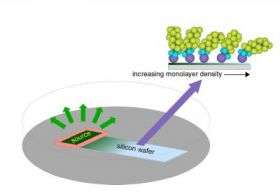
Schematic of the monolayer self-assembly process studied by the NIST/NCSU team. The silicon substrate is approximately 1 x 5 cm in dimensions. The source (left) is a mixture of organosilane (OS) molecules and parafin oil (to control the evaportion rate). The whole system is enclosed in a Petri dish. The concentration of OS molecules is higher near the source and the ordering process initiates near this region. Molecules behind the advancing self-assembly front are relatively ordered, while molecules ahead of the front are engulfed and incorporated as the front reaches them. The molecules at the leading edge of the front are less ordered and this region becomes broader as the front advances -- this is the key phenomenon measured in the experiment. Credit: National Institute of Standards and Technology

By making careful observations of the growth of a layer of molecules as they gradually cover the surface of a small silicon rectangle, researchers from the National Institute of Standards and Technology and North Carolina State University have gained basic insights into how self-propagating self-assembly wave fronts develop and have produced the first experimental verification of recently improved theoretical models of such systems.

In addition, the researchers say, the results reported in this week’s Proceedings of the National Academy of Science should be important to understanding self-propagating chemical reactions and ordering and self-assembly phenomena in situations involving confinement, such as thin films and the porous internal geometries of many materials, such as rocks and cement.

Systems that are transformed by so-called ‘self-propagating’ or ‘autocatalytic’ wave fronts actually are very common. Diverse molecular processes, and even social processes and population dynamics, often can be described in terms of fundamental ‘entities’ that undergo changes randomly on an individual level, but at large scales exhibit some regular motion or pattern formation as they collectively move from some unstable situation to a relatively stable state. Mathematicians have developed a highly successful basic model for such processes, called mean field theory.

The same basic equations describe, for example, the spread of advantageous genes in an animal population, the growth of brain tumors, wound healing, flame propagation, the spread of contagious epidemics, the spread of Neolithic farming techniques, and chemical reaction fronts and nerve propagation—all phenomena that grow outward on waves of change.

In recent years, simulations and theoretical arguments have suggested that small fluctuations can significantly influence the advance of these wavefronts as they grow. In the simple case of growth of a layer of molecules by self-assembly, this would lead to a progressive roughening of the interface between the ordered and disordered regions. This phenomenon is completely missed in the classical mean field theory, raising important questions about the applicability of these and philosophically similar models to describe propagating fronts under general conditions.

To provide experimental verification of this phenomenon in a real system, the NIST/NCSU team examined the spontaneous assembly of organosilane molecules into a monolayer film on an oxidized silicon surface. If a supply of the carbon-silicon-based molecules is placed along one edge of a treated silicon wafer, under controlled conditions, the organosilane molecules spontaneously organize themselves into a well-ordered layer, creating a carpet-like layer on the silicon that advances from the edge of the wafer at a constant velocity.

The technique involved was developed in the 1990s as a simple way to create substrates with a gradually changing surface-energy gradient, a useful experimental tool for surface scientists. The system lends itself to high-resolution measurement because the process is slow enough to allow highly precise, quantitative measurements of the layer as it advances using a high-resolution synchrotron X-ray technique. The team found wavelike ordering, as expected from classical theory, but with the interface of the growing front broadened in time, as predicted by the recent theoretical modeling, but in contrast with classical theory.

Citation: J.F. Douglas, K. Efimenko, D.A. Fischer, F.R. Phelan and J. Genzer. Propagating waves of self-assembly in organosilane monolayers. Proceedings of the National Academy of Science, 2007 104: 10324-10329.

Source: National Institute of Standards and Technology


print this article email this article download pdf blog this article bookmark this article     Digg this Stumble it share on Facebook share on Reddit add to delicious save to Yahoo! bookmarks
4.7/5 after 9 votes


June 21st, 2007 all stories
Physics / General Physics

Comments: 0
Rank: 4.7/5 after 9 votes

  • Stumble this up

  • Digg this

  • Share it:
  • share on Facebook
  • share on MySpace
  • share on Slashdot
  • rss-newsfeed
  • share on Google
  • share on Reddit
  • add to delicious
  • save to Yahoo! bookmarks
  • share on Windows Live
  • Add to Mixx!
Rating: 4.7/5 after 9 votes

  • Related Stories

  • High levels of cycling training damage triathletes' sperm
    created Jun 29, 2009 | popularity not rated yet | comments 0
  • Proteins in gel
    created Jun 24, 2009 | popularity not rated yet | comments 0
  • Researchers achieve breakthrough in effort to develop tiny biological fuel cells
    created Jun 19, 2009 | popularity not rated yet | comments 0
  • A Polymer Solar Cell with Near-Perfect Internal Efficiency
    created Jun 17, 2009 | popularity not rated yet | comments 0
  • Researchers create freestanding nanoparticle films without fillers
    created Jun 09, 2009 | popularity not rated yet | comments 0

Tags


  • Physicists Demonstrate Quantum Memory with Matter Qubits
    Physicists Demonstrate Quantum Memory with Matter Qubits
    Physics / General Physics
    created Jul 03, 2009 | popularity 4.4 / 5 (16) | comments 1
  • 'Holey' Nanosheets for Wastewater Dye Removal
    Nanotechnology / Nanomaterials
    created Jul 01, 2009 | popularity 5 / 5 (5) | comments 1
  • Jellyfish Robot Swims Like its Biological Counterpart
    Jellyfish Robot Swims Like its Biological Counterpart
    Electronics / Robotics
    created Jun 26, 2009 | popularity 4.4 / 5 (7) | comments 1
  • Could Maxwell's Demon Exist in Nanoscale Systems?
    Could Maxwell's Demon Exist in Nanoscale Systems?
    Physics / General Physics
    created Jun 24, 2009 | popularity 4.4 / 5 (18) | comments 29
  • Living Safely with Robots, Beyond Asimov's Laws
    Living Safely with Robots, Beyond Asimov's Laws
    Electronics / Robotics
    created Jun 22, 2009 | popularity 4.6 / 5 (52) | comments 40
  • Other News

    Science journals

    How to Spot an Influential Paper Based on its Citations

    Physics / General Physics

    created 18 hours ago | popularity 4 / 5 (7) | comments 5

    (PhysOrg.com) -- At first it may seem that the number of citations received by a published scientific paper is directly related to that paper's quality of content. The higher the quality, the more people read ...


    Scientists create first electronic quantum processor

    Scientists create first electronic quantum processor

    Physics / General Physics

    created Jun 28, 2009 | popularity 4.8 / 5 (50) | comments 39

    A team led by Yale University researchers has created the first rudimentary solid-state quantum processor, taking another step toward the ultimate dream of building a quantum computer.


    Fermilab's CDF observes Omega-sub-b baryon

    Fermilab's CDF observes Omega-sub-b baryon

    Physics / General Physics

    created Jun 29, 2009 | popularity 4.7 / 5 (16) | comments 7

    (PhysOrg.com) -- At a recent physics seminar at the Department of Energy’s Fermi National Accelerator Laboratory, Fermilab physicist Pat Lukens of the CDF experiment announced the observation of a new particle, ...


    New insights, and a new angle, on high-temperature superconductivity

    New insights, and a new angle, on high-temperature superconductivity

    Physics / Superconductivity

    created Jun 29, 2009 | popularity 4.8 / 5 (13) | comments 6

    (PhysOrg.com) -- A Princeton-led research team has revealed surprising information about how electron behavior influences the conduction of electricity in a class of high-temperature superconductors. An increased ...


    The art of invisibility and the perfect cat's eye

    The art of invisibility and the perfect cat's eye

    Physics / Optics & Photonics

    created Jun 30, 2009 | popularity 4 / 5 (8) | comments 6

    (PhysOrg.com) -- In recent years scientists have explored the impossible by developing invisibility or 'cloaking' devices, but can the same technology also help make things more visible?