June 22, 2007 feature
'Blown Bubble' Method Disperses Nanostructures Over Large Areas
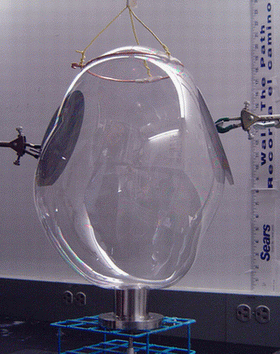
Researchers from Harvard University and the University of Hawaii at Manoa recently announced a new method for organizing nanowires and carbon nanotubes across large areas: blowing bubbles.
Bubble blowing, or blown-film extrusion, is a well developed technique used in industry, such as in plastic-film manufacturing, where polymers are melted and inflated into balloons that can be collapsed and cut. However, this is the first time that this approach has been used in nanoscience research.
The scientists suspended each type of nanostructure in a polymer-based liquid and created large bubbles using a circular die and controlled pressure. The very thin wall of each bubble (a few hundred nanometers thick) contains an even, well organized and aligned distribution of nanostructures. When an expanding bubble is placed against a surface, the bubble wall is transferred to it. This allows a thin film with a controllable nanostructure density and pattern to be deposited onto relatively large wafers, plastic sheets, and curved surfaces.
“This ability is necessary for many proposed optical and electronic applications for nanowires and nanotubes but, so far, other methods cannot be extended to the large-scale assembly of nanowires and nanotubes on both flexible and rigid substrates,” said Harvard scientist Charles Lieber, the paper's corresponding author, to PhysOrg.com.
Lieber and his colleagues worked with two types of nanowires – silicon and cadmium sulfide – and both single- and multi-walled carbon nanotubes. In each case, they were able to produce bubbles with diameters greater than 25 centimeters (cm) and heights greater than 50 cm. The films were transferred to various surfaces: a silicon wafer 20 cm in diameter, a flexible plastic sheet with dimensions of 22.5 cm x 30 cm, and a half cylinder 2.5 cm in diameter and 6 cm long.
The researchers say that by using larger dies and learning how to gain greater control of the expansion process they could potentially create bubbles up to a few meters in dimension as is achieved in today’s plastic-film industry. This means that films larger than one meter across could be produced and transferred, opening up the potential of new large-area electronics applications using nanowires and nanotubes.
Lieber and his colleagues illustrated this potential by using a silicon-nanowire blown-bubble film to create a large array of nanowire-based transistors on 7.5-cm-diameter plastic sheets. The transistors' properties and performance compare to, and often exceed, those created using other assembly methods. By using higher performance nanowires, the scientists expect that significant improvements are possible.
“Our method has the added advantage of being a more straightforward and efficient approach than other techniques in terms of making functional nanodevices over large areas,” said Lieber.
The scientists do concede that the nanowire density and wire-to-wire distance of the silicon-nanowire film currently achieved are “modest,” but can be further increased by preparing a higher concentration polymer suspension of nanostructures. However, they say, those values are still useful for some applications, such as biological sensor arrays and display screens.
This research is discussed in the May 27 online edition of Nature Nanotechnology.
Citation: Guihua Yu, Anyuan Cao and Charles M. Lieber, Nature Nanotechnology, 2007, 2, 372-377.
Copyright 2007 PhysOrg.com.
All rights reserved. This material may not be published, broadcast, rewritten or redistributed in whole or part without the express written permission of PhysOrg.com.


