New nano-method may help compress computer memory
June 22nd, 2007 New nano-method may help compress computer memory

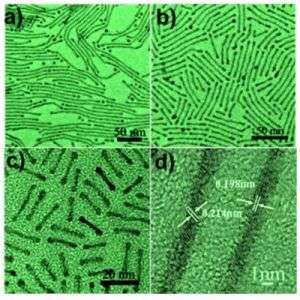
Simply changing the ratio of two chemicals in solution changes the length of iron-platinum nanowires and nanorods: transmission electron microscope images of a) 200 nm wires; b) 50 nm wires; c) 20 nm rods; d) two individual 50 nm wires. Credit: Chao Wang & Jaemin Kim/Brown University

A team of chemists at Brown University have devised a simple way to synthesize iron-platinum nanorods and nanowires while controlling both size and composition. Nanorods with uniform shape and magnetic alignment are one key to the next generation of high-density information storage, but have been difficult to make in bulk.

The technique, published online June 22 in the journal Angewandte Chemie International Edition, pro-duces nanorods and nanowires from 20 nm to 200 nm long, simply by varying the ratio of sol-vent and surfactant used in synthesis. Shouheng Sun, a professor of chemistry at Brown Univer-sity, postdoctoral researcher Yanglong Hou, and colleagues have also demonstrated that the same technique works to control the shape of cobalt-platinum nanorods, suggesting that it may work for many other combinations as well.

Just a few years ago, the average computer user’s documents, applications and even photos seemed to rattle around a 120 GB disk drive. Today’s multimedia-intensive user can exhaust that capacity in no time and the need continues to grow, but engineers expect to max out conven-tional magnetic storage techniques by about 2010. At that point, they’ll be looking for nanotech-nology to step up. Whether it will be ready, remains to be seen.

Getting tiny magnetic particles to align with each other has been one of the major obstacles to squeezing more information density out of the technology. Sun and Hou think they can harness particle shape to accomplish that critical task.

“Many people think that shape can control alignment,” said Sun, “but controlling shape has not been so easy. This method gives us a really simple way to tune length, diameter and composition all at the same time.”

A magnetic storage surface – the disk of a hard-disk drive -- consists of tiny sectors of magneti-cally-aligned particles. When the read-write head of a disk drive passes over a sector, it flips the magnetic field to the opposite direction – encoding a zero or a one. When it reads, it senses the magnetic field for the whole sector. To pack more information into a smaller area, engineers can make the particles smaller or the sectors smaller, but they need enough particles so that the occa-sional random flip doesn’t corrupt the whole sector.

It is now possible to apply magnetic nanoparticles in a thin, dense layer, but the magnetic fields of randomly-oriented spherical particles tend to cancel each other out. Instead of lining up at six o’clock or twelve o’clock, many particles align at two, three, four or five o’clock, diluting the overall strength of the magnetic signal.

Long, narrow nanorods could pack alongside each other, with their magnetic fields oriented in only two directions. Imagine a plate covered with Good and Plenty’s rather than fireballs. The elongated candies line up side-by-side, while the balls role around randomly. Nanorods, aligned in the same direction, should produce a stronger signal and switch cleanly from zero to one and vice versa.

The method developed by Sun, Hou, and graduate students Chao Wang and Jaemin Kim pro-duces batches of similarly-sized nanowires or nanorods in solution. The researchers found that including more surfactant (oleylamine) in the reaction mixture produced longer wires and that more solvent (octadecene) gave shorter rods. A three-to-one ratio of surfactant to solvent yielded 100 nm wires, while a one-to-one ratio produced 20 nm rods.

Based on this pattern, plus transmission electron microscope and x-ray diffraction images, the researchers think that surfactant molecules create protective tunnels around the growing nano-rods, guiding them into longer, rather than thicker shapes. The surfactant molecules line up with water-loving tails inward and water-repellant heads out. With more surfactant in the solution, the tunnels (and the nanorods inside) grow longer before solvent molecules interrupt the pattern.

In addition to information storage, the method has great potential in other areas where very dense magnetic charge is an advantage, including magnetic motors and generators. The stability and biocompatibility of the iron-platinum alloy also make such nanorods and nanowires good candi-dates for biological applications.

Source: Brown University


print this article email this article download pdf blog this article bookmark this article     Digg this Stumble it share on Facebook share on Reddit add to delicious save to Yahoo! bookmarks
4.3/5 after 31 votes


June 22nd, 2007 all stories
Nanotechnology / Nanomaterials

Comments: 0
Rank: 4.3/5 after 31 votes

  • Stumble this up

  • Digg this

  • Share it:
  • share on Facebook
  • share on MySpace
  • share on Slashdot
  • rss-newsfeed
  • share on Google
  • share on Reddit
  • add to delicious
  • save to Yahoo! bookmarks
  • share on Windows Live
  • Add to Mixx!
Rating: 4.3/5 after 31 votes

  • Related Stories

  • Cobalt Nanoparticles Boost Imaging Sensitivity and Edge Detection
    created Mar 26, 2009 | popularity not rated yet | comments 0
  • Nanoscopic probes can track down and attack cancer cells
    created Mar 16, 2009 | popularity not rated yet | comments 0
  • '2-faced' Bioacids Put a New Face on Carbon Nanotube Self-Assembly
    created Jan 13, 2009 | popularity not rated yet | comments 0
  • Just Scratching the Surface: New Technique Maps Nanomaterials as They Grow
    created Nov 04, 2008 | popularity not rated yet | comments 0
  • Teaching Nano to Swim
    created Oct 14, 2008 | popularity not rated yet | comments 0

Tags


  • Physicists Demonstrate Quantum Memory with Matter Qubits
    Physicists Demonstrate Quantum Memory with Matter Qubits
    Physics / General Physics
    created Jul 03, 2009 | popularity 4.4 / 5 (13) | comments 1
  • 'Holey' Nanosheets for Wastewater Dye Removal
    Nanotechnology / Nanomaterials
    created Jul 01, 2009 | popularity 5 / 5 (5) | comments 1
  • Jellyfish Robot Swims Like its Biological Counterpart
    Jellyfish Robot Swims Like its Biological Counterpart
    Electronics / Robotics
    created Jun 26, 2009 | popularity 4.4 / 5 (7) | comments 1
  • Could Maxwell's Demon Exist in Nanoscale Systems?
    Could Maxwell's Demon Exist in Nanoscale Systems?
    Physics / General Physics
    created Jun 24, 2009 | popularity 4.4 / 5 (18) | comments 29
  • Living Safely with Robots, Beyond Asimov's Laws
    Living Safely with Robots, Beyond Asimov's Laws
    Electronics / Robotics
    created Jun 22, 2009 | popularity 4.6 / 5 (51) | comments 39
  • Other News

    A 'quantum of sol' -- how nanotechnology could hold the key to a solar-powered future

    A 'quantum of sol' -- how nanotechnology could hold the key to a solar-powered future

    Nanotechnology / Nanomaterials

    created Jun 30, 2009 | popularity 3.5 / 5 (11) | comments 16

    (PhysOrg.com) -- A new generation of 'nano-structured' millimetre-sized solar cells that could convert the sun's energy to electricity more than twice as efficiently as current technology, is the subject of ...


    Australian researchers are set to begin human trials of a tiny nano-cell that acts as a "Trojan horse" against cancer

    Hi-tech 'Trojan horse' can kill cancer cells: researchers

    Nanotechnology / Bio & Medicine

    created Jun 29, 2009 | popularity 4.6 / 5 (11) | comments 7

    Australian researchers are set to begin human trials of a tiny nano-cell that acts as a "Trojan horse" against cancer cells, a breakthrough they say may curb the need for debilitating chemotherapy.


    Harnessing Nanoparticles To Track Cancer Cell Changes

    Nanotechnology / Bio & Medicine

    created Jul 03, 2009 | popularity not rated yet | comments 0

    The more dots there are, the more accurate a picture you get when you connect them. Cancer researchers adopting that philosophy have developed a new imaging technology that could give scientists the ability to simultaneously ...


    'Holey' Nanosheets for Wastewater Dye Removal

    Nanotechnology / Nanomaterials

    created Jul 01, 2009 | popularity 5 / 5 (5) | comments 1

    (PhysOrg.com) -- Researchers have discovered that extremely thin sheets of nickel oxide with hexagonally shaped holes can absorb hazardous dyes from wastewater nearly as well as the best traditional methods, but are recyclable. ...


    Implant bacteria, beware: Researchers create nano-sized assassins

    Implant bacteria, beware: Researchers create nano-sized assassins

    Nanotechnology / Bio & Medicine

    created Jun 26, 2009 | popularity 4.9 / 5 (7) | comments 0

    Staphylococcus epidermidis is quite an opportunist. Commonly found on human skin, the bacteria pose little danger. But S. epidermidis is a leading cause of infections in hospitals. From catheters to prosthetic ...