Mars Rover Laser Tool Ready for Testing
June 22, 2007
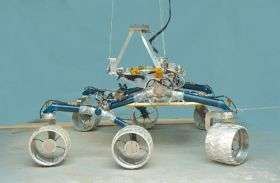
'Scarecrow' Mars Science Laboratory

This engineering model of Mars Science Laboratory was dubbed "Scarecrow" by the mobility team, because it is still without a brain like the famous scarecrow from "The Wizard of Oz." Credit: NASA/JPL-Caltech

Mars mission Job One: Get there. Job Two: Find rocks and zap them with your laser tool. Now learn the nature of the debris by spectrographically analyzing the ensuing dust and fragments. It’s every kid’s dream, vaporizing pebbles on other planets, and thanks to a team at Los Alamos National Laboratory, it’s going to happen.

When the JPL-NASA Mars Science Laboratory rover launches in 2009, it will carry this combination laser-telescope unit and enable the gadget-packed rover to know a great deal about rocks in its general vicinity. The ChemCam package includes a mast unit, projecting above the rover with a laser and telescope, and a body unit, the brains of the beast, with three spectrographs and the instrument controls.

The engineering model of ChemCam’s mast unit, fresh from Thales Laser and Centre d’Etude Spatiale des Rayonnements (CESR) in France, is undergoing rigorous testing at Los Alamos. A team of six French experts is checking out the mast unit this week and making sure that it is properly connected with the rest of the instrument, built at Los Alamos. This fall the entire instrument will be shipped to the Jet Propulsion Laboratory, where more tests will take place and additional equipment will be added.

“We’re pioneering a new technique for exploring Mars. It’s really exciting to see the whole thing come together,” said Roger Wiens, project lead and a Los Alamos scientist.

The ChemCam laser emits very short pulses of 7 nanoseconds, through a small telescope that focuses the beam to a spot where the power density exceeds 10 megawatts per square millimeter, producing a plasma of vaporized material from the target rock. The unit operates on targets at distances between 4 and 30 feet. The unit also contains a camera to take extreme close-up pictures of the targets to show geologic context for each sample. The telescope and electronics were built by CESR, a research institute in Toulouse, France. The mast unit was funded by CNES, the French Space Agency. The full ChemCam flight model will be delivered to JPL in Spring of 2008.

Scheduled to launch in the fall of 2009, Mars Science Laboratory is part of NASA’s Mars Exploration Program, a long-term effort of robotic exploration of the red planet. Mars Science Laboratory is a rover that will assess whether Mars ever was, or is still today, an environment able to support microbial life. In other words, its mission is to determine the planet’s habitability.

Source: Los Alamos National Laboratory

4.5 /5 (6 votes)  

Rank 4.5 /5 (6 votes)
Tags

Relevant PhysicsForums posts
  • Never ending outer space.....
    created23 hours ago
  • Neutron Star fragments?
    createdFeb 11, 2012
  • stationary or not?
    createdFeb 11, 2012
  • Scale of the Universe
    createdFeb 10, 2012
  • Titan's lack of impact craters
    createdFeb 09, 2012
  • Real pictures of black hole eating a star?
    createdFeb 08, 2012
  • More from Physics Forums - General Astronomy

More news stories

Salvage workers begin pumping fuel from Italian shipwreck

Salvage workers Sunday began pumping fuel from the shipwrecked Italian cruise liner Costa Concordia, a day ahead of schedule, officials said.

Space & Earth / Environment

created 8 hours ago | popularity 5 / 5 (1) | comments 0

Latin America mining boom clashes with conservation

Latin America is experiencing a mining boom as prices rise fuelled by a hike in global demand, but the region is also being hit by a wave of violent protests, strikes and rallies by environmentalists.

Space & Earth / Environment

created 16 hours ago | popularity 5 / 5 (1) | comments 1

Political leaders play key role in how worried Americans are by climate change: study

More than extreme weather events and the work of scientists, it is national political leaders who influence how much Americans worry about the threat of climate change, new research finds.

Space & Earth / Environment

created Feb 06, 2012 | popularity 5 / 5 (7) | comments 73

NASA budget will axe Mars deal with Europe: scientists

US President Barack Obama's budget proposal to be submitted next week for 2013 will cut NASA's budget by 20 percent and eliminate a major partnership with Europe on Mars exploration, scientists said Thursday.

Space & Earth / Space Exploration

created Feb 10, 2012 | popularity 5 / 5 (3) | comments 58

Humans may have helped the decline of African rainforests 3000 years ago

(PhysOrg.com) -- Large areas of rainforests in Central Africa mysteriously disappeared over three thousand years ago, to be replaced by savannas. The prevailing theory has been that the cause was a change ...

Space & Earth / Environment

created Feb 10, 2012 | popularity 4.1 / 5 (14) | comments 21 | with audio podcast report


Scientists discover molecular secrets of 2,000-year-old Chinese herbal remedy

For roughly two thousand years, Chinese herbalists have treated Malaria using a root extract, commonly known as Chang Shan, from a type of hydrangea that grows in Tibet and Nepal. More recent studies suggest that halofuginone, ...

New method to examine batteries -- MRI from the inside

There is an ever-increasing need for advanced batteries for portable electronics, such as phones, cameras, and music players, but also to power electric vehicles and to facilitate the distribution and storage of energy derived ...

A mitosis mystery solved: How chromosomes align perfectly in a dividing cell

Although the process of mitotic cell division has been studied intensely for more than 50 years, Whitehead Institute researchers have only now solved the mystery of how cells correctly align their chromosomes during symmetric ...

Google might launch Drive for cloud storage soon

(PhysOrg.com) -- Google's next big move, according to the Wall Street Journal, is a cloud storage service called Drive. Hardly first to the plate, Google is simply catching up to introducing its cloud reposi ...

Lab study raises questions over nano-particle impact

Tests involving chickens have raised questions about the impact on health from engineered nano-particles, the ultra-fine grains commonly used in drugs and processed foods, scientists said on Sunday.

Overeating may double risk of memory loss

New research suggests that consuming between 2,100 and 6,000 calories per day may double the risk of memory loss, or mild cognitive impairment (MCI), among people age 70 and older. The study was released today and will be ...