Evolution Study Tightens Human-Chimp Connection
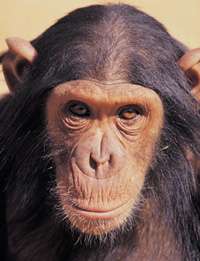
Scientists at the Georgia Institute of Technology have found genetic evidence that seems to support a controversial hypothesis that humans and chimpanzees may be more closely related to each other than chimps are to the other two species of great apes – gorillas and orangutans. They also found that humans evolved at a slower rate than apes.
Appearing in the January 23, 2006 issue of the Proceedings of the National Academy of Sciences, biologist Soojin Yi reports that the rate of human and chimp molecular evolution – changes that occur over time at the genetic level – is much slower than that of gorillas and orangutans, with the evolution of humans being the slowest of all.
As species branch off along evolutionary lines, important genetic traits, like the rate of molecular evolution also begin to diverge. They found that the speed of this molecular clock in humans and chimps is so similar, it suggests that certain human-specific traits, like generation time, began to evolve one million years ago - very recently in terms of evolution. The amount of time between parents and offspring is longer in humans than apes. Since a long generation time is closely correlated with the evolution of a big brain, it also suggests that developmental changes specific to humans may also have evolved very recently.
In a large-scale genetic analysis of approximately 63 million base pairs of DNA, the scientists studied the rate at which the base pairs that define the differences between species were incorrectly paired due to errors in the genetic encoding process, an occurrence known as substitution.
“For the first time, we’ve shown that the difference in the rate of molecular evolution between humans and chimpanzees is very small, but significant, suggesting that the evolution of human-specific life history traits is very recent,” said Yi.
Most biologists believe that humans and chimpanzees had a common ancestor before the evolutionary lines diverged about 5-7 million years ago. According to the analysis, one million years ago the molecular clock in the line that became modern humans began to slow down. Today, the human molecular clock is only 3 percent slower than the molecular clock of the chimp, while it has slowed down 11 percent from the gorilla’s molecular clock.
This slow down in the molecular clock correlates with a longer generation time because substitutions need to be passed to the next generation in order to have any lasting effect on the species,
"A long generation time is an important trait that separates humans from their evolutionary relatives,” said Navin Elango, graduate student in the School of Biology and first author of the research paper. “We used to think that apes shared one generation time, but that’s not true. There’s a lot more variation. In our study, we found that the chimpanzee’s generation time is a lot closer to that of humans than it is to other apes.”
The results also confirm that there is very little difference in the alignable regions of the human and chimp genomes. Taken together, the study’s findings suggest that humans and chimps are more closely related to each other than the chimps are to the other great apes.
"I think we can say that this study provides further support for the hypothesis that humans and chimpanzees should be in one genus, rather than two different genus’ because we not only share extremely similar genomes, we share similar generation time,” said Yi.
Even though the 63 million base pairs they studied is a large sample, it’s still a small part of the genome, Yi said. “If we look at the whole genome, maybe it’s a different story, but there is evidence in the fossil record that this change in generation time occurred very recently, so the genetic evidence and the fossil data seem to fit together quite well so far.”
Source: Georgia Institute of Technology


