Sounds of Star Death Near Middle C
January 24, 2006
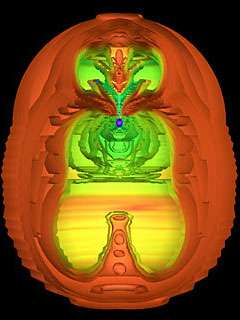
Computer-generated image of a star 25 times as massive as the sun as it explodes as a supernova

Computer-generated image of a star 25 times as massive as the sun as it explodes as a supernova. Explosions are probably driven by sound waves, researchers have discovered. This figure shows the accretion funnels still streaming onto the inner core (purple dot). It is these accretion streams that continue to excite the core oscillation that generates the acoustic power that eventually explodes the star in these simulations. Green is high entropy and brown is low entropy material.(Graphic: Courtesy of Adam Burrows, UA)

Scientists have made the astonishing discovery that sound might drive supernovae explosions. Their computer simulations say that dying stars pulse at audible frequencies -- for instance, at about the F-note above middle C -- for a split second before they blow up.

Researchers in the 1960s began using computer models to test ideas about what, exactly, causes stars to explode. But mathematical simulations have so far failed to satisfactorily explain the inner workings of nature's most spectacular blasts.

Neutrinos -- subatomic particles widely thought to power supernovae explosions -- don't seem to be energetic enough to do the job, especially for more massive stars. More sophisticated models that include convective motion work a bit better, but not well enough.

Adam Burrows of The University of Arizona and colleagues at UA's Steward Observatory, Hebrew University, and Germany's Max Planck Institute (Potsdam) have developed computer models that simulate the full second or more of star death, from the dynamics of core collapse through supernova explosion. Their two-dimensional computer models allow for the fact that supernovae outbursts are not spherical, symmetrical events.
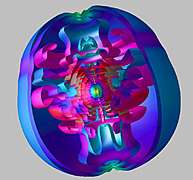
Computer-generated image of the 'isodensity contours' for the core of an 11-solar-mass star explosion

Computer-generated image of the "isodensity contours" for the core of an 11-solar-mass star explosion. The remnant neutron star is the green "dot" in the center and the outer shells are just interior to the blast wave that has been launched. The scale is ~2000 kilometers on a side and the time is ~800 milliseconds after the bounce at nuclear densities of the collapsed core. The colors reflect the entropies on the shells, where entropy is a measure of heat content. (Graphic: Courtesy of Adam Burrows, UA)

A supernova is a massive star that has burned for 10 million to 20 million years and developed a hot, dense 'white dwarf' star about the size of Earth at its core. When the white dwarf reaches a critical mass (about 1.5 times the mass of the sun), it collapses and creates a spherical shock wave, all within less than half a second before the star would explode as a supernova.

However, in all the best recent simulations, the shock wave stalls. So theorists have focused their work on what might revive the shock wave into becoming a supernova explosion.

According to Burrow's new results, part of the problem is that other computer models don't run long enough. His team's detailed models involve a million steps, or about five times as many as typical models that calculate only the first few hundred milliseconds of supernovae events. Burrows team's simulations also characterize the natural motion of a supernova core, something that other detailed models do not.

"Our simulations show that the inner core starts to execute pulsations," Burrows said. "And they allow us to follow the development to explosion for a longer time than other models do. They show that after about 500 milliseconds, the inner core begins to vibrate wildly. And after 600, 700 or 800 milliseconds, this oscillation becomes so vigorous that it sends out sound waves. In these computer runs, it's these sound waves that actually cause the star to explode, not the neutrinos."

He added, "We were quite sure when we started seeing this phenomenon that we were seeing sound waves, but it was so unexpected that we kept rechecking and retesting our results."

The team has used their models to make billions of calculations on computer clusters in the UA astronomy department, at Berkeley's supercomputer center and elsewhere, checking their analysis for the past year. They are publishing the research in the Astrophysical Journal. Their research is funded by the National Science Foundation, the Department of Energy, and the Joint Institute for Nuclear Astrophysics.

The team got a clear picture of what likely happens by making movies from their simulations. Burrows has posted the movies on his Website at http://zenith.as.a … rrows/briley

Collapsing material falls lopsidedly onto the inner core and soon excites oscillations at specific frequencies in the simulations. Within hundreds of milliseconds, the inner core vibrations become so intense that they actually generate sound waves. Typical sound frequencies are about 200 to 400 hertz, in the audible range bracketing middle C.

"Sound also generates pressure, which pushes the exciting streams of infalling matter to the opposite side of the core, further driving the core oscillations in a runaway process," Burrows said. "The sound waves reinforce the shock wave (created by the collapsed star) until it finally explodes aspherically."

Burrows said that others who study supernova explosions in computer experiments will be skeptical of his team's results -- and should be.

"This is such a break from 40 years of traditional thinking that one should be cautious trumpeting it," he said. "Nevertheless, this is provocative and interesting. It would open up many new possibilities and perhaps solve a long-standing problem of what triggers supernovae explosions."

Source: University of Arizona

4.8 /5 (18 votes)  

Rank 4.8 /5 (18 votes)
Tags

Relevant PhysicsForums posts

More news stories

Mars Science Laboratory computer issue resolved

(PhysOrg.com) -- Engineers have found the root cause of a computer reset that occurred two months ago on NASA's Mars Science Laboratory and have determined how to correct it.

Space & Earth / Space Exploration

created 13 minutes ago | popularity not rated yet | comments 0 | with audio podcast

Putin receives 'prehistoric' water from Antarctic lake

Prime Minister Vladimir Putin was given a water sample Friday taken from a pristine lake hidden under Antarctic ice for over a million years, after Russian scientists drilled down to its surface.

Space & Earth / Earth Sciences

created 19 minutes ago | popularity 5 / 5 (1) | comments 0

Rockot to launch two Sentinel satellites

ESA and Eurockot today signed contracts for launching two ESA satellites: Sentinel-2A and Sentinel-3A will fly in 2013 on Rockot vehicles from the Plesetsk Cosmodrome in northern Russia for Europe’s GMES ...

Space & Earth / Space Exploration

created 15 minutes ago | popularity 5 / 5 (1) | comments 0

Probing a link from Sahara dust to climate change

Qilong Min, Ph.D., Senior Research Associate and Professor with the Atmospheric Sciences Research Center (ASRC) at the University at Albany is developing innovative ways to measure how dust in the Sahara Desert ...

Space & Earth / Earth Sciences

created 8 minutes ago | popularity not rated yet | comments 0

Humans may have helped the decline of African rainforests 3000 years ago

(PhysOrg.com) -- Large areas of rainforests in Central Africa mysteriously disappeared over three thousand years ago, to be replaced by savannas. The prevailing theory has been that the cause was a change ...

Space & Earth / Environment

created 3 hours ago | popularity 5 / 5 (2) | comments 0 | with audio podcast report


New error-correcting codes guarantee the fastest possible rate of data transmission

Error-correcting codes are one of the triumphs of the digital age. They’re a way of encoding information so that it can be transmitted across a communication channel — such as an optical fiber o ...

A frank discussion of the power law and linking correlation to causation

(PhysOrg.com) -- Michael Stumpf a mathematics professor at Imperial College in London, and Mason Porter a lecturer at Oxford have teamed together to write and publish a perspective piece in Science regarding the in ...

Advanced power-grid model finds low-cost, low-carbon future in West

(PhysOrg.com) -- The least expensive way for the Western U.S. to reduce greenhouse gas emissions enough to help prevent the worst consequences of global warming is to replace coal with renewable and other ...

Small modular reactor design could be a 'SUPERSTAR'

(PhysOrg.com) -- Though most of today's nuclear reactors are cooled by water, we've long known that there are alternatives; in fact, the world's first nuclear-powered electricity in 1951 came from a reactor ...

High school students test best with 7 hours' rest

(Medical Xpress) -- Whether or not you know any high school students that actually get nine hours of sleep each night, that’s what federal guidelines currently prescribe.

The question of life in the ancient world

There’s a general feeling that we don’t get the Greeks – ancient or modern. Many, including heads of state like Angela Merkel, visibly shake their head in exasperation, rightly or wrongly, at ...