Nano World: First solar-powered nano motor
January 24th, 2006 First solar-powered nano motor

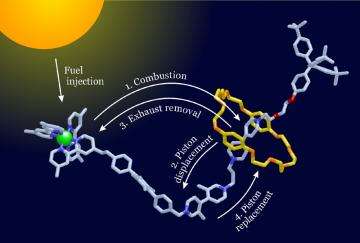
The absorption of sunlight by one of the two stoppers, a light-harvesting one, causes the transfer of one electron to station A, which is deactivated as far as wanting the ring to encircle it. As a consequence, the ring moves to its second port of call, station B. Station A is subsequently reactivated by the return of the transferred electron to the light-harvesting stopper, and the ring moves back to this station. Copyright © UCLA

An international team of scientists has created the first molecular motor powered solely by sunlight. By acting like pistons that move back and forth, these motors, which are only nanometers or billionths of meters across, could help read out data as ones and zeroes "for molecular photonics and electronics, two rapidly growing fields aimed at the construction of chemical computers," said researcher Vincenzo Balzani, a chemist at the University of Bologna, Italy.

Such motors could also operate nanovalves covering the surfaces of porous silica-based nanoparticles. Scientists could then use light to fill and empty the pores of these nanoparticles with molecules such as anti-cancer drugs. After doctors target cancers with these nanoparticles, "then light is used to trigger the release of the drug," said researcher J. Fraser Stoddart, a nanochemist at the University of California at Los Angeles.

The motor was designed and built over six years by researchers at the University of Bologna and UCLA. It essentially resembles a dumbbell roughly 6 nanometers long that threads a ring about 1.3 nanometers wide. The ring can move up and down the rod of the dumbbell but cannot go past the bulky stoppers at its ends.

There are two sites on the dumbbell's rod that the ring prefers to encircle. When one of the dumbbell's stoppers absorbs sunlight, it transfers an electron to one of these ports of call, driving the ring to then shuffle over to the other station. The ring returns to the old site after the electron transfers back to the stopper, allowing the cycle to begin all over again.

"The motions executed by the nanomotor are quite rapid. A full cycle is carried out in less than one-thousandth of a second," Stoddart said. That is roughly equivalent to "a car's engine running at 60,000 revolutions per minute," Balzani added.

"Noteworthy is the fact that this molecular motor does not require a chemical fuel to operate," said Devens Gust, a chemist at Arizona State University in Tempe who did not participate in this study. "Previous motors require fuel, including biological motors. The power for this system comes directly from light, with no need to move fuels around, consume them, and generate waste products. The analogy would be a solar-powered car vs. one fueled by a gasoline engine."

"This is an important step forward in the chemists' quest for molecular machines. I am impressed by the complexity of the synthesized structure," said Josef Michl, a chemist at the University of Colorado at Boulder who did not participate in this study.

At the moment, the nanomotors swim around fairly randomly in solution "and work independently and incoherently from one another, so that no work can actually be extracted from such a system," Balzani said. The researchers are now working to line these motors onto surfaces and into membranes so they can all work together "to obtain mechanical work on the macroscopic scale," Stoddart added. Their findings appeared online Jan. 23 in the Proceedings of the National Academy of Sciences.

Copyright 2006 by United Press International


print this article email this article download pdf blog this article bookmark this article     Digg this Stumble it share on Facebook share on Reddit add to delicious save to Yahoo! bookmarks
4.2/5 after 83 votes

Rank Filter

Move the slider to adjust rank threshold, so that you can hide some of the comments.


Display comments: newest first

  • JayD - Jan 06, 2008
    • Rank: not rated yet
    Energy conservation
    Just remember, corporations don't pay taxes--people pay taxes.
    It has been my observation that those in favor of restrictions, somehow believe that utilities will absorb the costs, cut profits, and keep the price of electricity steady. Electricity is a commodity that everyone needs, and everyone will pay a higher price--perhaps a MUCH higher price.
    It would be interesting (shocking?) to see a realistic projection regarding future electricity prices and the effect on the economy in general from the various legislation being proposed.
    New laws should be a result of well-reasoned thinking, not knee-jerk reactions or bandwagon jumping.
    I don't see any analysis of the downside risks to the economy of pulling out all of those billions in higher electricity costs and investing them only in energy-related projects. This is not a strong economy any more. 2012 is an "inconvenient target year." No new nuclear capacity can come on line by 2012, so no real cuts in fossil fuel generation can be practical. That means all the coal stays and all the increases are made up with natural gas. People will not tolerate electricity rationing
    The Green Line
    While I applaud the efforts of companies buying these green credits, there should be a parallel path to improve their stores energy efficiency. Right now with the Energy Policy Act of 2005 (EPACT) giving $.60 / square foot tax credit for energy efficient lighting retrofits, every company should be taking a serious look at this! There is no other initiative they can do that would have the bottom line impact as this lighting retrofit AND TAX credit for one year. Unless Congress extends, this TAX credit is only good through end of 2008, so wake up corporate America and call a local energy/lighting consultant today!
    Saving energy and reducing fuel costs are completely commendable from an economic point of view and for stretching out finite natural resources. But to go through costly contortions to be "green" by reducing carbon dioxide outputs is to believe that carbon dioxide is driving climate change. As revolutionary is the following idea might sound, there is no scientific that carbon dioxide is having anything more than a miniscule effect on climate. Various solar effects quite possibly are responsible for any observed climate changes, effects including El Nino, Le Nina, and numerous other cyclical phenomena, in addition to the possible interaction of the sun's magnetosphere and cosmic rays to vary cloud cover. This information is available to anyone who spends the time to look and read. All hypotheses relating climate warming to carbon dioxide concentration is confusing association with causation. We have to remember that temperatures have varied independent of CO2 concentration, even in the past century, and there are indications that there has been no warming since 1998. Some climate experts feel that we may be heading for a cooling phase. We just don't . The idea of anthropomorphic global warming is conjecture and belief, not proven fact.
    I am not receiving ANY funding from any energy or other company. This includes untrustworthy weather ground station installations and personnel (particularly outside Western countries) and thus untrustworthy temperature data; shenanigans within the IPCC process that screen out any views not in conformity with its predetermined message that everything is Man's fault; a similar process within some of the most influential scientific journals; the inaccuracies and outright deceptions in "An Inconvenient Truth"; the ignorance of the media in covering the question of climate causation; and the acceptance of the notion that a "scientific consensus" is equal to scientific proof. First, such a notion is bad science. And second, we have to investigate how much of the "vast scientific consensus" is real and how much merely the creation of warmist advocates who can make more noise and get the attention of the media better than quiet and sober true scientists and climatologists (and those who are concerned about their livelihoods if they speak out against the prevailing orthodoxy). Endless repetition does not equal proof or reality.
    We must keep an open mind on whether any of these heroic efforts to reduce carbon dioxide emissions has any useful function, or if they are driven solely by herd mentality and the desire to appear to the public to be "doing something", good PR but accomplishing nothing in the real world (shades of the Emperor's new clothes). My feeling is that the entire carbon-credits business is a giant edifice erected on the sands of a flood plain. Eventually a wave of reality will hit and cause a total collapse.

January 24th, 2006 all stories
Nanotechnology /

Comments: 1
Rank: 4.2/5 after 83 votes

  • Stumble this up

  • Digg this

  • Share it:
  • share on Facebook
  • share on MySpace
  • share on Slashdot
  • rss-newsfeed
  • share on Google
  • share on Reddit
  • add to delicious
  • save to Yahoo! bookmarks
  • share on Windows Live
  • Add to Mixx!
Rating: 4.2/5 after 83 votes

  • Related Stories

  • Researchers shake up scientific theory on motor protein
    created Feb 05, 2009 | popularity not rated yet | comments 0
  • Viruses, start your engines!
    created Dec 29, 2008 | popularity not rated yet | comments 0
  • 'Smart' materials get smarter with ability to better control shape and size
    created Jul 03, 2008 | popularity not rated yet | comments 0
  • Tethered molecules act as light-driven reversible nanoswitches
    created Jun 23, 2008 | popularity not rated yet | comments 0
  • Aromaticity may occur in unexpected materials
    created Feb 20, 2008 | popularity not rated yet | comments 0

Tags


  • Transform a ball into a rock -- or make it invisible -- using transformation optics
    Transform a ball into a rock -- or make it invisible -- using transformation optics
    Physics / General Physics
    created 6 hours ago | popularity 3 / 5 (2) | comments 0
  • Could a quantum motor do work?
    Physics / General Physics
    created Jul 07, 2009 | popularity 4 / 5 (12) | comments 0
  • Physicists Demonstrate Quantum Memory with Matter Qubits
    Physicists Demonstrate Quantum Memory with Matter Qubits
    Physics / General Physics
    created Jul 03, 2009 | popularity 4.5 / 5 (20) | comments 1
  • 'Holey' Nanosheets for Wastewater Dye Removal
    Nanotechnology / Nanomaterials
    created Jul 01, 2009 | popularity 5 / 5 (5) | comments 1
  • Jellyfish Robot Swims Like its Biological Counterpart
    Jellyfish Robot Swims Like its Biological Counterpart
    Electronics / Robotics
    created Jun 26, 2009 | popularity 4.4 / 5 (9) | comments 1
  • Other News

    Material world: Graphene's versatility promises new applications

    Graphene's versatility promises new applications

    Nanotechnology / Nanomaterials

    created 4 hours ago | popularity 5 / 5 (2) | comments 0

    Since its discovery just a few years ago, graphene has climbed to the top of the heap of new super-materials poised to transform the electronics and nanotechnology landscape. As N.J. Tao, a researcher at the ...


    Light-absorbing nanowires may make better solar panels

    Light-absorbing nanowires may make better solar panels

    Nanotechnology / Nanomaterials

    created Jul 07, 2009 | popularity 4.1 / 5 (9) | comments 5

    (PhysOrg.com) -- A century after German physicist Gustav Mie derived the math to explain why the colors in some stained glass windows look especially resplendent in the sunlight, a team of Stanford engineers ...


    Researchers enlist DNA to bring carbon nanotubes' promise closer to reality

    Nanotechnology / Bio & Medicine

    created Jul 08, 2009 | popularity 5 / 5 (1) | comments 1

    A team of researchers from DuPont and Lehigh University has reported a breakthrough in the quest to produce carbon nanotubes (CNTs) that are suitable for use in electronics, medicine and other applications.


    'Flexible camera' replaces lens with fiber web

    'Flexible camera' replaces lens with fiber web

    Nanotechnology / Nanomaterials

    created Jul 07, 2009 | popularity 4.6 / 5 (10) | comments 0

    (PhysOrg.com) -- Imagine a soldier's uniform made of a special fabric that allows him to look in all directions and identify threats that are to his side or even behind him. In work that could turn such science ...


    New way to make sensors that detect toxic chemicals

    New way to make sensors that detect toxic chemicals

    Nanotechnology / Nanomaterials

    created Jul 08, 2009 | popularity 5 / 5 (1) | comments 0

    (PhysOrg.com) -- Ohio State University researchers have developed a new method for making extremely pure, very small metal-oxide nanoparticles.