World's first X-ray free electron laser is on course to completion
June 25, 2007 World's first X-ray free electron laser is on course to completion

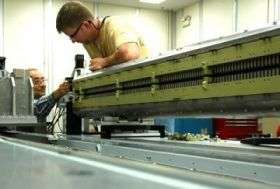
Preparation -- Isaac Vasserman (left) and Matt Kasa of Argonne's Accelerator Systems Division prepare an undulator for magnetic tuning and verification. Credit: Argonne National Laboratory

Argonne reached another milestone in the design and construction of the Linac Coherent Light Source (LCLS) undulator system.

LCLS will be the world's first X-ray free electron laser when it becomes operational at the Stanford Linear Accelerator Center (SLAC) in 2009. It will be the first X-ray laser to combine the brilliance of laser sources with the penetrating power and atomic sensitivity of X-rays. Argonne is a partner laboratory on the project and is responsible for the 130-meter undulator system, including magnets, support structures, beam diagnostics, controls and vacuum systems.

Undulators are the heart of the LCLS free electron laser, providing a precise magnetic field through which an electron beam will travel. The undulators' magnetic fields force the electrons to oscillate back and forth and produce large amounts of X-rays. These X-rays interact back on the electrons and force them to bunch at X-ray wavelengths. When this occurs, the electrons emit their light coherently, causing a large gain in radiation power that raises the X-rays' intensity.

“Argonne was tapped to participate in this project due to the expertise demonstrated with the Advanced Photon Source undulator systems,” said J. Murray Gibson, associate laboratory director of Argonne's Scientific User Facilities. “An X-ray laser such as LCLS will open up new scientific frontiers and represents an immense technical achievement for the United States. We could not have done this without the partnership of national laboratories, universities and industry.”

“The last of the 40 LCLS undulators was assembled and accepted by Argonne late last month, on time and within budget, from Hi-Tech Manufacturing in Illinois and Metalex Manufacturing in Ohio,” said Argonne LCLS Project Director Geoff Pile. “The LCLS project remains on course for completion in March 2009.”

“This is the first time such ultra-precise undulators were mass-produced in America by non-specialized small businesses,” said Emil Trakhtenberg, Argonne senior mechanical engineer at APS.

Each undulator comprises a precision-tuned array of ultra-strong neodymium-iron-boron permanent magnets and vanadium permendur magnetic poles. The magnets and poles are mounted in aluminum structures bolted into a 3.4-meter-long titanium strongback. The strongback secures the magnet and pole assemblies, counteracts the very high magnetic forces between the upper and lower magnetic arrays, and is critical in determining the thermal and mechanical stability of the undulator. Precision and stability requirements for the LCLS devices far exceed those for existing undulators at the Advanced Photon Source and other light-source facilities.

The pulses of X-ray laser light from LCLS, a fourth-generation light-source, will be shorter and a billion times brighter than can be produced by any other X-ray source available now or in the near future.

“These advanced characteristics will aid scientists in discovering and probing new states of matter, understanding and following chemical reactions and biological processes in real time, imaging chemical and structural properties of materials on the nanoscale, and many new and exciting discoveries we cannot even imagine today,” said Marion White, senior physicist at APS. “The LCLS will enable revolutionary new science.”

Source: Argonne National Laboratory


print this article email this article download pdf blog this article bookmark this article     Stumble it Digg this share on Facebook retweet share on Reddit add to delicious
Rate this story - 4.3 /5 (23 votes)


June 25, 2007 all stories

Comments: 0

4.3 /5 (23 votes)
  • Stumble this up

  • Digg this

  • share this

  • hide
  • Related Stories

  • Science Begins at the World's Most Powerful X-ray Laser (w/ Video)
    created Nov 02, 2009 | popularity not rated yet | comments 0
  • LCLS: The World's Largest Laser Writer?
    created Oct 20, 2009 | popularity not rated yet | comments 0
  • New Twist on Favorite X-ray Technique Promises Ultrafast Molecular Studies
    created Oct 12, 2009 | popularity not rated yet | comments 0
  • First Test of New X-ray Laser Strips Neon Bare
    created Sep 18, 2009 | popularity not rated yet | comments 0
  • Jet-propelled Imaging for an Ultrafast Light Source
    created Aug 04, 2009 | popularity not rated yet | comments 0


  • hide
  • Relevant PhysicsForums posts

  • moment of inertia and friction
    created 3 hours ago
  • two-dimensional collision
    created 5 hours ago
  • I Need Help Selecting a Good Text Book to Learn the Basics
    created 7 hours ago
  • The acceleration of mass using light
    created 7 hours ago
  • More from Physics Forums - General Physics

Other News

In the Brain, Seven Is A Magic Number

In the Brain, Seven Is A Magic Number

Physics / General Physics

created 11 hours ago | popularity 4.2 / 5 (16) | comments 5

Having a tough time recalling a phone number someone spoke a few minutes ago or forgetting items from a mental grocery list is not a sign of mental decline; in fact, it's natural.


Scientists react as they stand in front of a screen at CERN

First atoms reported smashed in Large Hadron Collider (Update)

Physics / General Physics

created 14 hours ago | popularity 4.9 / 5 (20) | comments 9

Two circulating beams on Monday produced the first particle collisions in the world's biggest atom smasher, the Large Hadron Collider (LHC), three days after its restart, scientists announced.


Straightening messy correlations with a quantum comb

Straightening messy correlations with a quantum comb

Physics / Quantum Physics

created 14 hours ago | popularity 4.7 / 5 (7) | comments 0

Quantum computing promises ultra-fast communication, computation and more powerful ways to encrypt sensitive information. But trying to use quantum states as carriers of information is an extremely delicate ...


Visual assistance for cosmic blind spots

Visual assistance for cosmic blind spots

Physics / General Physics

created 15 hours ago | popularity 4.3 / 5 (3) | comments 0

A bit of imagination on the part of a measuring instrument wouldn't be a bad thing. It could help to add data from areas where the instrument is unable to measure. However, it must do so constructively. In ...


Big Bang atom smasher sends beams in 2 directions (AP)

Large Hadron Collider sends beams in 2 directions

Physics / General Physics

created 18 hours ago | popularity 4.9 / 5 (10) | comments 0

(AP) -- The world's largest atom smasher made another leap forward Monday by circulating beams of protons in opposite directions at the same time in the $10 billion machine after more than a year of repairs, ...