Scientists identify first gene linked to scoliosis
June 25, 2007
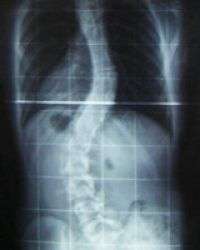
An X-ray of a case of scoliosis showing the abnormal curvature of the spine.
Physicians have recognized scoliosis, the abnormal curvature of the spine, since the time of Hippocrates, but its causes have remained a mystery -- until now. For the first time, researchers have discovered a gene that underlies the condition, which affects about 3 percent of all children.
The new finding lays the groundwork for determining how a defect in the gene -- known as CHD7 -- leads to the C- and S-shaped curves that characterize scoliosis. The gene's link to scoliosis was identified by scientists at Washington University School of Medicine in St. Louis, working in collaboration with investigators at the University of Texas Southwestern Medical Center and Texas Scottish Rite Hospital for Children, both in Dallas, Rutgers State University of New Jersey and the University of Iowa. The group published its results in May in the American Journal of Human Genetics.
"Hopefully, we can now begin to understand the steps by which the gene affects spinal development," says Anne Bowcock, Ph.D., professor of genetics, of medicine and of pediatrics. "If we understand the genetic basis of the condition, we can theoretically predict who is going to develop scoliosis and develop treatments to intervene before the deformity sets in. It may take many years to accomplish these goals, but I think it will eventually happen."
The researchers have traced a defect in CHD7 to idiopathic scoliosis, the form of the condition for which there is no apparent cause. It is the most common type of scoliosis, occurs in otherwise healthy children and is typically detected during the growth spurt that accompanies adolescence.
Although scientists have known for years that scoliosis runs in families, its pattern of inheritance has remained unclear. That's because the condition is likely caused by several different genes that work in concert with one another -- and the environment -- to cause scoliosis. Bowcock predicts that scientists will soon find other genes involved in the disease.
The CHD7 gene is thought to play a critical role in many basic functions in the cell. The researchers zeroed in on the gene after finding that it is missing or profoundly disrupted in a rare syndrome called CHARGE. Babies born with the syndrome often die in infancy. Those that survive have heart defects, mental retardation, genital and urinary problems, ear abnormalities and deafness, among other problems. They also develop late-onset scoliosis.
"This led us to consider that milder variations of CHD7 may be involved in other types of scoliosis," Bowcock said.
The researchers, led by Carol Wise, Ph.D., at Scottish Rite Hospital, collected data on 52 families with a history of scoliosis in at least two members -- the one who sought treatment and another from earlier generation. The patients had an average spinal curvature of 40 degrees and did not have any illnesses, such as Marfan syndrome or cerebral palsy, which can also involve scoliosis. The researchers performed genome-wide scans that spelled out the 6 billion letters of genetic code in the affected family members and analyzed the data.
They found that patients with scoliosis very often had a defect in the gene's non-coding region, meaning that the error did not disrupt production of the CHD7 protein. The researchers speculate that this particular mutation alters the binding of a molecule that controls whether the gene is turned on. In this case, they think the gene is turned off more often than it should be, which reduces the amount of CHD7 protein produced.
"The change in the amount of the protein produced is subtle, which correlates with the onset of scoliosis, which typically happens very gradually," explains Michael Lovett, Ph.D., professor of genetics and pediatrics. "This particular defect was so highly associated with scoliosis that it is either the real McCoy or is very closely linked to the defect that causes the condition."
The researchers will continue to look for genetic variations involved in scoliosis by studying additional families with the condition.
Severe scoliosis is typically treated by surgery or by wearing an orthopedic brace, which straightens the curvature over time. Most minor spinal curves can be monitored by a doctor and do not progress to the point where treatment is necessary.
Source: Washington University
-
The mystery of symmetry is revealed
Feb 19, 2010 |
3.7 / 5 (3) |
0
-
Mechanism for potential Friedreich's ataxia drug uncovered
Sep 25, 2009 |
5 / 5 (1) |
0
-
Researchers reverse Friedreich's ataxia defect in cell culture
Aug 21, 2006 |
4.4 / 5 (10) |
0
-
Biocomplexity researchers announce multi-scale model of early embryonic development in vertebrates
Oct 21, 2011 |
5 / 5 (2) |
1
-
Study: Youths in residential treatment have high rates of health problems
Oct 19, 2011 |
5 / 5 (1) |
0
-
Engineers build first sub-10-nm carbon nanotube transistor
Feb 01, 2012 |
4.9 / 5 (33) |
30
-
Something old, something new: Evolution and the structural divergence of duplicate genes
Jan 31, 2012 |
4.6 / 5 (7) |
1
-
The hidden nanoworld of ice crystals: Revealing the dynamic behavior of quasi-liquid layers
Jan 30, 2012 |
5 / 5 (4) |
1
-
Stock market network reveals investor clustering
Jan 27, 2012 |
3.9 / 5 (23) |
8
-
Of microchemistry and molecules: Electronic microfluidic device synthesizes biocompatible probes
Jan 26, 2012 |
5 / 5 (2) |
0
-
Classical and Quantum Mechanics via Lie algebras
Apr 15, 2011
- More from Physics Forums - Independent Research
More news stories
Overeating may double risk of memory loss
New research suggests that consuming between 2,100 and 6,000 calories per day may double the risk of memory loss, or mild cognitive impairment (MCI), among people age 70 and older. The study was released today and will be ...
Medicine & Health / Neuroscience
1 hour ago |
5 / 5 (1) |
0
|
Injured boomers beware: Know when to see doctor
(AP) -- It happened to nurse Jane Byron years after an in-line skating fall, business owner Haralee Weintraub while doing "men's" push-ups, and avid cyclist Gene Wilberg while lifting a heavy box.
6 hours ago |
5 / 5 (1) |
0
Starve a virus, feed a cure? Findings show how some cells protect themselves against HIV
A protein that protects some of our immune cells from the most common and virulent form of HIV works by starving the virus of the molecular building blocks that it needs to replicate, according to research published online ...
4 hours ago |
5 / 5 (1) |
0
|
FDA-approved drug rapidly clears amyloid from the brain, reverses Alzheimer's symptoms in mice
Neuroscientists at Case Western Reserve University School of Medicine have made a dramatic breakthrough in their efforts to find a cure for Alzheimer's disease. The researchers' findings, published in the journal Science, show t ...
Medicine & Health / Neuroscience
Feb 09, 2012 |
4.9 / 5 (58) |
15
|
Green tea found to reduce disability in the elderly
(Medical Xpress) -- A lot of research has been done over the past several years looking into the health benefits of green tea. As a result, scientists have found that regular consumption of the beverage leads ...
Google might launch Drive for cloud storage soon
(PhysOrg.com) -- Google's next big move, according to the Wall Street Journal, is a cloud storage service called Drive. Hardly first to the plate, Google is simply catching up to introducing its cloud reposi ...
Scientists discover molecular secrets of 2,000-year-old Chinese herbal remedy
For roughly two thousand years, Chinese herbalists have treated Malaria using a root extract, commonly known as Chang Shan, from a type of hydrangea that grows in Tibet and Nepal. More recent studies suggest that halofuginone, ...
New method to examine batteries -- MRI from the inside
There is an ever-increasing need for advanced batteries for portable electronics, such as phones, cameras, and music players, but also to power electric vehicles and to facilitate the distribution and storage of energy derived ...
Lab study raises questions over nano-particle impact
Tests involving chickens have raised questions about the impact on health from engineered nano-particles, the ultra-fine grains commonly used in drugs and processed foods, scientists said on Sunday.
A mitosis mystery solved: How chromosomes align perfectly in a dividing cell
Although the process of mitotic cell division has been studied intensely for more than 50 years, Whitehead Institute researchers have only now solved the mystery of how cells correctly align their chromosomes during symmetric ...
Researchers find extensive RNA editing in human transcriptome
In a new study published online in Nature Biotechnology, researchers from BGI, the world's largest genomics organization, reported the evidence of extensive RNA editing in a human cell line by analysis of RNA-seq data, demons ...