The beetle's dilemma
June 26, 2007 Carabid Beetle

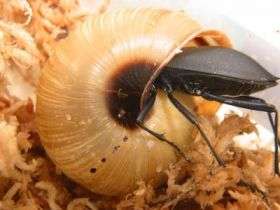
A carabid beetle inserting its head into a snail shell. Credit: photograph by J. Konuma

Large jaws are efficient in crushing hard prey, whereas small jaws are functional in capturing elusive prey. Researchers have suggested that such trade-offs between “force” and “velocity” could cause evolutionary diversification of morphology in animals such as birds, fish, and salamanders.

Junji Konuma and Satoshi Chiba of Tohoku University found that a new trade-off exists in animal feeding behavior. The team suggests that diversification of carabid beetles could be caused by a “force” and “fit” trade-off.

There are both elongate, small-headed and stout, large-headed carabid beetles that feed upon land snails. Large-headed beetles can readily crush snail shells with their powerful jaws, but cannot insert their oversized heads into the shells. In contrast, small-headed beetles can insert their heads into the shells for direct predation on snail bodies, but poorly crush the shells because of their frugal jaws.

“Crushing and inserting are alternatively effective in feeding on snails,” said Konuma. Carabid beetles that feed on snails tend to have an extremely slender or stout forebody compared with beetles that eat insects and earthworms. Phylogenetic studies show that adaptations for snail feeding led to the diversification of beetle heads.

Interestingly, it has been demonstrated that the same trade-off diversifies shell morphology in studies of freshwater snails, where elongate shells are adaptive in protecting against entry attacks and rounded shells are adaptive in protecting against crushing attacks. “Trade-offs between force and fit have a significant, important role in both morphologies of snails and snail predators in evolution,” said Konuma.

Source: University of Chicago


print this article email this article download pdf blog this article bookmark this article     Stumble it Digg this share on Facebook retweet share on Reddit add to delicious
Rate this story - 4 /5 (1 vote)


June 26, 2007 all stories

Comments: 0

4 /5 (1 vote)
  • Stumble this up

  • Digg this

  • share this

  • hide
  • Related Stories

  • Snail fossils suggest semiarid eastern Canary Islands were wetter 50,000 years ago
    created Oct 27, 2009 | popularity not rated yet | comments 0
  • Research finds higher acidity in Alaska waters
    created Aug 24, 2009 | popularity not rated yet | comments 0
  • Invasive species threaten critical habitats, oyster among victims
    created Jul 17, 2009 | popularity not rated yet | comments 0
  • Is the Pacific Ocean's chemistry killing sea life?
    created Jun 21, 2009 | popularity not rated yet | comments 0
  • Abalone are treasured -- nearly to extinction
    created May 13, 2009 | popularity not rated yet | comments 0


Other News

Volunteers attempt to save Pilot whales in May

More than 20 whales die in mass beaching in New Zealand

Biology / Plants & Animals

created 1hour ago | popularity not rated yet | comments 0

More than 20 pilot whales died in a mass beaching in New Zealand Sunday while another 40 were successfully herded back to sea, conservation officials said.


Emerald BioStructures announces discovery of small molecule modulators of PDE4

Biology / Biotechnology

created 4 hours ago | popularity not rated yet | comments 0

Emerald BioStructures (formerly deCODE biostructures) announced a publication in the December 27, 2009 advance online issue of Nature Biotechnology, detailing the application of structure-based drug design (SBDD) to engine ...


Citrus

Citrus surprise: Vitamin C boosts the reprogramming of adult cells into stem cells

Biology / Cell & Microbiology

created Dec 24, 2009 | popularity 4.8 / 5 (26) | comments 4

Famous for its antioxidant properties and role in tissue repair, vitamin C is touted as beneficial for illnesses ranging from the common cold to cancer and perhaps even for slowing the aging process. Now, ...


The sun sets behind the Manhattan skyline on December 11 in New York

New Yorkers beware! New cockroach hits the Big Apple

Biology / Evolution

created Dec 24, 2009 | popularity 4.1 / 5 (17) | comments 3

New Yorkers are used to fighting each other for space, but there may be a new contender in town according to a Rockefeller study that appears to have uncovered a new species of cockroach.


Fungal footage fosters foresight into plant, animal disease

Meddling in mosquitoes' sex lives could help stop the spread of malaria, says study

Biology / Plants & Animals

created Dec 22, 2009 | popularity 4.5 / 5 (2) | comments 2

(PhysOrg.com) -- Stopping male mosquitoes from sealing their sperm inside females with a 'mating plug' could prevent mosquitoes from reproducing, and offer a potential new way to combat malaria, say scientists ...