Frog molecule could provide drug treatment for brain tumors
June 26, 2007
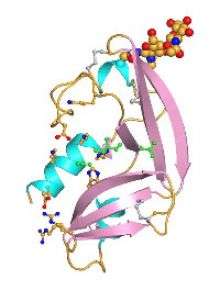
Amphinase Molecule

Amphinase molecule. Credit: Professor Ravi Acharya, University of Bath

A synthetic version of a molecule found in the egg cells of the Northern Leopard frog (Rana pipiens) could provide the world with the first drug treatment for brain tumours.

Known as Amphinase, the molecule recognises the sugary coating found on a tumour cell and binds to its surface before invading the cell and inactivating the RNA it contains, causing the tumour to die.

In new research published in the Journal of Molecular Biology, scientists from the University of Bath (UK) and Alfacell Corporation (USA) describe the first complete analysis of the structural and chemical properties of the molecule.

Although it could potentially be used as a treatment for many forms of cancer, Amphinase offers greatest hope in the treatment of brain tumours, for which complex surgery and chemotherapy are the only current treatments.

“This is a very exciting molecule,” said Professor Ravi Acharya, from the Department of Biology & Biochemistry at the University of Bath.

“It is rather like Mother Nature’s very own magic bullet for recognising and destroying cancer cells.

“It is highly specific at hunting and destroying tumour cells, is easily synthesised in the laboratory and offers great hope as a therapeutic treatment of the future.”

Amphinase is a version of a ribonuclease enzyme that has been isolated from the oocytes (egg cells) of the Northern Leopard frog.

Ribonucleases are a common type of enzyme found in all organisms. They are responsible for tidying up free-floating strands of RNA cells by latching on to the molecule and cutting it into smaller sections.

In areas of the cell where the RNA is needed for essential functions, ribonucleases are prevented from working by inhibitor molecules. But because Amphinase is an amphibian ribonuclease, it can evade the mammalian inhibitor molecules to attack the cancer cells.

As a treatment, it is most likely to be injected into the area where it is needed. It will have no effect on other cells because it is only capable of recognising and binding to the sugar coating of tumour cells.

“Amphinase is in the very early stages of development, so it is likely to be several years and many trials before it could be developed into a treatment for patients,” said Professor Acharya and his colleagues Drs Umesh Singh and Daniel Holloway.

“Having said that, the early data is promising and through this study we have provided the kind of information needed if approval for use is requested in the future.”

Amphinase is the second anti-tumour ribonuclease to be isolated by Alfacell Corporation from Rana pipiens oocytes.

The other, ONCONASE(R) (ranpirnase), is currently in late-stage clinical trials as a treatment for unresectable malignant mesothelioma, a rare and fatal form of lung cancer, and in Phase I/II clinical trials in non-small cell lung cancer and other solid tumours.

“We are pleased with the superb work performed by Professor Acharya and his talented team at the University of Bath,” commented Kuslima Shogen, Alfacell’s chairman and chief executive officer.

“Their work is critical to the continued development and understanding of our family of novel ribonuclease based therapeutics with the potential to help patients suffering from cancer and other dismal diseases.”

The company is now working on pre-clinical trials of Amphinase with a view to beginning clinical trials in the future.

Source: University of Bath

4.6 /5 (14 votes)  

Rank 4.6 /5 (14 votes)
Tags

Relevant PhysicsForums posts
  • Is Everyday Technology Killing Us?
    createdFeb 08, 2012
  • Exercise and weight loss
    createdFeb 08, 2012
  • Why do we have head aches? Our brains can't feel anything.
    createdFeb 07, 2012
  • "The end of diseases" by David Agus, interview from Daily Show with Jon Stewart
    createdFeb 04, 2012
  • Oncolytic adenovirus
    createdFeb 04, 2012
  • Nutrition label stuffs and diets
    createdFeb 02, 2012
  • More from Physics Forums - Medical Sciences

More news stories

Complex wiring of the nervous system may rely on a just a handful of genes and proteins

Researchers at the Salk Institute have discovered a startling feature of early brain development that helps to explain how complex neuron wiring patterns are programmed using just a handful of critical genes. ...

Medicine & Health / Research

created 13 hours ago | popularity 4.9 / 5 (9) | comments 1 | with audio podcast

Team isolates nerve cells involved in storing long term memory and gene proteins associated with them

(Medical Xpress) -- A research team in Taiwan has succeeded in isolating two nerve cells in fruit fly brains that are believed to be the major players in allowing for the formation of long term memories. Furthermore, ...

Medicine & Health / Neuroscience

created 19 hours ago | popularity 5 / 5 (4) | comments 2 | with audio podcast report

Seeing colors in music, tasting flavors in shapes may happen in life's early months

Famed violinist Itzhak Perlman sees a deep forest green whenever he plays a B-flat on his Stradivarius' G string. The A on the E string is red.

Medicine & Health / Psychology & Psychiatry

created 20 hours ago | popularity 4.5 / 5 (2) | comments 2 | with audio podcast

Both maternal and paternal age linked to autism

Older maternal and paternal age are jointly associated with having a child with autism, according to a recently published study led by researchers at The University of Texas Health Science Center at Houston (UTHealth).

Medicine & Health / Psychology & Psychiatry

created 17 hours ago | popularity 4.3 / 5 (3) | comments 0 | with audio podcast

New understanding of DNA repair could eventually lead to cancer therapy

A research group in the Faculty of Medicine & Dentistry at the University of Alberta is hoping its latest discovery could one day be used to develop new therapies that target certain types of cancers.

Medicine & Health / Cancer

created 17 hours ago | popularity 4.8 / 5 (6) | comments 0 | with audio podcast


Anonymous knocks CIA website offline (Update)

The website of the Central Intelligence Agency was inaccessible on Friday after the hacker group Anonymous claimed to have knocked it offline.

New error-correcting codes guarantee the fastest possible rate of data transmission

Error-correcting codes are one of the triumphs of the digital age. They’re a way of encoding information so that it can be transmitted across a communication channel — such as an optical fiber o ...

Humans may have helped the decline of African rainforests 3000 years ago

(PhysOrg.com) -- Large areas of rainforests in Central Africa mysteriously disappeared over three thousand years ago, to be replaced by savannas. The prevailing theory has been that the cause was a change ...

Small modular reactor design could be a 'SUPERSTAR'

(PhysOrg.com) -- Though most of today's nuclear reactors are cooled by water, we've long known that there are alternatives; in fact, the world's first nuclear-powered electricity in 1951 came from a reactor ...

New power source discovered

(PhysOrg.com) -- Researchers at the Massachusetts Institute of Technology (MIT) and RMIT University have made a breakthrough in energy storage and power generation.

The power of estrogen -- male snakes attract other males

A new study has shown that boosting the estrogen levels of male garter snakes causes them to secrete the same pheromones that females use to attract suitors, and turned the males into just about the sexiest ...