Electrified cells don't get dizzy
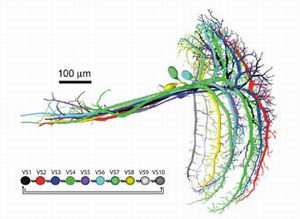
An unusual but simple direct electrical connection between neighbouring nerve cells enables a neuronal network in the fly’s flight control centre to detect rotational axes. The system remains stable, even when information from single cells is missing, and may thus also be interesting for the coordination of movements in robots.
One might think that flies are mainly annoying. However, taking a closer look quickly reveals that flies are amazing flight artists. The house fly, for example, races with two meters per second through the room, only to land with half a backward roll on the ceiling. In contrast to humans, the fly can’t move its eyes and has to move its head or whole body to keep the environment in view.
The correct detection and differentiation of optical input - how and where to does it fly, or is an enemy approaching - seem quite complex for the comparatively small fly brain. The more amazing is that the central flight control centre in the fly’s brain needs only 60 nerve cells for these complex tasks. Alexander Borst and his group at the Max-Planck-Institute of Neurobiology investigate just how these cells accomplish this.
In cooperation with two colleagues from London and Jerusalem, the scientists focused on a subset of ten cells. These so-called VS-cells enable the fly to detect rotational axes. When a fly rotates its body around an axis, the environment passes its eyes in the opposite direction. To process this information, the VS-cells have a parallel arrangement, and each cell receives its information only from a small vertical column in the eye. In this way VS1 "sees" a small column in front of the fly, VS5 to the side and VS10 in the hind part of the eye.
Surprisingly, the scientists found that VS-cells respond also to information from neighbouring columns, although the cells’ morphology shouldn’t give them access to such information. To solve this puzzle, the problem was approached from two sides. The scientists injected a current in one VS-cell and recorded any changes in the potential of neighbouring cells. In addition, they constructed a realistic computer model of the ten VS-cells and simulated changes in the potential when stimulating single cells. Both methods yielded the same result: VS-cells are electrically coupled to their neighbouring cells and their parallel arrangement results in a serial cell connection. The area of connection lies close to the part where information is transmitted to cells of the next higher processing level. This result was quite unexpected, since most nerve cells are connected via chemical synapses and not through a direct electrical coupling. Amazing in itself, the result immediately posed a new question: If VS-cells are explicitly designed in such a way that they receive their information only from a small column in the eye, why then mix the information with that of neighbouring cells?
The answer to this question was uncovered when the scientists compared the cells’ response to artificial and natural images. Artificial images are created by assigning each point a random level of brightness. The resulting image is generally a balanced mix of light and dark points. The rotation of such an image results in the replacement of one point by another with a different brightness. These changes in contrast over time are perceived by the VS-cells as movement. Independent of any electrical connection, the cells are able to calculate from this information the axis of the fly’s rotation. However, natural images are generally a lot less homogenous. Here, large areas with similar contrast such as the sky yield no or only little information when rotated - one point is replaced by another with similar brightness. It is in these situations that the electrical connection becomes essential. Unable to calculate the rotational axis due to missing changes in contrast in its own visual column, enables the electrical coupling a cell to calculate the missing data from the information of its neighbouring cells. This simple but very effective connection scheme allows the VS-cell network to determine the axis of rotation even when single cells contribute no or only incomplete information.
"We would have never understood the reason for this coupling, had we used only artificial images" explains Alexander Borst. Random artificial images are created in order to eliminate a possible bias in the stimulus. However, natural systems such as the fly’s visual system developed in correspondence to the natural environment. "The full comprehension of such systems in a purely artificial context is often not possible" says Alexander Borst, who already thinks about a possible usage for the motion control of robots.
Citation: Cuntz, H., J. Haag, F. Förster, I. Segev and A. Borst, Robust coding of flow-field parameters by axo-axonal gap junctions between fly visual interneurons, PNAS, online first, June 12, 2007
Source: Max Planck Institute of Neurobiology


