Female iguanas pay high costs to choose a mate
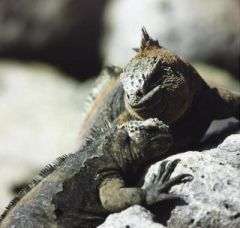
Picking a mate isn’t easy—if you are a female iguana. In a study published in the June 27th issue of the online, open-access journal PLoS ONE, Maren Vitousek of Princeton University and colleagues found that female Galápagos marine iguanas spend a lot of energy picking a mate from a wide range of suitors – energy they could otherwise spend foraging, producing eggs, or avoiding predators.
Scientists have generally assumed that being choosy about potential mates carries low costs for females. These costs were thought to be particularly small when male territories are clustered together in groups, known as ‘leks’, which make it possible for females to assess many candidates without traveling far.
Vitousek and colleagues measured how much energy female iguanas expend on mate choice in the wild using miniaturized data loggers developed by Anthony Woakes at the University of Birmingham. They found that females devote a surprising amount of effort to picking among males on a lek, even though they appear to gain only genetic material from their chosen mate. Visiting ‘attractive’ males (males that display more often) carries the highest costs. The longer female iguanas spend in the company of these appealing suitors the more weight they lose, and the smaller the eggs they subsequently produce.
Being choosy about potential mates can also decrease a female’s chances for survival. During El Niño years marine iguanas have a hard time finding food, and those that start the season at a low body weight are less likely to live through it.
To make these costs worthwhile, the genetic or other payoffs females gain from their chosen mates must be substantial. Ongoing research is aimed at quantifying the magnitude of these benefits in order to gain a complete picture of the way mate choice works in this species.
These findings provide some of the first evidence that selecting a desirable partner is energetically costly for females. Understanding the costs of being choosy should help to illuminate the process of sexual selection, one of the primary forces driving evolution.
Source: Public Library of Science


