Neutron stars join the black hole jet set
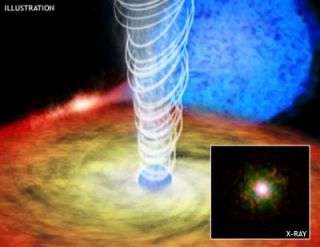
June 27, 2007 Illustration of Neutron Star Jet

This artist's illustration (main graphic) depicts the jet of relativistic particles blasting out of Circinus X-1, the first extended X-ray just associated with a neutron star in a binary system. The Chandra image (inset) shows this jet to the upper right, with possible evidence of counter jets to the lower left. The jet in Circinus X-1 is helping astronomers better understand how neutron stars, and not just black holes, can generate these powerful beams of particles. Credit: Illustration: NASA/CXC/M. Weiss X-ray image: NASA/CXC/U. of Wisc/S. Heinz et al

NASA’s Chandra X-ray Observatory has revealed an X-ray jet blasting away from a neutron star in a binary system. This discovery may help astronomers understand how neutron stars as well as black holes can generate powerful beams of relativistic particles.

The jet was found in Circinus X-1, a system where a neutron star is in orbit around a star several times the mass of the Sun, about 20,000 light years from Earth. A neutron star is an extremely dense remnant of an exploded star consisting of tightly packed neutrons.

Many jets have been found originating near black holes - both the supermassive and stellar-mass variety - but the Circinus X-1 jet is the first extended X-ray jet associated with a neutron star in a binary system. This detection shows that the unusual properties of black holes - such as presence of an event horizon and the lack of an actual surface - may not be required to form powerful jets.

"Gravity appears to be the key to creating these jets, not some trick of the event horizon," said Sebastian Heinz of the University of Wisconsin at Madison, who led the study.

The discovery of this jet with Chandra also reveals how efficient neutron stars can be as cosmic power factories. Heinz and his colleagues estimate that a surprisingly high percentage of the energy available from material falling onto the neutron star is converted into powering the jet.

"In terms of energy efficiency across the Universe, this result shows that neutron stars are near the top of the list," said Norbert Schulz, a coauthor from the Massachusetts Institute of Technology in Cambridge. "This jet is almost as efficient as one from a black hole."

The Chandra results also help to explain the origin of diffuse lobes of radio emission previously detected around Circinus X-1. The team found the X-ray jets of high-energy particles are powerful enough to create and maintain these balloons of radio-emitting gas.

"We’ve seen enormous radio clouds around supermassive black holes at the centers of galaxies," said Heinz. "What's unusual here is that this pocket-sized version, relatively speaking, is being powered by a neutron star, not a black hole."

The main evidence for the newly found jet comes in two extended features in the Chandra data. These two fingers of X-ray emission are separated by about 30 degrees and may represent the outer walls of a wide jet. When overlapped with radio images, these X-ray features, which are at least five light years from the neutron star, closely trace the outline of the radio jet.

Another interpretation is that these two features represent two separate, highly collimated jets produced at different times by a precessing neutron star. That is, the neutron star wobbles like a top as it spins and the jet fires at different angles at different times.

Jet precession is also consistent with radio observations taken at different times, which show varying orientation angles of the jet. If the precession scenario is correct, Circinus X-1 would possess one of the longest, narrowest jets found in X-ray binary systems to date, representing yet another way in which neutron stars can rival and even outdo their larger black hole relatives.

These results will appear in an upcoming issue of The Astrophysical Journal Letters.

Source: Chandra X-ray Center


print this article email this article download pdf blog this article bookmark this article     Stumble it Digg this share on Facebook retweet share on Reddit add to delicious
Rate this story - 4.7 /5 (18 votes)


June 27, 2007 all stories

Comments: 0

4.7 /5 (18 votes)
  • Stumble this up

  • Digg this

  • share this

  • hide
  • Related Stories

  • Active galaxies flare and fade in Fermi telescope all-sky movie (w/Video)
    created Apr 24, 2009 | popularity not rated yet | comments 0
  • The Oddball Hosts of Gamma-ray Bursts
    created Oct 22, 2008 | popularity not rated yet | comments 0
  • Infrared echoes give NASA's Spitzer a supernova flashback
    created Oct 01, 2008 | popularity not rated yet | comments 0
  • Integral locates origin of high-energy emission from Crab Nebula
    created Aug 29, 2008 | popularity not rated yet | comments 0
  • GLAST Observatory reveals entire gamma-ray sky
    created Aug 26, 2008 | popularity not rated yet | comments 0


  • hide
  • Relevant PhysicsForums posts

  • The shape of our solar system's orbits.
    created Nov 07, 2009
  • Above or Below the Line of Nodes
    created Nov 07, 2009
  • Supernova vs. Nova?
    created Nov 07, 2009
  • Supernova's Gamma Rays and Comets
    created Nov 06, 2009
  • More from Physics Forums - General Astronomy

Other News

Deep creep means milder, more frequent earthquakes along Southern California's San Jacinto fault

Deep creep means milder, more frequent earthquakes along Southern California's San Jacinto fault

Space & Earth / Earth Sciences

created 10 hours ago | popularity 4.7 / 5 (3) | comments 0

With an average of four mini-earthquakes per day, Southern California's San Jacinto fault constantly adjusts to make it a less likely candidate for a major earthquake than its quiet neighbor to the east, the ...


Success in 'space elevator' competition (AP)

Success in 'space elevator' competition (Update 3)

Space & Earth / Space Exploration

created Nov 05, 2009 | popularity 4.3 / 5 (33) | comments 50

(AP) -- A robot powered by a ground-based laser beam climbed a long cable dangling from a helicopter on Wednesday to qualify for prize money in a $2 million competition to test the potential reality of the ...


In a Galaxy Far, Far Away...

In a Galaxy Far, Far Away...

Space & Earth / Astronomy

created Nov 06, 2009 | popularity 4.8 / 5 (5) | comments 15

(PhysOrg.com) -- Astronomers have published the discovery of the farthest known object in the cosmos: a star that exploded when the universe was only 630 million years old -- only 4.6% of its current age. ...


'Dropouts' pinpoint earliest galaxies

'Dropouts' pinpoint earliest galaxies

Space & Earth / Astronomy

created Nov 06, 2009 | popularity 4.2 / 5 (10) | comments 13

Astronomers, conducting the broadest survey to date of galaxies from about 800 million years after the Big Bang, have found 22 early galaxies and confirmed the age of one by its characteristic hydrogen signature ...


Space hotel taking bookings for 2012 opening

Space hotel taking bookings for 2012 opening

Space & Earth / Space Exploration

created Nov 05, 2009 | popularity 4.4 / 5 (20) | comments 11

(PhysOrg.com) -- The first orbiting space hotel is on track to open for its first customers in 2012, but hurry, as bookings are filling fast.