Researchers find gene that spurs development of the epididymis
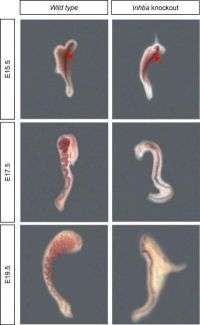
Human sperm cells travel up to 6 meters in their transit from testes to penis, and most of that journey occurs in the epididymis, a tightly coiled tube that primes the cells for their ultimate task: fertilization. In a paper released this week in the Proceedings of the National Academy of Sciences, researchers at the University of Illinois report that they have discovered a gene – and related mechanism – essential to the embryonic development of the epididymis.
The findings are the result of a serendipitous discovery, said professor of veterinary biosciences Humphrey Hung-Chang Yao. His graduate student, Jessica Tomaszewski, was examining the testes of mouse embryos when she noticed something odd: In one specimen the normally convoluted coil of the epididymis was instead a stunted, straight tube.
The lack of coiling had serious implications for the fertility of the mouse, Yao said.
“If you take sperm directly from the testis and put it into the female reproductive tract, it won’t swim. It won’t be able to fertilize the egg,” he said. Going through the epididymis changes the biochemical properties of the sperm and helps it develop the energy-generating machinery that allows it to swim. “So without this structure, under normal circumstances a male cannot be fertile.”
The researchers first thought that the abnormality was due to a lack of the male hormone, testosterone. Decades of research had shown that the development and maintenance of male reproductive structures depend on an increase in testosterone levels that begins in the latter half of the life of an embryo.
But all the normal indicators of adequate testosterone levels (its production and other physiological characteristics) were present in the mutant embryos.
Tomaszewski looked at younger mouse embryos from the same parents, to see how early in their development the abnormality appeared. She found the earliest evidence of a lack of proper coiling in the epididymis between days 15.5 and 17.5. (Mouse gestation is about 19 days.)
Before it is formed in the embryo, the epididymis is part of a structure called the Wolffian duct. When the male mouse embryo is about 13 days old, the Wolffian duct begins to grow and differentiate into the plumbing system connecting testes and vas deferens. This normally occurs in males shortly after testosterone levels begin their increase. But in the embryos Tomaszewski had found, the epididymis did not follow the standard path, even though testosterone production was normal.
From his earlier work, Yao knew that the gene for one component of a growth factor, inhibin beta A, is highly expressed in the part of the Wolffian duct that eventually becomes the epididymis. He also knew that expression of this gene increases in response to a rise in testosterone. Inhibin beta A forms part of a protein, activin, that spurs a cascade of activity in certain cells.
By staining the cells of the developing epididymis – for inhibin beta A and for a marker of activin activation – Yao’s team was able to show that inhibin beta A was spurring activity in the cells that form the walls of epididymal tube.
Further study showed that a lack of inhibin beta A led to stasis in these cells. Without it, the cells divided too slowly to adequately lengthen the tube.
This research adds to the evidence that while testosterone is the master switch that triggers the development of male reproductive structures, it doesn’t work alone, Yao said. Other studies had shown that testosterone works with other “regionally specific” factors to spur the development of structures such as the prostate gland or seminal vesicles. Inhibin beta A is the first such factor shown to contribute to epididymal coiling, he said.
“The identification of inhibin beta A in the development of the epididymis is important for understanding the basic biology of male sexual development,” Yao said. “But it also provides new insight into male infertility.”
Source: University of Illinois at Urbana-Champaign


