New imaging technique could promote early detection of multiple sclerosis
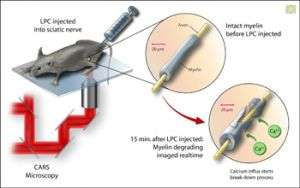
Researchers from Purdue University have studied and recorded how myelin degrades real-time in live mice using a new imaging technique. Myelin is the fatty sheath coating the axons, or nerve cells, that insulate and aid in efficient nerve fiber conduction. In diseases such as multiple sclerosis, the myelin sheath has been found to degrade.
This unprecedented feat of looking real-time at the actual progress of demyelination will advance understanding of and perhaps promote early detection of conditions such as multiple sclerosis.
Using a technique called coherent anti-Stokes Raman scattering microscopy, or CARS, scientists injected a compound called lysophosphatidylcholine (LPC) into the myelin of a mouse. Then, using CARS, they observed an influx of calcium ions into the myelin. This influx is now believed to start the process of myelin degradation.
Source: National Science Foundation


