Bright future for nanowire light source
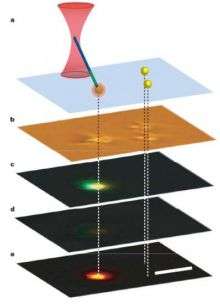
A bio-friendly nano-sized light source capable of emitting coherent light across the visible spectrum, has been invented by a team of researchers with the U.S. Department of Energy’s Lawrence Berkeley National Laboratory, and the University of California at Berkeley. Among the many potential applications of this nano-sized light source, once the technology is refined, are single cell endoscopy and other forms of subwavelength bio-imaging, integrated circuitry for nanophotonic technology, and new advanced methods of cyber cryptography.
“Working with individual nanowires, we’ve developed the first electrode-free, continuously tunable coherent visible light source that’s compatible with physiological environments,” said chemist Peidong Yang, one of the principal investigators behind this project, and a leading nanoscience authority who holds joint appointments with Berkeley Lab’s Molecular Foundry and Materials Sciences Division, and the UC Berkeley Chemistry Department.
“We’ve also demonstrated that it is possible to trap and manipulate single nanowires with optical tweezers, a critical capability not only for bio-imaging but also for wiring together nanophotonic circuitry.”
Jan Liphardt, a biophysicist who holds a joint appointment with Berkeley Lab's Physical Biosciences Division and UC Berkeley’s Physics Department, was another principal investigator for this research.
“This nanowire light source is like having a tiny flashlight that we can potentially scan across a living cell, visualizing the cell while mechanically interacting with it,” Liphardt said.
Yang and Liphardt were among the co-authors of a paper that is featured on the cover of the June 28, 2007 edition of the journal Nature. The paper is entitled: “Tunable Nanowire Nonlinear Optical Probe.” Other authors of the paper were Yuri Nakayama, Peter Pauzauskie, Aleksandra Radenovic, Robert Onorato and Richard Saykally.
In this paper, the researchers describe a technique in which nanowires of potassium niobate were synthesized in a special hot water solution and separated using ultrasound. The wires were highly uniform in size, several microns long, but only about 50 nanometers in diameter. A beam from an infrared laser was used to create an optical trap that allowed individual nanowires to be grabbed and manipulated. Because of potassium niobate’s unique optical properties, this same beam of infrared laser light also served as an optical pump, causing the nanowires to emit visible light whose color could be selected. In a demonstration of the technique’s potential, these nanowire light sources were used to generate fluorescence from specially treated beads.
“Our potassium niobate nanowires have diameters that are substantially below the wavelengths of visible light,” said Yang. “They also have excellent electronic and optical properties, and low toxicity, plus they are chemically stable at room temperatures. This makes them ideal for subwavelength laser and imaging technology.”
“In microscopy, the general rule has always been that you can look at an object or you can touch it,” said Liphardt. “With our nanowire light source technology, we combine both these capabilities in a single device. This opens up the possibility of being able to manipulate a specimen as you visualize it.”
Central to the success of the nanowire light source are the exceptional nonlinear optical properties of potassium niobate. These nonlinear properties enable the frequencies of the incoming infrared light to be mixed or doubled, through techniques known respectively as second harmonic generation (SHG) or sum frequency generation (SFG), before being emitted as visible light. The result is light that is tunable as well as coherent, which fulfills a technological requirement that has posed a major challenge for both photo-imaging and photo-detection in subwavelength optics.
Coupled with earlier projects in which Yang and his research group created ultraviolet nanowire nanolasers, and made nanoribbon optical waveguides that can channel and direct light through circuitry, the new nanowire light source lays firm groundwork for future nanophotonic technology. Photonics, a technology in which the movement of light waves replaces the movement of electrons as information carriers, promises computers and networks that are thousands of times faster than what we have today.
“Lasers, waveguides, non-linear optical converters and photodetectors are all important components for photonic technology,” said Yang. “A full-fledged nanophotonic technology will require these elements to create integrated nanophotonic circuitry. They are also quite important for other applications such as lab-on-a-chip technologies or quantum cryptography.”
Bio-imaging may be the field in which this nanowire light source technology has its biggest impact. Optical or visible light microscopy remains at the forefront of biological research because it allows scientists to study living cells and tissues. However, whereas the resolution of optical microscopy is limited by diffraction, through subwavelength techniques it becomes possible to visualize features smaller than visible light wavelengths. For biology, this brings normally invisible subcellular structures into view.
“We hypothesized that a single potassium niobate nanowire would, when optically trapped, be able to double the frequency of the trapping light and then waveguide this locally generated light to its ends, thereby enabling the development of a novel form of scanning light microscopy,” said Liphardt. “In addition to demonstrating this scanning transmission mode, we also demonstrated a fluorescence mode.”
When a nanowire light source was touched to a fluorescent bead, the bead emitted a distinct orange fluorescence at the contact point. When the nanowire was removed, the orange fluorescence was immediately reduced 80-fold, confirming that the nanowire was the predominant source of fluorescent excitation.
“The work shows that we can create and operate coherent bio-friendly nanoscale light sources in liquid environments and use them for subwavelength imaging,” said Yang. “The next direction we would like to push is single cell endoscopy, in which we use these nanoscale light source and subwavelength waveguides to do high resolution imaging inside the individual cell. The ability to monitor processes within living cells should greatly improve our fundamental understanding of cell functions, intracellular physiological processes, and cellular signal pathways.”
Yang and Liphardt caution that the nanowire light source technology is at a very early stage of development. Liphardt compares it to where atomic force microscopy was some 10 years ago. He also says that this technology is not intended to replace existing microscopy technologies, but will enable researchers to do things that cannot be done with current technology.
“Still, this nanowire light source technology, if developed to its full potential, could yield an embarrassment of riches in new knowledge,” Liphardt said.
Source: Lawrence Berkeley National Laboratory


