NASA Mars Rover Ready for Descent Into Crater
June 28, 2007 NASA Mars Rover Ready for Descent Into Crater

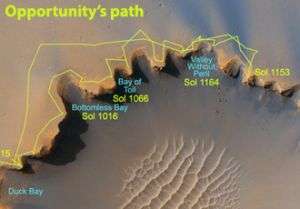
The route followed by NASA's Mars Exploration Rover Opportunity during its exploration partway around the rim of Victoria Crater is marked on this map. Image credit: NASA/JPL/Cornell/University of Arizona/Ohio State University

NASA's Mars rover Opportunity is scheduled to begin a descent down a rock-paved slope into the Red Planet's massive Victoria Crater. This latest trek carries real risk for the long-lived robotic explorer, but NASA and the Mars Rover science team expect it to provide valuable science.

Opportunity already has been exploring layered rocks in cliffs around Victoria Crater. The team has planned the descent carefully to enable an eventual exit, but Opportunity could become trapped inside the crater or lose some capabilities. The rover has operated more than 12 times longer than its originally intended 90 days.

The scientific allure is the chance to examine and investigate the compositions and textures of exposed materials in the crater's depths for clues about ancient, wet environments. As the rover travels farther down the slope, it will be able to examine increasingly older rocks in the exposed walls of the crater.

"While we take seriously the uncertainty about whether Opportunity will climb back out, the potential value of investigations that appear possible inside the crater convinced me to authorize the team to move forward into Victoria Crater," said Alan Stern, NASA associate administrator, Science Mission Directorate, NASA Headquarters, Washington. "It is a calculated risk worth taking, particularly because this mission has far exceeded its original goals."

The robotic geologist will enter Victoria Crater through an alcove named Duck Bay. The eroding crater has a scalloped rim of cliff-like promontories, or capes, alternating with more gently sloped alcoves, or bays.

A meteor impact millions of years ago excavated Victoria, which lies approximately 4 miles south of where Opportunity landed in January 2004. The impact-created bowl is half a mile across and about five times as wide as Endurance Crater, where Opportunity spent more than six months exploring in 2004.

The rover began the journey to Victoria from Endurance 30 months ago. It reached the rim at Duck Bay nine months ago. Opportunity then drove approximately a quarter of the way clockwise around the rim, examining rock layers visible in the promontories and possible entry routes in the alcoves. Now, the rover has returned to the most favorable entry point.

"Duck Bay looks like the best candidate for entry," said John Callas, rover project manager, NASA's Jet Propulsion Laboratory, Pasadena, Calif. "It has slopes of 15 to 20 degrees and exposed bedrock for safe driving."

If all of its six wheels continue working, engineers expect Opportunity to be able to climb back out of the crater. However, Opportunity's twin rover Spirit lost the use of one wheel more than a year ago, diminishing its climbing ability.

"These rovers are well past their design lifetimes, and another wheel could fail on either rover at any time," Callas said. "If Opportunity were to lose the use of a wheel inside Victoria Crater, it would make it very difficult, perhaps impossible, to climb back out."

"We don't want this to be a one-way trip," said Steve Squyres, principal investigator for the rovers' science instruments, Cornell University, Ithaca, N.Y. "We still have some excellent science targets out on the plains that we would like to visit after Victoria. But if Opportunity becomes trapped there, it will be worth the knowledge gained."

Source: NASA


print this article email this article download pdf blog this article bookmark this article     Stumble it Digg this share on Facebook retweet share on Reddit add to delicious
Rate this story - 4.7 /5 (15 votes)


June 28, 2007 all stories

Comments: 0

4.7 /5 (15 votes)
  • Stumble this up

  • Digg this

  • share this

  • hide
  • Related Stories

  • NASA to Begin Attempts to Free Sand-Trapped Mars Rover
    created Nov 12, 2009 | popularity not rated yet | comments 0
  • LADEE Mission to Study the Moon's Fragile Atmosphere
    created Oct 26, 2009 | popularity not rated yet | comments 0
  • Scientists work to free Mars rover Spirit
    created Oct 13, 2009 | popularity not rated yet | comments 0
  • Dust Storm Passing Over Spirit
    created Aug 26, 2009 | popularity not rated yet | comments 0
  • Meteorite Found on Mars Yields Clues About Planet's Past
    created Aug 10, 2009 | popularity not rated yet | comments 0


  • hide
  • Relevant PhysicsForums posts

  • Question about 2-body gravity
    created 9 hours ago
  • life on Mars
    created 12 hours ago
  • Semi-major axis from cartesian co-ordinates
    created Nov 23, 2009
  • Primary Mirror grinding
    created Nov 23, 2009
  • More from Physics Forums - General Astronomy

Other News

CO2 emissions continue significant climb

Space & Earth / Environment

created 27 minutes ago | popularity not rated yet | comments 0

The annual rate of increase in carbon dioxide emissions from fossil fuels has more than tripled in this decade, compared to the 1990s, reports an international consortium of scientists, who paint a bleak picture of the Earth's ...


Infrared Image of Circumstellar Disk Illuminates Massive Star Formation Process

Infrared Image of Circumstellar Disk Illuminates Massive Star Formation Process

Space & Earth / Astronomy

created 29 minutes ago | popularity not rated yet | comments 0

(PhysOrg.com) -- A team of astronomers from Ibaraki University, Japan Aerospace Exploration Agency, Kanagawa University, University of Tokyo, Academica Sinica, and National Astronomical Observatory of Japan ...


Cassini Captures Ghostly Dance of Saturn's Northern Lights

Cassini Captures Ghostly Dance of Saturn's Northern Lights (w/ Video)

Space & Earth / Space Exploration

created 2 hours ago | popularity 5 / 5 (1) | comments 0

(PhysOrg.com) -- In the first video showing the auroras above the northern latitudes of Saturn, Cassini has spotted the tallest known "northern lights" in the solar system, flickering in shape and brightness ...


First black holes may have incubated in giant, starlike cocoons, says CU-Boulder study

First black holes may have incubated in giant, starlike cocoons

Space & Earth / Astronomy

created 5 hours ago | popularity 4.6 / 5 (8) | comments 7

(PhysOrg.com) -- The first large black holes in the universe likely formed and grew deep inside gigantic, starlike cocoons that smothered their powerful x-ray radiation and prevented surrounding gases from ...


The e-waste dilemma

The e-waste dilemma

Space & Earth / Environment

created 1hour ago | popularity not rated yet | comments 0

(PhysOrg.com) -- Electronic devices could create significant environmental and health problems after they are thrown away. UC Irvine researchers are working with engineers, manufacturers and public health ...