NASA satellite captures first view of 'night-shining' clouds
June 29, 2007
NASA satellite captures first view of 'night-shining' clouds

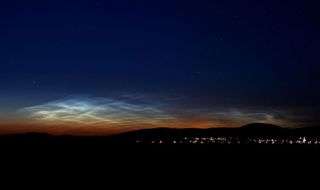
This image shows one of the first ground sightings of noctilucent clouds in the 2007 season. Credit: Veres Viktor of Budapest, Hungary taken on June 15, 2007.

A NASA satellite has captured the first occurrence this summer of mysterious iridescent polar clouds that form 50 miles above Earth's surface.

The first observations of these clouds by the Aeronomy of Ice in the Mesosphere (AIM) satellite occurred above 70 degrees north on May 25. Observers on the ground began seeing the clouds on June 6 over northern Europe. AIM is the first satellite mission dedicated to the study of these unusual clouds.

These mystifying clouds are called Polar Mesospheric Clouds, or PMCs, when they are viewed from space and referred to as "night-shining" clouds, or noctilucent clouds, when viewed by observers on Earth. The clouds form during the Northern Hemisphere's summer season that begins in mid-May and extends through the end of August. They are being seen by AIM's instruments more frequently as the season progresses. The clouds also are seen in the high latitudes of the Southern Hemisphere during the summer months.

Very little is known about how these clouds form over the poles, why they are being seen more frequently and at lower latitudes than ever before, or why they have been growing brighter. AIM will observe two complete polar mesospheric cloud seasons over both poles, documenting for the first time the entire, complex life cycle of PMCs.

"It is clear that PMCs are changing, a sign that a distant and rarified part of our atmosphere is being altered, and we do not understand how, why or what it means," stated AIM principal investigator James Russell III, Hampton University, Hampton, Va. "These observations suggest a connection with global change in the lower atmosphere and could represent an early warning that our Earth's environment is being altered."

The AIM instruments are returning valuable information on the global extent and variability of these clouds and preliminary information on their particle sizes and shapes. Early indications are that the clouds occur at high latitudes early in the season then move to lower latitudes as time progresses. The AIM science team is studying these new data to understand whether the changes in the clouds may be related to global climate change.

When the Northern Hemisphere summer season ends in mid- to late August, the AIM science team will not have to wait long before the Southern Hemisphere's season starts. This occurs about three months later in mid- to late November. The Southern season lasts until approximately mid-March of 2008. Early results from the AIM mission will be reported at a major international conference focused on PMCs and other high altitude layered phenomena to be held at the end of August 2007 in Fairbanks, Alaska.

The satellite was launched on April 25, only four weeks before the first science observations began. During the satellite-commissioning phase and now in routine observations, all three state-of-the-art instruments have been working exceptionally well and returning high quality data.

The Cloud Imaging and Particle Size instrument offers a 2-D look at the clouds, collecting multiple views from different angles. The cameras are providing panoramic PMC images of the Arctic polar cap daily. The Solar Occultation For Ice Experiment is measuring new information on cloud particles: their variability with altitude, the chemicals within the clouds and the environment in which the clouds form. The Cosmic Dust Experiment is recording the amount of space dust that enters Earth's atmosphere to help scientists assess the role this dust plays in PMC formation.

The AIM mission coincides with the two-year, worldwide scientific community's International Polar Year, and the mission is expected to make unique contributions to the International Polar Year's objective of advancing polar research.

Source: Goddard Space Flight Center

4.3 /5 (39 votes)  

Rank 4.3 /5 (39 votes)
Tags

Relevant PhysicsForums posts
  • Do some geologists actually act a lot like Randy Marsh?
    createdFeb 11, 2012
  • Discrepancy between oxygen and carbon-dioxide levels
    createdFeb 09, 2012
  • where gems are found in the world
    createdFeb 09, 2012
  • Wind Waves in Reservoir ~ Wind run-up and Wind set-up
    createdFeb 08, 2012
  • Balance of oxygen in the atmosphere
    createdFeb 01, 2012
  • The case for a methanol-based economy
    createdJan 30, 2012
  • More from Physics Forums - Earth

More news stories

Latin America mining boom clashes with conservation

Latin America is experiencing a mining boom as prices rise fuelled by a hike in global demand, but the region is also being hit by a wave of violent protests, strikes and rallies by environmentalists.

Space & Earth / Environment

created 4 hours ago | popularity not rated yet | comments 0

Political leaders play key role in how worried Americans are by climate change: study

More than extreme weather events and the work of scientists, it is national political leaders who influence how much Americans worry about the threat of climate change, new research finds.

Space & Earth / Environment

created Feb 06, 2012 | popularity 5 / 5 (6) | comments 72

NASA budget will axe Mars deal with Europe: scientists

US President Barack Obama's budget proposal to be submitted next week for 2013 will cut NASA's budget by 20 percent and eliminate a major partnership with Europe on Mars exploration, scientists said Thursday.

Space & Earth / Space Exploration

created Feb 10, 2012 | popularity 5 / 5 (3) | comments 55

Humans may have helped the decline of African rainforests 3000 years ago

(PhysOrg.com) -- Large areas of rainforests in Central Africa mysteriously disappeared over three thousand years ago, to be replaced by savannas. The prevailing theory has been that the cause was a change ...

Space & Earth / Environment

created Feb 10, 2012 | popularity 4.1 / 5 (14) | comments 20 | with audio podcast report

High planetary tilt lowers odds for life?

Highly-tilted worlds would have extreme seasons, subjecting life to alternating periods of scorching and subzero temperatures. This could make the development of all but hardiest, simplest creatures a long ...

Space & Earth / Space Exploration

created Feb 06, 2012 | popularity 4.8 / 5 (12) | comments 14 | with audio podcast


Google might launch Drive for cloud storage soon

(PhysOrg.com) -- Google's next big move, according to the Wall Street Journal, is a cloud storage service called Drive. Hardly first to the plate, Google is simply catching up to introducing its cloud reposi ...

Walney offshore wind farm is world's biggest (for now)

(PhysOrg.com) -- The Walney wind farm on the Irish Sea--characterized by high tides, waves and windy weather--officially opened this week. The farm is treated in the press as a very big deal as the Walney ...

Love a click away in Indonesia's Twitter Republic

He was a geeky kid from Yogyakarta, she a glamorous city girl in Jakarta. In a country with one of the world's most vibrant social networking scenes they fell in love on Twitter.

Europeans protest controversial Internet pact

Tens of thousands of people marched in protests in more than a dozen European cities Saturday against a controversial anti-online piracy pact that critics say could curtail Internet freedom.

Navy to begin tests on electromagnetic railgun prototype launcher

The Office of Naval Research (ONR)'s Electromagnetic (EM) Railgun program will take an important step forward in the coming weeks when the first industry railgun prototype launcher is tested at a facility ...

Explained: Sigma

It's a question that arises with virtually every major new finding in science or medicine: What makes a result reliable enough to be taken seriously? The answer has to do with statistical significance -- but ...