Hubble Catches Jupiter Changing Its Stripes
June 29, 2007 Hubble Catches Jupiter Changing Its Stripes

Massive Jupiter is undergoing dramatic atmospheric changes that have never been seen before with the keen "eye" of NASA's Hubble Space Telescope.

Jupiter's turbulent clouds are always changing as they encounter atmospheric disturbances while sweeping around the planet at hundreds of miles per hour. But these Hubble images reveal a rapid transformation in the shape and color of Jupiter's clouds near the equator, marking an entire face of the globe.

The planet is wrapped in bands of yellows, browns, and whites. These bands are produced by air flowing in different directions at various latitudes. Lighter-hued areas where the atmosphere rises are called zones. Darker regions where air falls are called belts. When these opposing flows interact, storms and turbulence appear.

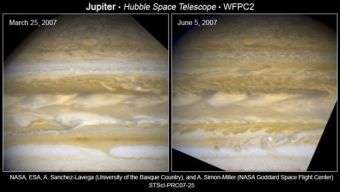
Between March 25 and June 5, Hubble's Wide Field and Planetary Camera 2 captured entire bands of clouds changing color. Zones have darkened into belts and belts have lightened and transformed into zones. Cloud features have rapidly altered in shape and size.

The image at left shows a thin band of white clouds above Jupiter's equator. The white color indicates clouds at higher altitudes in Jupiter's atmosphere. In the image at right, the band's white hue has turned brown, showing clouds deep within the planet's atmosphere. The whole band appears to have merged with the one below it.

In the same cloud band above the equator, the small swirls in the left-hand image have morphed into larger wave-like features in the right-hand photo. Dominating the band is a dark streak that resembles a snake. This serpent-shaped structure is actually a small tear in the cloud deck, which gives astronomers a view deep within the atmosphere.

Below the equatorial region, the brownish upside-down shark fin in the left-hand image disappears in the photo at right. Appearing instead are brownish tongue-shaped clouds with a stream of white swirls below them.

These global upheavals have been seen before, but not with Hubble's sharp resolution. Astronomers using ground-based telescopes first spied drastic atmospheric transformation in the 1980s. Another major disturbance was seen in the early 1990s, after Hubble was launched into space. The telescope, however, did not have the resolution to view the upheaval in fine detail. These higher-quality Hubble images may help astronomers understand how such global upheavals develop on Jupiter. Image credits: NASA; ESA; A. Simon-Miller (NASA Goddard Space Flight Center, Greenbelt); A. Sánchez-Lavega, R. Hueso, S. Pérez-Hoyos (University of the Basque Country, Spain); E. García-Melendo (Esteve Duran Observatory Foundation, Spain); and G. Orton (Jet Propulsion Laboratory)

Source: Donna Weaver/Ray Villard, Space Telescope Science Institute, Baltimore, Md.


print this article email this article download pdf blog this article bookmark this article     Stumble it Digg this share on Facebook retweet share on Reddit add to delicious
Rate this story - 4.5 /5 (30 votes)


June 29, 2007 all stories

Comments: 0

4.5 /5 (30 votes)
  • Stumble this up

  • Digg this

  • share this

  • hide
  • Related Stories

  • NASA's Great Observatories Celebrate International Year of Astronomy
    created Nov 10, 2009 | popularity not rated yet | comments 0
  • Opening up a colorful cosmic jewel box
    created Oct 29, 2009 | popularity not rated yet | comments 0
  • X-Ray Jets from Galaxies
    created Oct 19, 2009 | popularity not rated yet | comments 0
  • Chandra X-Ray Observatory Turns Ten
    created Aug 20, 2009 | popularity not rated yet | comments 0
  • Hubble Photographs a Planetary Nebula to Commemorate Decommissioning of Super Camera
    created May 11, 2009 | popularity not rated yet | comments 0


  • hide
  • Relevant PhysicsForums posts

Other News

New computer-developed map shows more extensive valley network on Mars

New computer-developed map shows more extensive valley network on Mars

Space & Earth / Space Exploration

created 11 hours ago | popularity 4.6 / 5 (7) | comments 0

New research adds to the growing body of evidence suggesting the Red Planet once had an ocean.


Supervolcano eruption -- in Sumatra -- deforested India 73,000 years ago

Supervolcano eruption -- in Sumatra -- deforested India 73,000 years ago

Space & Earth / Earth Sciences

created 13 hours ago | popularity 4.3 / 5 (10) | comments 2

A new study provides "incontrovertible evidence" that the volcanic super-eruption of Toba on the island of Sumatra about 73,000 years ago deforested much of central India, some 3,000 miles from the epicenter, ...


Is global warming unstoppable?

Space & Earth / Environment

created 22 hours ago | popularity 3.9 / 5 (25) | comments 24

In a provocative new study, a University of Utah scientist argues that rising carbon dioxide emissions - the major cause of global warming - cannot be stabilized unless the world's economy collapses or society builds the ...


Spitzer Telescope Observes Baby Brown Dwarf

Spitzer Telescope Observes Baby Brown Dwarf

Space & Earth / Astronomy

created 10 hours ago | popularity 4.9 / 5 (8) | comments 0

(PhysOrg.com) -- NASA's Spitzer Space Telescope has contributed to the discovery of the youngest brown dwarf ever observed -- a finding that, if confirmed, may solve an astronomical mystery about how these ...


Scientist: Leak of climate e-mails appalling

Space & Earth / Environment

created 16 hours ago | popularity 3.2 / 5 (10) | comments 8

(AP) -- A leading climate change scientist whose private e-mails are included in thousands of documents that were stolen by hackers and posted online said Sunday the leaks may have been aimed at undermining next month's ...