Titania Nanotube Arrays Harness Solar Energy
January 25, 2006
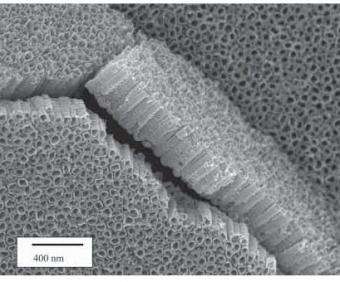
FESEM image of titania nanotube arrays, top and lateral views.
Penn State researchers are finding new ways to harness the power of the sun using highly-ordered arrays of titania nanotubes for hydrogen production and increased solar cell efficiency.
Creating a renewable energy resource to supplement and ultimately replace dwindling petroleum reserves is one of the pressing needs our nation faces within our own and our children’s lifetimes. But gasoline, an almost perfect fuel, with a tremendous amount of power contained in a small cupful, is not easy to replace.
One of the most likely prospects for an efficient renewable resource is solar energy, either to produce hydrogen, the third most abundant element on the earth’s surface, or to power solar cells. At Penn State University, researchers are finding new ways to harness the power of the sun using highly-ordered arrays of titania nanotubes for hydrogen production and increased solar cell efficiency.
“This is an amazing material architecture for water photolysis,” says Craig Grimes, professor of electrical engineering and materials science and engineering. Referring to some recent finds of his research group (G. K. Mor, K. Shankar, M. Paulose, O. K. Varghese, C. A. Grimes, Enhanced Photocleavage of Water Using Titania Nanotube-Arrays, Nano Letters, vol. 5, pp. 191-195.2005 ), “Basically we are talking about taking sunlight and putting water on top of this material, and the sunlight turns the water into hydrogen and oxygen. With the highly-ordered titanium nanotube arrays, under UV illumination you have a photoconversion efficiency of 13.1%. Which means, in a nutshell, you get a lot of hydrogen out of the system per photon you put in. If we could successfully shift its bandgap into the visible spectrum we would have a commercially practical means of generating hydrogen by solar energy. It beats fighting wars over middle-eastern oil.”
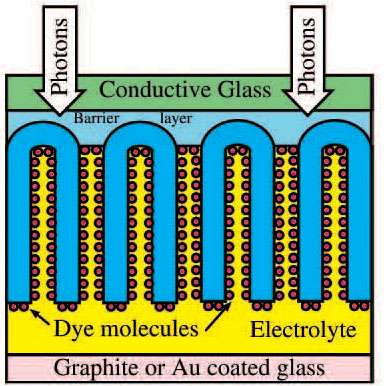
Integration of transparent nanotube array architecture into dye solar cell structure.
The highly ordered nanotube arrays also demonstrate remarkable properties when used in solar cells, as reported in the Vol. 6 No. 2 issue of Nano Letters; the Grimes’ team, which includes Gopal K. Mor, Karthik Shankar, Maggie Paulose, and Oomman K. Varghese, describes the initial results of their application of highly-ordered transparent titania nanotubes on the negative electrode in dye solar cells. This type of solar cell shows great promise as a relatively low cost solution to efficiently producing electricity from the sun.
According to the authors, the highly ordered nanotube arrays provide excellent pathways for electron percolation, in effect acting as ‘electron highways’ for directing the photo-generated electrons to where they can do useful work. Their results suggest that highly-efficient dye solar cells could be made simply by increasing the length of the nanotube arrays. Grimes and colleagues feel that solutions to this and other processing issues are within reach and will result in a considerable, possibly quite dramatic increase in solar cell efficiency.
On the web: http://www.mri.psu.edu
Source: Penn State
-
Comparing energy conversion of plants and solar cells
Jan 16, 2012 |
2.3 / 5 (3) |
3
-
Future Aussie trucking: silent and green
Nov 10, 2011 |
5 / 5 (1) |
1
-
Vast amounts of solar energy radiate to the Earth, but tapping it cost-effectively remains a challenge
Oct 26, 2011 |
5 / 5 (6) |
32
-
Scientists bring mysterious magnetic process down to earth
Oct 25, 2011 |
4.9 / 5 (9) |
20
-
Atmospheric simulations will help NASA interpret data from the Juno Mission to Jupiter
Aug 03, 2011 |
5 / 5 (3) |
0
-
Engineers build first sub-10-nm carbon nanotube transistor
Feb 01, 2012 |
4.9 / 5 (30) |
30
-
Something old, something new: Evolution and the structural divergence of duplicate genes
Jan 31, 2012 |
4.6 / 5 (7) |
1
-
The hidden nanoworld of ice crystals: Revealing the dynamic behavior of quasi-liquid layers
Jan 30, 2012 |
5 / 5 (3) |
1
-
Stock market network reveals investor clustering
Jan 27, 2012 |
3.9 / 5 (23) |
8
-
Of microchemistry and molecules: Electronic microfluidic device synthesizes biocompatible probes
Jan 26, 2012 |
5 / 5 (1) |
0
More news stories
'Dark plasmons' transmit energy
Microscopic channels of gold nanoparticles have the ability to transmit electromagnetic energy that starts as light and propagates via "dark plasmons," according to researchers at Rice University.
15 hours ago |
5 / 5 (5) |
0
|
Nanotube therapy takes aim at breast cancer stem cells
Wake Forest Baptist Medical Center researchers have again proven that injecting multiwalled carbon nanotubes (MWCNTs) into tumors and heating them with a quick, 30-second laser treatment can kill them.
Nanotechnology / Bio & Medicine
20 hours ago |
5 / 5 (1) |
0
|
New kind of solar cell could capture significantly more energy than current cells
New solar cells could increase the maximum efficiency of solar panels by over 25%, according to scientists from the University of Cambridge.
Feb 08, 2012 |
4.5 / 5 (11) |
14
|
New technology platform for molecule-based electronics
Researchers at the Nano-Science Center at the University of Copenhagen have developed a new nano-technology platform for the development of molecule-based electronic components using the wonder material graphene. At the same ...
Nanotechnology / Nanomaterials
22 hours ago |
5 / 5 (2) |
0
Nanoshell whispering galleries improve thin solar panels
Visitors to Statuary Hall in the U.S. Capitol Building may have experienced a curious acoustic feature that allows a person to whisper softly at one side of the cavernous, half-domed room and for another on ...
Nanotechnology / Nanomaterials
Feb 07, 2012 |
4.3 / 5 (6) |
6
|
New error-correcting codes guarantee the fastest possible rate of data transmission
Error-correcting codes are one of the triumphs of the digital age. Theyre a way of encoding information so that it can be transmitted across a communication channel such as an optical fiber o ...
A frank discussion of the power law and linking correlation to causation
(PhysOrg.com) -- Michael Stumpf a mathematics professor at Imperial College in London, and Mason Porter a lecturer at Oxford have teamed together to write and publish a perspective piece in Science regarding the in ...
Mars Science Laboratory computer issue resolved
(PhysOrg.com) -- Engineers have found the root cause of a computer reset that occurred two months ago on NASA's Mars Science Laboratory and have determined how to correct it.
Advanced power-grid model finds low-cost, low-carbon future in West
(PhysOrg.com) -- The least expensive way for the Western U.S. to reduce greenhouse gas emissions enough to help prevent the worst consequences of global warming is to replace coal with renewable and other ...
Small modular reactor design could be a 'SUPERSTAR'
(PhysOrg.com) -- Though most of today's nuclear reactors are cooled by water, we've long known that there are alternatives; in fact, the world's first nuclear-powered electricity in 1951 came from a reactor ...
High school students test best with 7 hours' rest
(Medical Xpress) -- Whether or not you know any high school students that actually get nine hours of sleep each night, thats what federal guidelines currently prescribe.