Making waves: New research could minimize the impact of future tsunami
July 2nd, 2007 Making waves: New research could minimize the impact of future tsunami

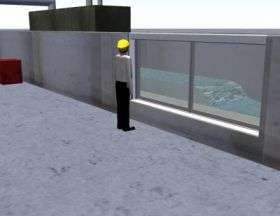
Artist's impression of the tsunami generator and wave flume. Credit: HR Wallingford

For the first time, a team of experts is preparing to create tsunami in a controlled environment in order to study their effects on buildings and coastlines - ultimately paving the way for the design of new structures better able to withstand their impact.

Ahead of today’s Coastal Structures 2007 International Conference Dr Tiziana Rossetto, UCL Department of Civil & Environmental Engineering, unveiled plans to develop an innovative new tsunami generator capable of creating scaled-down versions of the devastating waves. The UCL team will be working with marine engineering specialists HR Wallingford (HRW) throughout the project.

“Tsunami are water waves generated by earthquakes, underwater landslides, volcanic eruptions or major debris slides,” said Dr Rossetto. “The waves travel across oceans with small vertical displacements and in open water you could easily bob over one without noticing. It’s when the waves approach the coastline, hit shallower water, slow down, and grow taller that you get the huge wall of water that people visualise when you mention a tsunami.

“The main gap in our knowledge is about what happens when the tsunami wave approaches the nearshore region and then runs inland. These flow processes cannot be simplified using mathematical models because of the complex interaction that takes place with beaches, sediment, coastal defences and then in and around buildings.

“It is possible for the whole process to be simulated with hydraulic models, but to get meaningful data the tsunami wave has to be accurately generated in the first place. Conventional wave generators haven’t been able to replicate tsunami because of the unusually long wavelength that is required.”

Professor William Allsop of HRW said: “Our new machine will control the flow of a large mass of water by using air suction within an inverted tank. We have used this technology over many years to make model tides in large scale models and our collaboration with UCL means we will be able to produce a unique research facility.”

The new tsunami generator will be able to create multiple waves, replicating the three or four peaks experienced during the Boxing Day tsunami that hit the Indian Ocean in 2004. The tsunami will pass down a 45m long flume at realistic wavelengths, mimicking the characteristics of waves which have passed from deep water (approx. 200m) into shallow water (20m – 50m) as they approach the coast. The wave flume will be equipped to measure coastal processes, inundation and wave forces as the tsunami travels up a shelving seabed, breeches the coastline and flows inland.

After the initial series of experiments, a team of researchers from UCL and HRW will go on to examine the effects of retreating and repeated waves on seawalls and beaches. The tests will measure the force exerted by the waves on representative buildings and quantify the wave’s ability to erode the coast, potentially destabilising structures completely.

The tsunami experiments will take place at HR Wallingford’s laboratories in Oxfordshire and construction of the generator is scheduled for completion in the summer of 2008. UCL and HRW plan to make the facility available to international teams of researchers in autumn 2009.

Source: University College London


print this article email this article download pdf blog this article bookmark this article     Digg this Stumble it share on Facebook share on Reddit add to delicious save to Yahoo! bookmarks
4/5 after 5 votes


July 2nd, 2007 all stories
Technology / Engineering

Comments: 0
Rank: 4/5 after 5 votes

  • Stumble this up

  • Digg this

  • Share it:
  • share on Facebook
  • share on MySpace
  • share on Slashdot
  • rss-newsfeed
  • share on Google
  • share on Reddit
  • add to delicious
  • save to Yahoo! bookmarks
  • share on Windows Live
  • Add to Mixx!
Rating: 4/5 after 5 votes

  • Related Stories

  • Studies offers new picture of Lake Tahoe's earthquake potential
    created Apr 29, 2009 | popularity not rated yet | comments 0
  • Contrary to recent hypothesis, 'chevrons' are not evidence of megatsunamis
    created Apr 29, 2009 | popularity not rated yet | comments 0
  • Mathematicians provide new insight into tsunamis
    created Apr 01, 2009 | popularity not rated yet | comments 0
  • Locations of strain, slip identified in major earthquake fault
    created Feb 15, 2009 | popularity not rated yet | comments 0
  • Riding -- and reading -- the Earth tide
    created Jan 29, 2009 | popularity not rated yet | comments 0

Tags


  • Physicists Demonstrate Quantum Memory with Matter Qubits
    Physicists Demonstrate Quantum Memory with Matter Qubits
    Physics / General Physics
    created Jul 03, 2009 | popularity 4.4 / 5 (17) | comments 1
  • 'Holey' Nanosheets for Wastewater Dye Removal
    Nanotechnology / Nanomaterials
    created Jul 01, 2009 | popularity 5 / 5 (5) | comments 1
  • Jellyfish Robot Swims Like its Biological Counterpart
    Jellyfish Robot Swims Like its Biological Counterpart
    Electronics / Robotics
    created Jun 26, 2009 | popularity 4.4 / 5 (8) | comments 1
  • Could Maxwell's Demon Exist in Nanoscale Systems?
    Could Maxwell's Demon Exist in Nanoscale Systems?
    Physics / General Physics
    created Jun 24, 2009 | popularity 4.4 / 5 (18) | comments 29
  • Living Safely with Robots, Beyond Asimov's Laws
    Living Safely with Robots, Beyond Asimov's Laws
    Electronics / Robotics
    created Jun 22, 2009 | popularity 4.6 / 5 (52) | comments 40
  • Other News

    Japan demands 119 million dlrs in tax from Amazon: report

    Technology / Business

    created 12 hours ago | popularity 3.5 / 5 (4) | comments 0

    Japanese authorities told a sales affiliate of US retail giant Amazon.com to pay about 119 million dollars in tax for unreported income over a three-year period, a newspaper said Sunday.


    Iconic skyscrapers find new luster by going green (AP)

    Iconic skyscrapers find new luster by going green

    Technology / Energy

    created 13 hours ago | popularity 1 / 5 (1) | comments 0

    (AP) -- When owners of the Empire State Building decided to blanket its towering facade this year with thousands of insulating windows, they were only partly interested in saving energy. They also needed ...


    Geeks double as scourges and sages at media summit

    Technology / Business

    created 8 hours ago | popularity not rated yet | comments 0

    (AP) -- The media moguls attending an annual powwow staged by investment bank Allen & Co. used to be able to rest comfortably in the Idaho mountains as they mulled their next moves.


    UK spy chief's family details posted on Facebook

    Technology / Internet

    created 13 hours ago | popularity not rated yet | comments 0

    (AP) -- He's the spy who came in from the beach.


    Downturn dating: Hearts flutter as markets stutter (AP)

    Downturn dating: Hearts flutter as markets stutter

    Technology / Internet

    created 13 hours ago | popularity not rated yet | comments 0

    (AP) -- Credit the recession for "staycations" and bringing us more game-night parties at home. But also give it a shout for spurring more first dates.